
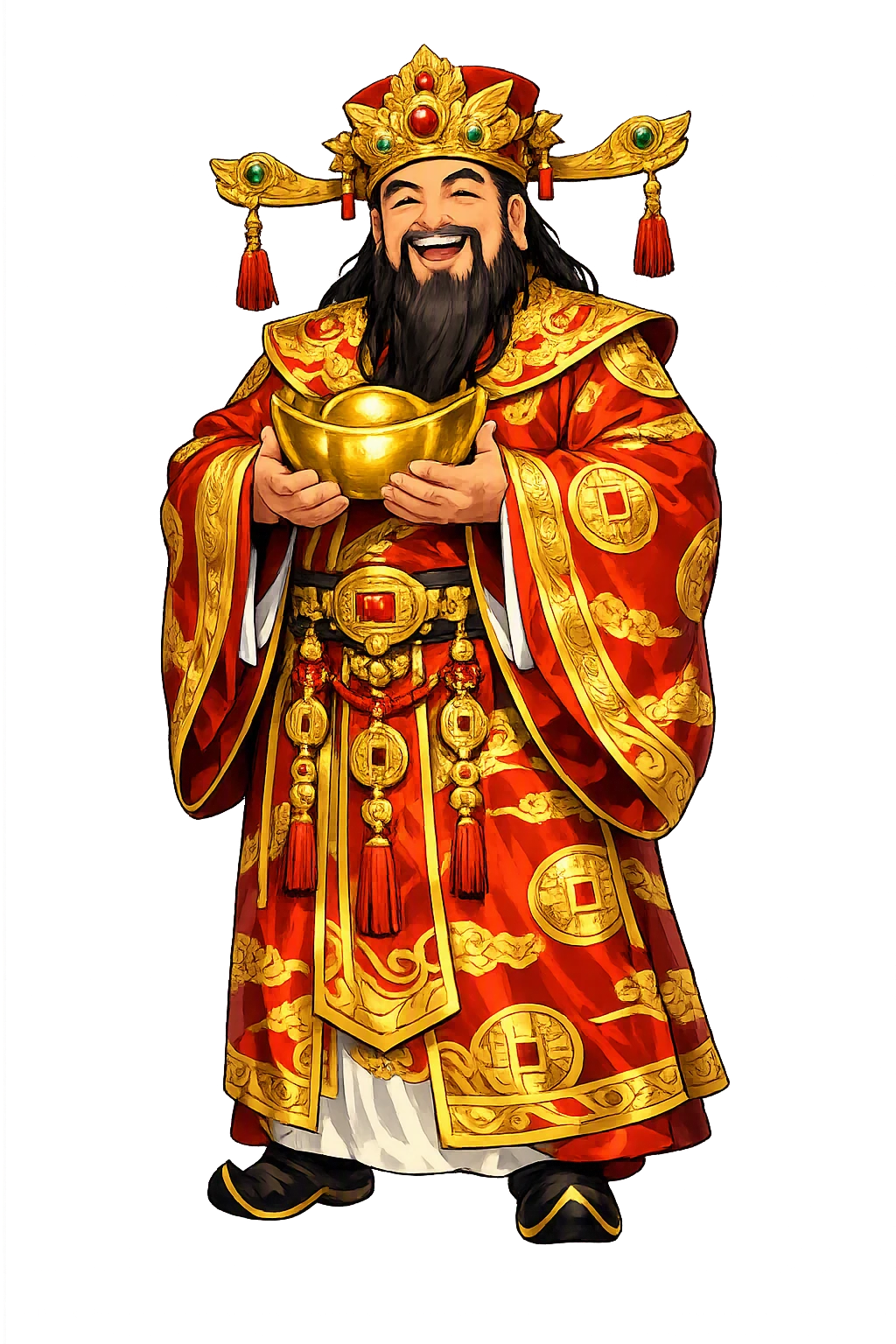
Cáishén and the industries that were always telling its story
The myths did not retire. They moved offices. This is the file on where Cáishén works now.
Cáishén's mythology is young and openly composite. The cult is a Song-dynasty growth over older roots, and every avatar brings his own story: a Ming novel supplies the marshal, a Han historian the heartless minister, merchants the retired sage. The tradition never pretends otherwise — and its honesty is part of its power.
The pattern atlas — which maps every flagship temple to the industries its archetype demonstrably resonates with, each match argued and open to challenge — seats this temple in 6 industries. This file reads those seats the way they were earned: through the myths.
At a Glance
- Temple: Cáishén
- Pantheon: Chinese
- Domain of influence: Wealth, Prosperity, New Year
- Pattern seats: 6
- Sectors touched: Commerce & Governance · Culture & Entertainment · Technology & Innovation · Society & Spirit
- Strongest seat: Finance, Wealth & Commerce
- Series: The Resonance Files, No. 99 of 548
The Myth at Work
One Office, Many Gods. The two characters 財神 simply mean 'god of wealth' — a title, not a personal name, and the tradition treats it that way. There is no canonical birth-story of Cáishén; instead, the office has been filled, again and again, by figures the culture wished to honor: a loyal minister, a canonized marshal, an honest merchant, even the red-faced war-god Guan Yu in some regions. — hold that image; the industries below are where it goes to work.
Zhao Gongming on the Black Tiger. The fullest avatar-story comes from the Ming novel Fengshen Yanyi (Investiture of the Gods). During the fall of the Shang dynasty, Zhao Gongming, a hermit of Mount Emei, comes down to aid the doomed house with his black tiger, his iron whip, and his magic pearls; battle after battle turns on his power, until Jiang Ziya's side breaks him with Lu Ya's sorcery — an effigy of straw pierced by arrows. — that is not just a story. It is a business model, four thousand years early.
The Seats
Each of these is argued in the atlas with a weight and a why-line. What the atlas cannot fit in one line is the whole myth — so here is each seat with its story restored.
Finance, Wealth & Commerce
Banking, investment, and commercial enterprise. (Sector: Commerce & Governance)
The Chinese god of wealth whose image appears in shops, homes, and businesses during the New Year. — the atlas stops there, out of discipline. The myth keeps going: the function Cáishén performs in the stories is precisely the function this industry sells.
Mythic Name Restoration
Scholarly Unicode restorations of mythic names for modern identity. (Sector: Culture & Entertainment)
The Chinese god of wealth in toned pinyin. Swap the costume and the sentence is indistinguishable from the myth. That is what a resonance seat means.
Retail & Marketplaces
Shops, marketplaces, and e-commerce — where goods meet buyers. (Sector: Commerce & Governance)
The god of wealth is the patron of merchants; his image hangs in shops and market stalls across the Chinese diaspora. — the atlas stops there, out of discipline. The myth keeps going: the function Cáishén performs in the stories is precisely the function this industry sells.
Diacritic-First Domains
IDN domains where the restored marks are the entire point. (Sector: Technology & Innovation)
Acute tones turn Cáishén into a precise pinyin domain restoration. — the atlas stops there, out of discipline. The myth keeps going: the function Cáishén performs in the stories is precisely the function this industry sells.
Global Pantheon Brands
Cross-cultural deity and hero names as sovereign brand anchors. (Sector: Society & Spirit)
The Chinese god of wealth in toned pinyin, a global New Year emblem of prosperity. Swap the costume and the sentence is indistinguishable from the myth. That is what a resonance seat means.
The temple holds 1 further seat beyond these — the full, argued list lives on its patterns floor.
The Long Employment
At Lunar New Year, Cáishén is the busiest god alive. The fifth-day welcome, the firecrackers, the reopened shops, the paper icons, and the greeting Gong Xi Fa Cai — 'wishing you prosperity' — all run on his calendar, from Harbin to Singapore to San Francisco. The age changed. The work did not.
The Method, Stated Plainly
Skeptical? Good — the system is built for you. Every seat in this file carries its why-line and its weight, the full derivation is public at the methodology page, and the challenge process is part of the design. Falsifiable is not a posture here; it is the mechanism.
For the Ones Who Work There
If you work in finance, wealth & commerce, mythic name restoration, or any trade this temple holds a seat in, this is the honest version of what a placement means: your industry beside the story it has been re-telling all along — on the temple floor itself, before an audience that came specifically to read it. The patron tier and the advertising terms describe the mechanics; the resonance above describes the fit.
The File Continues
One of 548 Resonance Files — the series where the pantheon goes to work. Read the founding dispatch for the name, the Restoration File for the spelling, or the whole archive end to end.
Continue the series — previous: Qāyīn (read it) · next: Kérberos (read it).
The Resonance Files are argued from the same canonical record as the pattern atlas itself: the lexicon, the lore catalog, and the cited sources. Every seat can be challenged at the methodology page — and the challenge is the point.