
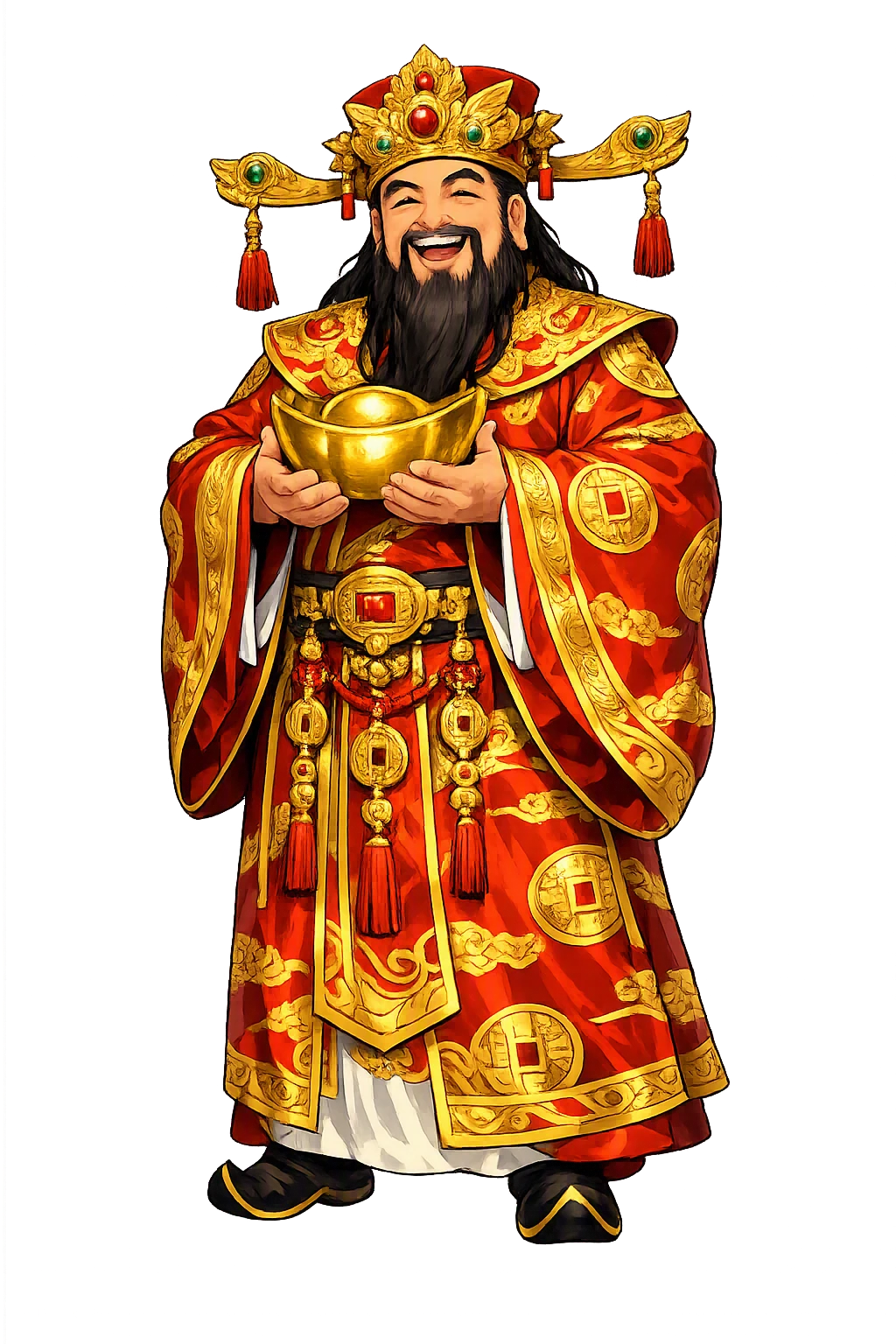
How Cáishén got its accent back
The ASCII form caishen is missing something. Cáishén restores the marks the source language used to distinguish this name from a thousand others — and those marks change how the name is read, pronounced, and understood. This post explains, with the full scholarly record behind it, what each restored mark preserves: the Chinese characters evidence, the reconstructed sound, the myths the name carries, and the mechanical logic of what each restored mark preserves. By the end, the marks in Cáishén will look less like ornaments and more like what they are — recovered evidence, pinned back in its proper place.
At a Glance
- Restored name: Cáishén
- ASCII form: caishen
- Meaning: "God of wealth"
- Domain of influence: Wealth, Prosperity, New Year
- Pantheon: Chinese
- Restoration: Preserves stress
- Original script: 財神 (Chinese characters)
- Live domain: cáishén.com
Overview
Cáishén (caishen) — Wealth, Prosperity, New Year · God of wealth — belongs to the Chinese tradition, where it is catalogued under the domain "Wealth, Prosperity, New Year". The name means "God of wealth".
Cáishén belongs to the Chinese tradition, where it is associated with wealth, prosperity, new year.
PuniCodex restores the name as Cáishén and serves its temple at caishen.com. The restoration preserves at least one distinctive feature — a diacritic or a distinctive letter — that the ASCII form loses, and exactly one historically valid Unicode restoration exists. The plain ASCII form caishen survives as a modern convenience imposed by the early domain-name system; the restoration, not the fallback, is the form the project defends as philologically complete.
The Name
The name is attested in Chinese characters as 財神. Etymologically it means "God of wealth".
Cái (財) 'wealth, riches'; Shén (神) 'god, spirit' — the popular deity of prosperity worshipped at New Year.
The ASCII form caishen survives only because the early domain-name system could not carry diacritics; it is a technological compromise, not an ancient spelling. The Unicode restoration Cáishén recovers the stress accent of the original directly in the address bar. The restoration preserves at least one distinctive feature — a diacritic or a distinctive letter — that the ASCII form loses, and exactly one historically valid Unicode restoration exists.
The letter-by-letter transformation runs:
- c → C — Same, capitalized
- a → á — Acute tone mark
- i → i — Same
- s → s — Same
- h → h — Same
- e → é — Acute tone mark
- n → n — Same
The canonical temple for this name is served at caishen.com.
Etymology & Roots
The recorded derivation reads: Cái (財) 'wealth, riches'; Shén (神) 'god, spirit' — the popular deity of prosperity worshipped at New Year.
The root gloss is "wealth god."
The reconstruction is classed as attested.
The Original Script
The name is written in Chinese characters as 財神. This original script is the form against which the ASCII fallback caishen and the PuniCodex restoration Cáishén are measured: the restoration preserves its pitch accent of the written form, so that a reader typing the modern address still speaks the ancient name.
Pronunciation
The reconstructed pronunciation of the name is /caishen/ — Chinese Reconstruction.
Phoneme by phoneme:
- C — Initial character of the restored form Cáishén.
- áishén — Remainder of the name, preserving the distinctive marks of the Chinese tradition.
For the modern speaker, the closest approximation is: 'CAISHEN' — pronounce the restored form with attention to the preserved diacritics and length.
Kindred and historical forms of the name:
- Chinese — Cáishén, the restored Unicode form of the name
Cáishén preserves both features because the Chinese form preserves distinctive features that ASCII loses: stress, length, or special characters.
Mythology
The stories of Cáishén circulate within the Chinese corpus, where the figure embodies wealth, prosperity, new year.
Primary Attestation (Sources)
Cáishén is attested in the canonical Chinese sources as a figure associated with wealth, prosperity, new year.
Name and Meaning (Etymology)
The name means "God of wealth" and reflects the figure's role in the tradition. Cáishén is the Chinese god of wealth, appearing in several forms including Zhào Gōngmíng, Bǐ Gān, and Fàn Lí. He confers prosperity on families and businesses during the Lunar New Year, when images of him are displayed and burned as offerings. His cult reflects the moral ambiguity of wealth: it must be attracted ethically and shared generously. Merchants place his image beside cash registers and householders burn paper effigies to ensure his favor in the coming year.
One Office, Many Gods (The Title)
The two characters 財神 simply mean 'god of wealth' — a title, not a personal name, and the tradition treats it that way. There is no canonical birth-story of Cáishén; instead, the office has been filled, again and again, by figures the culture wished to honor: a loyal minister, a canonized marshal, an honest merchant, even the red-faced war-god Guan Yu in some regions. The clearest early attestations belong to the Song dynasty (960–1279), when China's commercial revolution made wealth a god worth petitioning; the Ming-era compendium Santjiao soushen daquan and the novel Fengshen Yanyi then fixed the cast of avatars. The sources disagree openly about who 'really' holds the office — which is the honest thing for a god of fortune, since every trade, region, and dynasty wants to claim him. A god with many faces is a god owned by many classes; Cáishén's multiplicity is the theology of a civilization that decided prosperity itself was divine.
Zhao Gongming on the Black Tiger (The Marshal)
The fullest avatar-story comes from the Ming novel Fengshen Yanyi (Investiture of the Gods). During the fall of the Shang dynasty, Zhao Gongming, a hermit of Mount Emei, comes down to aid the doomed house with his black tiger, his iron whip, and his magic pearls; battle after battle turns on his power, until Jiang Ziya's side breaks him with Lu Ya's sorcery — an effigy of straw pierced by arrows. When the war ends and the fallen are canonized, Jiang Ziya invests the dead marshal as the God of Wealth, true lord of the dragon-tiger altar, mounted on his tiger, whip in hand, gold ingot ready — with four assistant deities who manage the welcoming of treasure, the gathering of valuables, the inviting of wealth, and the profiting of markets. The novel turns fortune into a bureaucracy: wealth flows not from luck but from an office, staffed, audited, and answerable — a very Chinese answer to the oldest of prayers.
Bi Gan's Missing Heart (The Heartless Minister)
The civil face of the god descends from an atrocity recorded by Sima Qian in the Shiji (c. 90 BCE, 'Basic Annals of Yin'). Bi Gan, uncle and chief minister of King Zhou of Shang, remonstrated against the tyrant's cruelties until the king, goaded on by his favorite Daji, ordered the minister's heart cut out — to test the old claim that a sage's heart has seven openings. Because Bi Gan died heartless, later tradition reasoned, he is beyond greed: no bribe reaches a god who has no heart to desire one. He became the Civil God of Wealth, the form merchants and bankers trust, usually shown in an official's robes holding a ruyi scepter and a scroll. The logic is ruthless and perfectly practical: the only trustworthy custodian of wealth is the man whose desire for it has been surgically removed — a parable about greed built on a mutilation, and one of the darkest etiologies any god carries.
Symbols & Iconography
The iconography associated with Cáishén concentrates in a small set of recurring attributes, each a compressed statement about the name:
- Restored Name — The Unicode form Cáishén carries the original marks of the Chinese tradition.
- Source Script — Attested in the original script as 財神.
- Domain — Wealth, Prosperity, New Year
- Etymology — God of wealth
- The gold ingot (yuanbao) — The boat-shaped silver-gold ingot held by every avatar of Cáishén — wealth made visible and graspable.
- The black tiger — Marshal Zhao's mount; the tiger that can carry wealth away as easily as it brings it.
- The iron whip — Zhao Gongming's weapon, disciplining the pursuit of riches — wealth taken unjustly is wealth reclaimed.
- The ruyi scepter — 'As you wish' — the wish-granting wand of the Civil God of Wealth.
- The account book — The ledger in which the god's office records each household's fortune for the coming year.
Archaeology & Evidence
The material record for Cáishén survives in a small number of securely identified remains, catalogued below; the corpus is thin but unambiguous, and each site is tied to the name by ancient testimony.
Cáishén is attested in the textual and iconographic record of the Chinese tradition.
Realm & Domain
Cáishén belongs to the Chinese tradition, where it is associated with wealth, prosperity, new year.
Wealth
The central domain of Cáishén in the chinese tradition.
God of wealth
The name signifies "God of wealth".
Unicode Restoration
The restoration Cáishén recovers what plain ASCII caishen flattens.
Original Attestation
Attested in the sources as 財神. Devotees also associate him with gambling windfalls, business negotiations, and the honest accumulation of family prosperity.
Marshal Zhao
Zhao Gongming: black tiger, iron whip, gold ingot — the Martial God of Wealth canonized in the Fengshen Yanyi.
The Civil God
Bi Gan, the Shang minister whose heart King Zhou cut out; without a heart, he cannot be greedy, so merchants trust him.
Welcoming the God
On the fifth day of the New Year, businesses reopen with firecrackers to be first to receive him.
The Five Paths
Worshipped in sets of five — the Five Gods of Wealth, bringing fortune from every direction of the compass.
Across Cultures
Cáishén appears within the Chinese tradition and has influenced later retellings, artistic depictions, and scholarly study. The Unicode restoration preserves the name's distinctive orthography for contemporary use.
Within the Chinese tradition, closely related names in the corpus include Bāguà, Cháng'é, Fúxī, Guāndì, Guānyīn, and Hòuyì.
Cultural Legacy
Cáishén continues to appear in scholarship, art, and popular reception as a significant figure of the Chinese tradition. Restoring the name in Unicode returns the original marks that ASCII removes. Cáishén remains one of the most commonly invoked deities in Chinese popular religion, especially during New Year observances.
The Scholarly Record
The account of Cáishén given in this edition rests on the witnesses and reference works listed below. Lexica and etymological dictionaries secure the form and meaning of the name; the literary and religious texts supply the narrative evidence.
- Unihan Database.
- Hanyu Da Zidian. Regional gazetteers and temple gazetteers record the multiplication of Cáishén temples during the Ming-Qing commercial revolution.
A Meditation
Cáishén embodies wealth, prosperity, new year in the Chinese imagination. The name's restoration is not merely cosmetic: it recovers the stress, length, and script that make the figure recognizable in the source tradition.
The Unicode Restoration
Cáishén preserves stress. The ASCII fallback caishen still resolves everywhere, but it is the restored form that carries the name's full information. Across the 7 characters of the name, the restoration adjusts 2: 2 marks of stress (á, é). That is the whole thesis of this temple: the marks are the message.
Character by Character
The journey from caishen to Cáishén, one character at a time:
- c → C — Same, capitalized
- a → á — Acute tone mark
- i → i — Same
- s → s — Same
- h → h — Same
- e → é — Acute tone mark
- n → n — Same
The Domain Name
The restored name is live as a working domain: cáishén.com, which the DNS carries in punycode form as xn--cishn-xqa3d.com — an ASCII-compatible encoding that lets a non-ASCII name travel the global network without breaking older infrastructure. The visitor sees Cáishén; the machines see the encoding. That duality is the engineering compromise on which the entire restoration rests, and it is why a name written the way its own tradition wrote it in Chinese characters can now be typed into any browser on earth.
The Chinese Pantheon
Cáishén is one of 59 entries the PuniCodex lexicon catalogues under the Chinese pantheon. The Pantheon page gathers the tradition's major figures in one place, and the Lexicon lets you filter all 983 restorations by tradition or script — the fastest way to see where this name sits among its kin.
Frequently Asked Questions
What does Cáishén mean? The traditional gloss is "God of wealth."
Which tradition does Cáishén belong to? Cáishén is catalogued in the Chinese pantheon of the PuniCodex lexicon.
What does Cáishén preserve that ASCII cannot show? The form itself answers: Cáishén preserves stress — and the marks in the restored spelling are exactly that evidence.
Is Cáishén a working domain? Yes — cáishén.com resolves today and routes to this temple.
What is the punycode for cáishén.com? The DNS encoding is xn--cishn-xqa3d.com; browsers perform the translation automatically, so visitors only ever see the restored name.
Can I use Cáishén in a normal browser? Yes. The DNS resolves the punycode form automatically, and the type tool on this site converts caishen to Cáishén for copying and pasting.
Where does the scholarly information come from? The entry is built from lexica, inscriptional evidence, and reviewed scholarly sources listed in the Scholarly Edition. Every claim is traceable to a canonical source.
Typing Cáishén
You do not need a special keyboard to use this restoration. The PuniCodex Type Tool converts the ASCII form caishen into Cáishén as you type, and the browser extension offers the same conversion inside any text field. Copy the restored form, paste it into the address bar, and the DNS does the rest.
Sister Temples
Other temples in the Chinese pantheon include Lóng, and Sānzàng — each with its own restoration story, its own scholarly record, and its own place in the lexicon.
Why This Restoration Matters
The marks in Cáishén were never lost; they were only waiting for a carrier that could hold them. Now that the carrier exists, the burden flips: every use of caishen is a choice to leave evidence on the table. The PuniCodex temple keeps the restored form in circulation — as a domain, a dataset entry, and a scholarly argument — so that the choice to use it stays easy. Accent by accent, macron by macron, that is how the original names come back: not with a single grand gesture, but with a spelling that finally works everywhere.
Explore Further
This post is one doorway into the temple. The home page carries the full character breakdown and the ambient canvas; the lore page tells the myths in long form; the Scholarly Edition preserves the sources, pronunciation data, and revision history; and the patron wall supports the restoration directly. For the wider map, browse the Lexicon, explore the Pantheon, or return to the PuniCodex blog.
A Closer Look at the Marks
A restored name is a small map. In Cáishén, the journey from the ASCII fallback caishen to the Unicode form can be read letter by letter, and each letter tells a story. Of the 7 characters, 5 remain unchanged; they anchor the name to its modern shape. The remaining adjustments recover marks the source tradition used to distinguish this name from every other word built from the same letters.
The c stays as it is — Same, capitalized.
The a becomes á — Acute tone mark.
The i stays as it is — Same.
The s stays as it is — Same.
The h stays as it is — Same.
The e becomes é — Acute tone mark.
The n stays as it is — Same.
Together these changes are not decoration. They are the minimum set of marks needed to keep the name legible in its own tradition. Remove them and you still have a string of letters; you no longer have the name as it was written.
Cáishén in Its Tradition
Cáishén does not stand alone. It belongs to the Chinese tradition, where it is counted among 59 names in the PuniCodex lexicon. Its sphere — Wealth, Prosperity, New Year — places it beside other figures who govern similar aspects of experience. The restored spelling is therefore not only a philological decision; it is a way of keeping the name in the company of its kin. When the address bar shows Cáishén, it marks the boundary between a generic search term and a named entry in a living catalog of myth. That catalog is the point of the project. Every restored name is a vote for specificity: the web should know the difference between a figure and a keyword, between a tradition and a trend. Cáishén is one such vote.
Related Names
Sources
The full scholarly apparatus — every citation, revision, and review — lives in the Scholarly Edition. Key references for this post:
- Fengshen Yanyi (Investiture of the Gods).
- Daoist Canon (Daozang), ritual manuals for wealth deities.
- Taoist canon (Dàozàng).
- Chinese Buddhist canon (Dàzàngjīng / Taishō Tripiṭaka).
- Unihan Database.
- Hanyu Da Zidian.
- Unihan Database.
- Hanyu Da Zidian.
- Lexicon authorities for this entry: Chinese folk religion, Chinese folklore, Fengshen Yanyi.