
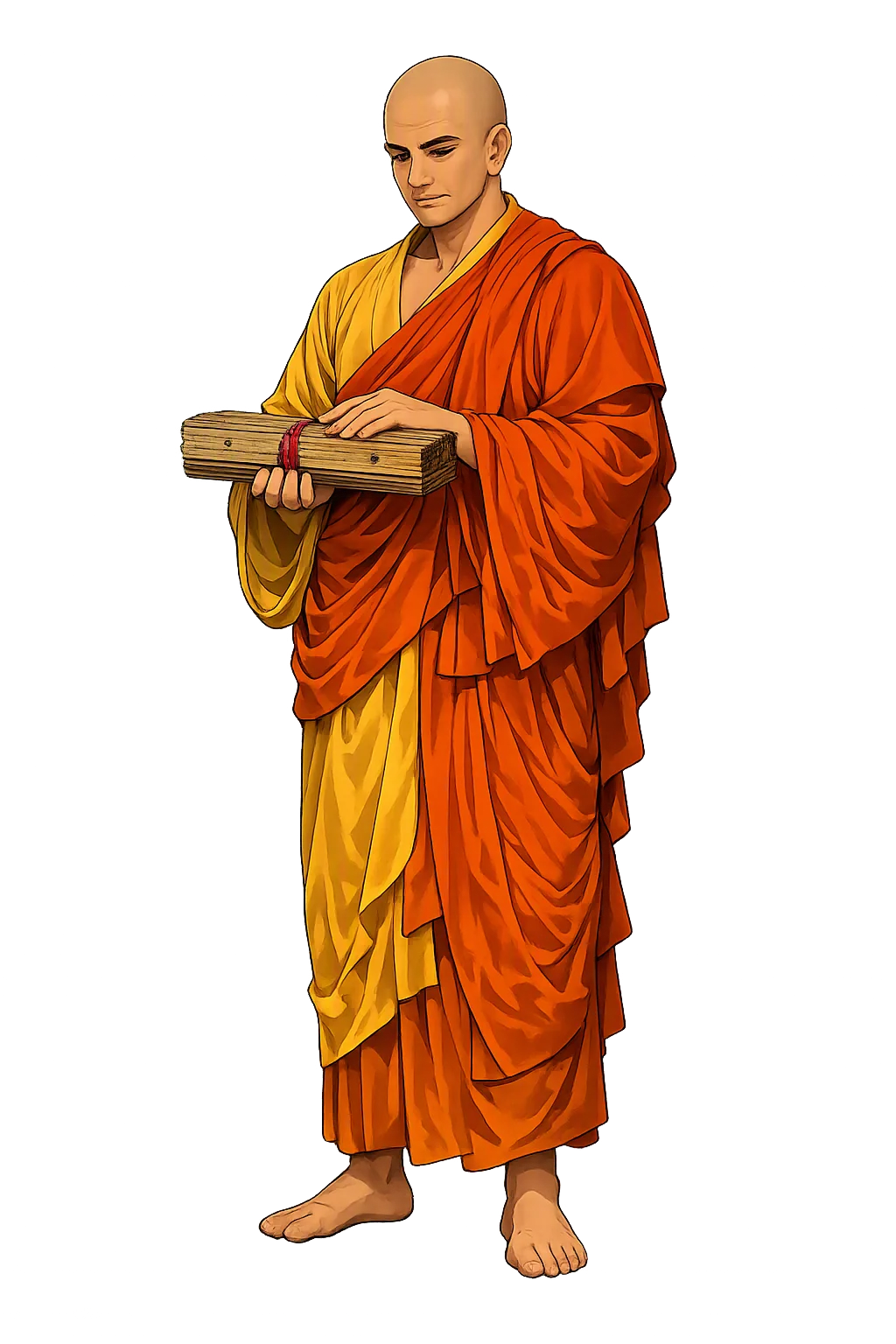
The appointments Asanga made — and who is keeping them
The mistake is reading myths as entertainment. Asanga's cycle reads more like a charter — each story assigning a duty the modern world still pays for.
At a Glance
- Temple: Asanga
- Pantheon: Buddhist
- Domain of influence: Yogacara, Mind-Only
- Pattern seats: 3
- Sectors touched: Society & Spirit · Culture & Entertainment
- Strongest seat: Education, Research & Knowledge
- Series: The Resonance Files, No. 55 of 548
The Cycle, Read Forward
Education, Research & Knowledge — through Two Brothers, One Teaching
Asanga and his younger half-brother Vasubandhu — arguably the two most consequential Buddhist philosophers after Nāgārjuna — were born, the story runs (Xuanzang preserves it in his Great Tang Records of the Western Regions), to a brahmin of Kauśika lineage; their mother, the legend adds, resolved that one son should master the Mahāyāna and the other its rival, the analytical Abhidharma of Kaśmīr. Vasubandhu became the encyclopedist of the Abhidharmakośa; Asanga wandered and meditated until he founded Yogācāra.
The atlas states the seat in one line: Primary seat: Asanga embodies yogacara, mind-only — the core of education. The story above is the long version of the same sentence. That is the cycle working: story becomes duty, duty becomes trade.
Mythic Name Restoration — through Twelve Years, a Wounded Dog, and Maitreya
The founding vision of Yogācāra is a story about compassion first. Asanga, the tradition says (Xuanzang; the Tibetan historians Bu ston and Tāranātha repeat it), spent twelve years in solitary retreat awaiting a vision of the future Buddha Maitreya — and saw nothing.
The atlas states the seat in one line: Resonant seat: Asanga shares symbolic territory with mythic restoration. The story above is the long version of the same sentence. The trade thinks it is optimizing a process. It is re-enacting a charter.
Writing, Publishing & Media — through Yogācāra, the Practice of Mind-Only
What Asanga built — with Vasubandhu and their lineage — the tradition called Yogācāra, "practice of yoga," and its opponents called cittamātra, "mind-only. " Its masterworks, the Mahāyāna-saṃgraha ("Compendium of the Mahāyāna") and the Abhidharmasamuccaya, set out a psychology of awakening: the store-consciousness (ālayavijñāna), a deep repository in which the seeds of deeds and habits sleep, waiting to sprout as the world; the three natures — the imagined (the snake), the dependent (the rope), the perfected (the seeing); and the radical claim that the "external world" is a construction of consciousness, no more independent than a dream is independent of the dreamer.
The atlas states the seat in one line: Resonant seat: Asanga shares symbolic territory with publishing media. The story above is the long version of the same sentence. The trade thinks it is optimizing a process. It is re-enacting a charter.
The Theme That Runs the Cycle
Asanga's mythology is the hagiography of a psychologist: the vision that founded his school came through compassion for a dog, and his school's charter texts were, by tradition, dictated by the future Buddha — scholarship's verdict is that Asanga wrote them himself, which changes nothing about the parable.
The Method, Stated Plainly
Skeptical? Good — the system is built for you. Every seat in this file carries its why-line and its weight, the full derivation is public at the methodology page, and the challenge process is part of the design. Falsifiable is not a posture here; it is the mechanism.
For the Ones Who Work There
If you work in education, research & knowledge, mythic name restoration, or any trade this temple holds a seat in, this is the honest version of what a placement means: your industry beside the story it has been re-telling all along — on the temple floor itself, before an audience that came specifically to read it. The patron tier and the advertising terms describe the mechanics; the resonance above describes the fit.
The File Continues
One of 548 Resonance Files — the series where the pantheon goes to work. Read the founding dispatch for the name, the Restoration File for the spelling, or the whole archive end to end.
Continue the series — previous: Aša (read it) · next: Ašeratu (read it).
The Resonance Files are argued from the same canonical record as the pattern atlas itself: the lexicon, the lore catalog, and the cited sources. Every seat can be challenged at the methodology page — and the challenge is the point.