
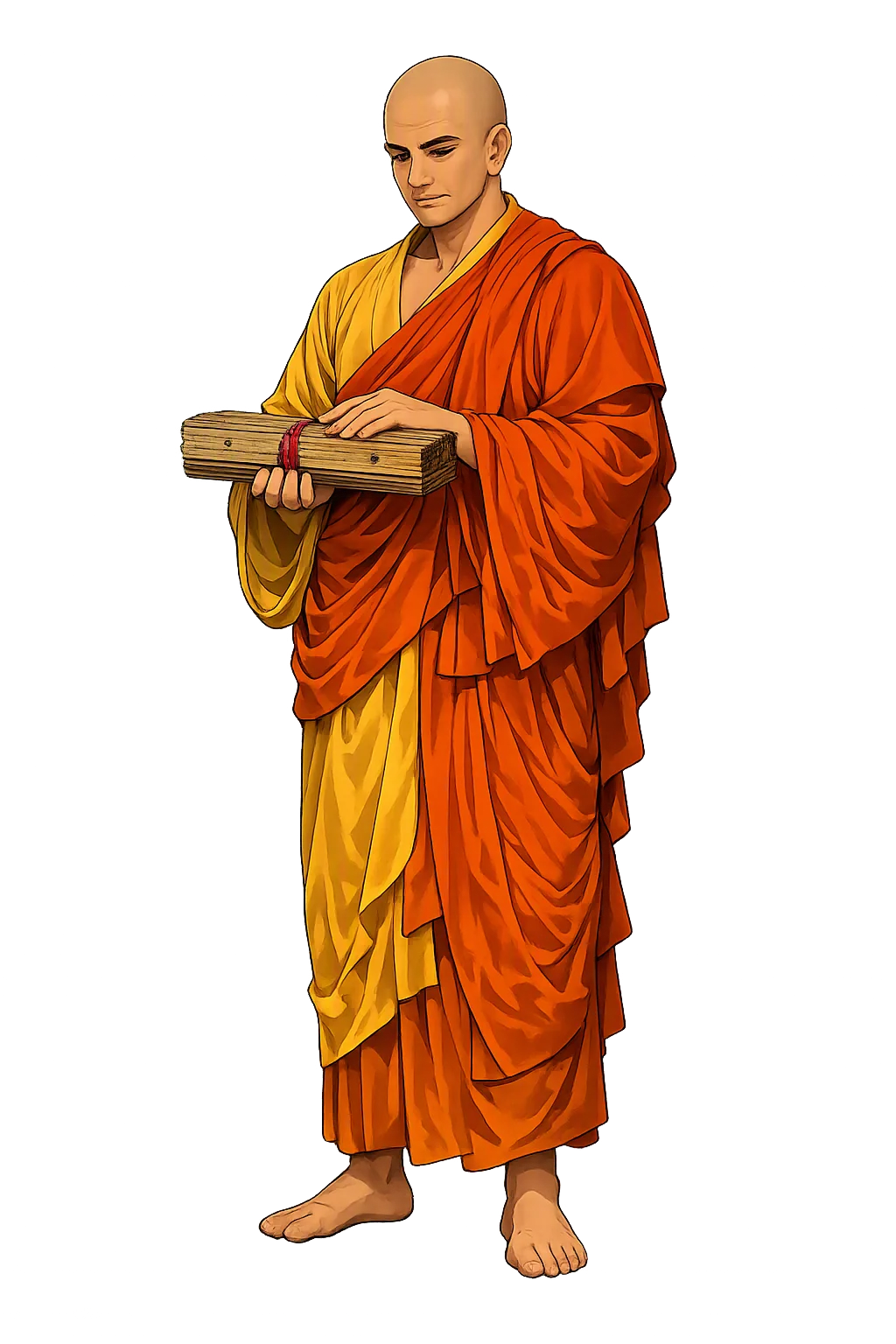
How Asanga was rebuilt, mark by mark
Bench notes, Asanga: what we found, what we rejected, and what we finally set down. Kept in the open, because a restoration you cannot audit is just a spelling with confidence.
What We Found
The attestation runs through the tradition's own sources: असन्ग. Meaning: "Without attachment".
The figure behind the name: Asanga's mythology is the hagiography of a psychologist: the vision that founded his school came through compassion for a dog, and his school's charter texts were, by tradition, dictated by the future Buddha — scholarship's verdict is that Asanga wrote them himself, which changes nothing about the parable.
What the Name Carried In
Two Brothers, One Teaching. Asanga and his younger half-brother Vasubandhu — arguably the two most consequential Buddhist philosophers after Nāgārjuna — were born, the story runs (Xuanzang preserves it in his Great Tang Records of the Western Regions), to a brahmin of Kauśika lineage; their mother, the legend adds, resolved that one son should master the Mahāyāna and the other its rival, the analytical Abhidharma of Kaśmīr. Vasubandhu became the encyclopedist of the Abhidharmakośa; Asanga wandered and meditated until he founded Yogācāra.
Twelve Years, a Wounded Dog, and Maitreya. The founding vision of Yogācāra is a story about compassion first. Asanga, the tradition says (Xuanzang; the Tibetan historians Bu ston and Tāranātha repeat it), spent twelve years in solitary retreat awaiting a vision of the future Buddha Maitreya — and saw nothing.
A spelling that has to carry stories like these is not a label. It is equipment.
Where It Stood Before Us
Asanga left no monument of his own, and his century left few datable ones — the 4th–5th-century Buddhist world of northern India is known mostly through the pilgrim accounts (Faxian, then Xuanzang) and the great monastic cities they describe. Nālandā, excavated by the Archaeological Survey of India from 1915 and now a UNESCO site, preserves the excavated grid of his school's eventual home: eleven monasteries and six temples in brick, the sarai and the stūpas. The Ajanta caves' later viharas (5th–6th c.) show the scholastic monasticism his movement filled — rows of cells, lecture halls, painted jātakas. His true artifacts are textual: the five Maitreya treatises survive in hundreds of Sanskrit fragments and complete Tibetan and Chinese translations, their colophons still arguing about who wrote them — which is, for a school about the construction of authorship, exactly right. The bench inherits all of it — the web temple is the newest site, not the first.
What We Rejected
Any form invented for availability. The rule on the bench: if the evidence does not carry it, the domain does not get it — whatever the registrar has in stock.
What We Set Down
Asanga — One decisive feature survives — a single, honest mark — which places the restoration in Tier-2: exact, and exactly labeled.
For the voice: 'UH-sung-guh' — short vowels, even stress; the ṅg is the nasal 'ng' of 'singer,' not 'finger.'
The temple stands at /asanga/ — the notes above are public in its Scholarly Edition, sources and all.
At a Glance
- Restored name: Asanga
- ASCII form: asanga
- Meaning: "Without attachment"
- Domain of influence: Yogacara, Mind-Only
- Pantheon: Buddhist
- Classification: Tier 2
- Original script: असन्ग
- Series: The Restoration Files, No. 55 of 548
The File Continues
The temple's founding dispatch tells the name's story; its Resonance File reads the myths into the industries; the blog index holds the whole archive.
Continue the series — previous file: Aša (read it here) · next file: Ašeratu (read it here).
The Restoration Files are written from the same canonical record as the temples themselves: the lexicon, the lore catalog, the pattern atlas, and the cited scholarly sources. If a file ever disagrees with its temple, the temple is right — tell us, and the file will be corrected.