
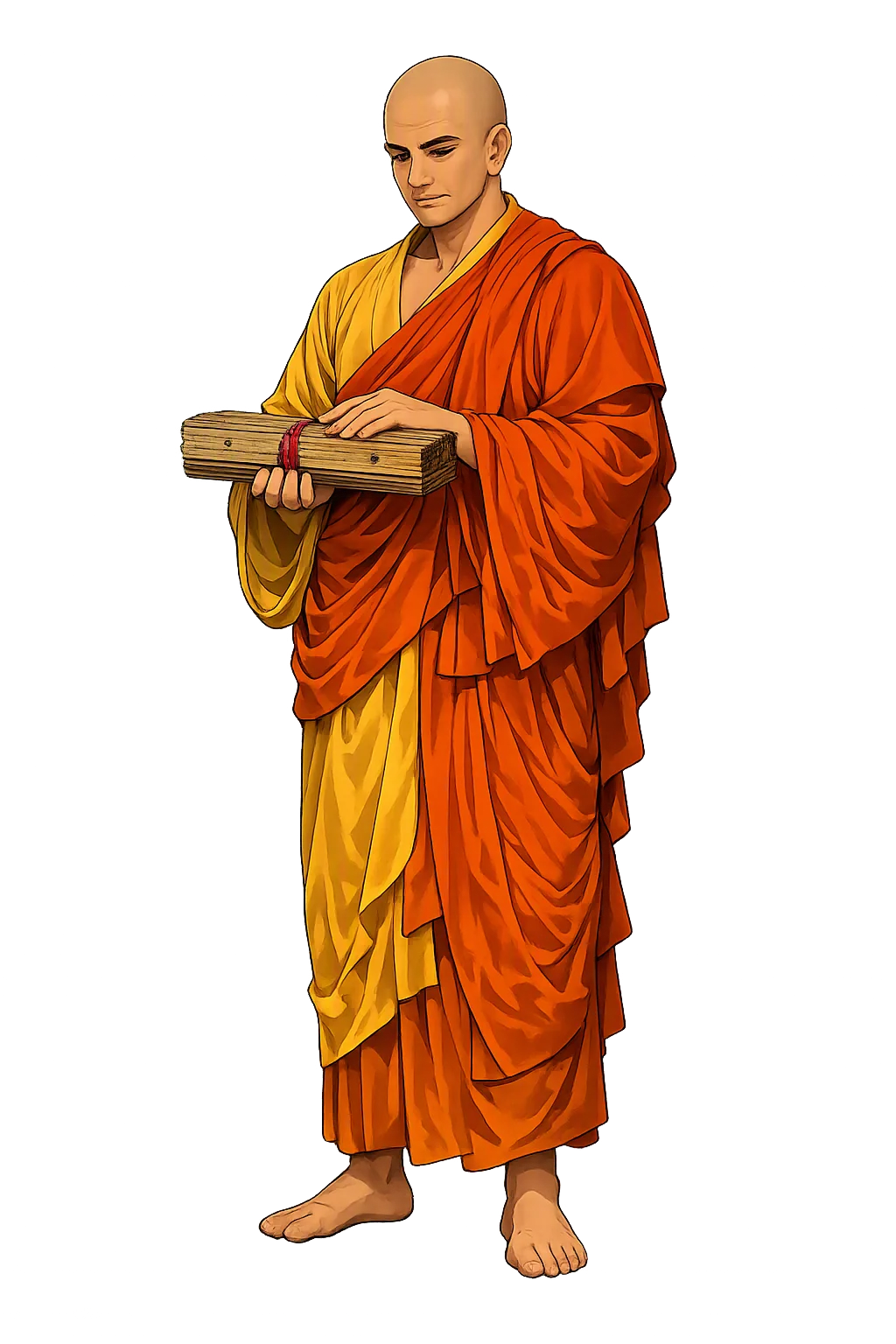
Pronouncing Asanga: a guide for the curious
Some names are remembered for miracles, others for empires. Asanga is remembered for an idea: that the world we experience is, in the last analysis, mind-only. He was a philosopher of extraordinary ambition, a system-builder who tried to explain how consciousness constructs the objects it seems merely to perceive. His name, Sanskrit Asaṅga — "without attachment" or "unstuck" — describes both the man and the teaching. The tradition says he was so devoted to the bodhisattva Maitreya that he received teachings directly from the future Buddha in the Tushita heaven, then returned to the human world to turn those visions into the school called Yogācāra. Today his name also lives as a Unicode domain, restored by PuniCodex to its capitalized scholarly form Asanga. This post offers a complete guide to the name and the thinker: how to say it, how it is written, what it means, and why its restoration still matters in a digital age.
At a Glance
- Restored name: Asanga
- ASCII form: asanga
- Meaning: "Without attachment"
- Domain of influence: Yogācāra, Mind-Only
- Pantheon: Buddhist
- Classification: Tier 2
- Original script: असन्ग (Devanagari)
- Pronunciation: /asanga/ — "ah-sung-ga," with the stress implied by the scholarly restoration
Overview
Asanga (asanga) stands at the center of one of the most influential movements in the history of Indian Buddhism. Born, according to traditional accounts, in Puruṣapura in the Gandhara region during the fourth century of the common era, he began his monastic career in the mainstream Abhidharma traditions of northwestern India. Dissatisfied with the explanatory power of the systems he had learned, he turned toward the Mahayana sūtras and, in the traditional telling, received a series of revelations from the bodhisattva Maitreya. From these revelations he composed or transmitted the founding texts of the Yogācāra or "Yoga Practice" school, sometimes called the "Mind-Only" school because of its central claim that the objects of experience are forms of consciousness.
The PuniCodex restoration keeps the name as Asanga, with no diacritic in the public domain spelling. The original Sanskrit would be Asaṅga, with a dot under the n to mark the palatal nasal; the Pali and Prakrit forms simplify the cluster. Because the domain restoration does not include the underdot, the entry is classified Tier 2: ASCII carries almost everything, but the capital letter restores the name's status as a proper noun and signals that this is a historical person, not a Sanskrit adjective. The temple lives at its temple, where the full record is kept current.
Etymology and Meaning
The name is built from the Sanskrit prefix a-, meaning "not" or "without," and the root sañj or saṅga, meaning attachment, clinging, or association. An asaṅga is therefore "without attachment," "unstuck," "not clinging." The meaning is doctrinally precise. Buddhist psychology identifies clinging, or upādāna, as one of the links in the chain of dependent origination that produces suffering. To be without attachment is not to be cold or indifferent; it is to relate to experience without the grasping that turns perception into bondage. The name Asanga therefore describes the psychological ideal at the heart of his own philosophy.
In everyday Sanskrit, asaṅga can also mean "not associated with," "independent," or "unimpeded." All of these shades are relevant to a thinker who argued that the mind is not genuinely bound by external objects because those objects are themselves configurations of mind. The etymology is not a decorative label; it is a summary of the school's deepest claim. To understand the name is already to glimpse the teaching.
Asanga and the Yogācāra School
The Yogācāra school is sometimes described as Buddhist idealism, though modern scholars debate how closely it matches Western philosophical idealism. Its core thesis is that the objects we take to be external are actually transformations of consciousness. Perception does not reach a world independent of mind; it reaches a mental representation that mind itself has constructed. This does not mean that rocks and trees disappear when no one looks at them. It means that even the category "rock" or "tree" is a cognitive achievement, a way consciousness organizes its own flow.
Asanga's contribution was to systematize this insight into a comprehensive map of mind. He distinguished eight consciousnesses: the five sense consciousnesses, the mental consciousness, the defiled mind-consciousness (kliṣṭamanas), and the storehouse consciousness (ālayavijñāna). The last of these is the most famous. The ālayavijñāna is a subliminal stream of consciousness that stores the seeds, or bīja, of past experiences and inclines the mind toward future ones. It explains how karma can persist across lives without requiring a permanent soul, and it explains how habitual patterns can operate below the threshold of ordinary awareness.
Asanga also developed the doctrine of the three natures (trisvabhāva): the imagined nature, the dependent nature, and the perfected nature. The imagined nature is the world as falsely constructed by conceptual projection. The dependent nature is the flow of causes and conditions that underlies that projection. The perfected nature is the recognition that the dependent flow is empty of the imagined essences we superimpose on it. This threefold scheme became one of the most durable frameworks in Mahayana philosophy, debated in India, Tibet, China, and Japan for more than a millennium.
The Three Natures Explained
The doctrine of the three natures is the philosophical heart of Asanga's Yogācāra. The first nature, the imagined (parikalpita), is the world as ordinary cognition constructs it: solid objects, enduring selves, friends and enemies, winners and losers. These constructions are not entirely arbitrary; they are shaped by language, culture, and personal habit. But they are also false in a crucial sense, because they attribute fixed essences to processes that are empty of such essences. The imagined nature is the sphere of misunderstanding, the root of suffering.
The second nature, the dependent (paratantra), is the flow of causes and conditions itself. It is the stream of consciousness and its objects as they actually occur, prior to conceptual freezing. Dependent nature is not false; it is simply unstable. It is the field in which karma operates, in which habits are laid down and reinforced, and in which transformation is possible. Without the dependent nature there would be no path, because there would be no continuum to purify. The third nature, the perfected (pariniṣpanna), is the dependent nature seen without the imagined essences superimposed upon it. It is not a separate realm but the same flow recognized as empty of inherent existence. The perfected nature is therefore synonymous with the Buddhist understanding of emptiness, viewed through the lens of consciousness.
This threefold scheme allowed Asanga to steer between two dangers. He could deny that external objects exist in the way naive realism supposes without falling into the opposite error of denying the efficacy of causes and conditions. Mind constructs experience, but it does not do so out of nothing. The seeds stored in the ālayavijñāna ripen in lawful ways, and the path consists in replacing defiled seeds with pure ones until the entire stream is clarified.
Brother and Lineage
No account of Asanga is complete without his younger half-brother, Vasubandhu. Vasubandhu began as one of the most brilliant exponents of the Sarvāstivāda Abhidharma and authored the encyclopedic Abhidharmakośa. According to tradition, Asanga converted him to Mahayana through a combination of philosophical argument and compassionate persistence. After his conversion, Vasubandhu became the great systematizer of Yogācāra thought, writing commentaries and treatises that remain central to the tradition. The two brothers together are remembered as the founding pair of the school, Asanga the visionary recipient of Maitreya's teachings and Vasubandhu the razor-sharp analyst who clarified them.
The Maitreya corpus associated with Asanga includes five major works: the Yogācārabhūmi-Śāstra, the Mahāyāna-sūtrālaṃkāra, the Madhyānta-vibhāga, the Abhisamayālaṃkāra, and the Dharmadharmatāvibhāga. Scholars continue to argue about which of these were composed by Asanga himself, which were transmitted from an older source, and which were composed by later authors attributing their work to Maitreya. Whatever the historical verdict, the texts became canonical for the Yogācāra tradition and shaped the curricula of the great monastic universities of India, including Nālandā and Vikramaśīla.
Asanga's own compositions include the Mahāyāna-saṃgraha, a systematic summary of Mahayana doctrine, and the Abhidharma-samuccaya, a reworking of Abhidharma categories from a Yogācāra perspective. These works show a mind that could move between the fine-grained taxonomy of the Abhidharma schools and the sweeping metaphysical claims of the Mahayana sūtras. He was, in effect, a bridge-builder, translating between two intellectual worlds that had often regarded each other with suspicion.
Cultural Legacy
The influence of Asanga's thought extends far beyond the borders of India. In Tibet, the Yogācāra school became one of the "two great chariots" of Mahayana philosophy, alongside Madhyamaka. The Gelug, Sakya, Kagyu, and Nyingma schools all study the Maitreya-Asanga texts, and the Dalai Lama tradition has repeatedly turned to the Mahāyāna-sūtrālaṃkāra and Madhyānta-vibhāga for guidance on the bodhisattva path. The idea of the ālayavijñāna also influenced Tibetan theories of death and rebirth, including the descriptions of the intermediate state, or bardo.
In East Asia, Asanga's legacy took shape through the translations of Paramārtha, Xuanzang, and others. Xuanzang's journey to India in the seventh century was partly motivated by a desire to resolve disputes about the nature of consciousness that had divided Chinese Buddhists. His translation school, known as Faxiang or "Dharma Characteristics," became the Chinese form of Yogācāra. In Japan the corresponding school is called Hossō. Although these schools eventually lost political prominence to Chan and Pure Land movements, their philosophical vocabulary remained embedded in East Asian Buddhist thought.
The modern academic study of Buddhism also owes a debt to Asanga. The categories he developed — storehouse consciousness, the three natures, the transformation of consciousness — remain central topics in Buddhist philosophy courses worldwide. His work is read alongside the idealisms of Kant and Berkeley, not because it is identical to them, but because it raises similar questions about the relationship between mind and world with a rigor that rewards comparison.
Asanga and the Bodhisattva Ethic
Although Asanga is famous for his metaphysics of mind, his work is equally concerned with ethics. The Mahāyāna-sūtrālaṃkāra, traditionally received from Maitreya, is as much a manual of bodhisattva conduct as a treatise on ontology. It describes the six perfections (pāramitā) — generosity, morality, patience, effort, meditation, and wisdom — as the indispensable practices of one who vows to liberate all beings. Asanga's presentation is systematic and practical: he explains how to give without attachment, how to maintain ethical discipline in difficult circumstances, how to endure insult without anger, and how to cultivate the wisdom that sees emptiness.
This ethical emphasis distinguishes Yogācāra from a merely intellectual idealism. For Asanga, the point of understanding that the world is mind-only is not to escape into private illusion but to become more effective at alleviating suffering. If suffering is a construction of mind, then it can be deconstructed by mind, and the bodhisattva's compassionate activity is the engine of that deconstruction. The name Asanga, "without attachment," is therefore the ethical as well as the metaphysical ideal: one who acts in the world without clinging to results.
Textual Survival and Modern Study
The survival of Asanga's corpus is itself a story of cultural transmission. Many of the Sanskrit originals were lost in India as Buddhism declined, but they were preserved in Tibetan and Chinese translations. The Tibetan canon (Kangyur and Tengyur) contains multiple translations of the Maitreya-Asanga works, often with commentaries by Indian masters such as Sthiramati and Dharmapala. The Chinese canon preserves Xuanzang's influential translations, which shaped East Asian Yogācāra for centuries.
Modern scholars use these multilingual witnesses to reconstruct the history of the school. They debate whether the Maitreya texts were composed by Asanga, by a historical Maitreya, or by a community of authors working under the Maitreya name. They also compare Yogācāra idealism with Western phenomenology and cognitive science, asking whether concepts such as the ālayavijñāna anticipate modern theories of the unconscious or of predictive processing. These scholarly conversations keep Asanga's work alive not as a museum piece but as a living resource for understanding mind and ethics.
The Original Script and Sound
The Devanagari form recorded by PuniCodex is असन्ग. The characters spell a-sa-n-ga: अ (a), स (sa), न् (n with halant), ग (ga). The scholarly Sanskrit form would be असङ्ग, with ङ (ṅa) replacing the न्ग cluster to represent the palatal nasal. The domain restoration uses the simplified form because the Unicode domain environment is most stable when it avoids combining marks and rare clusters. The sound is approximately "ah-sung-ga," with the stress on the first syllable and a smooth transition through the nasal.
Pronouncing the name correctly is more than a courtesy. It is a way of marking the transition from a generic search term to a specific historical person. When the name is spoken with its proper syllabic weight, it stops being an entry in a database and becomes the name of a thinker who shaped the religious imagination of half the world. The PuniCodex pronunciation record gives /asanga/ as the restored scholarly form, a practical compromise that keeps the name pronounceable across languages while respecting its Sanskrit origin.
The Unicode Restoration
The ASCII form asanga has served the internet well enough. It is typeable on every keyboard, indexable by every search engine, and pronounceable by most speakers. But it is also a flattened form. It erases the capital that marks a proper noun, it cannot carry the Sanskrit underdot, and it gives no hint that the name belongs to one of the most important philosophers of ancient India. The restoration Asanga recovers at least the proper-noun dignity. It says: this is a person, not a word.
PuniCodex hosts the restored name at its temple. That address is more than a redirect. It is a stable place where the etymology, the philosophy, the lineage, and the cultural afterlife of Asanga can be gathered and updated as scholarship advances. In an era when large language models scrape the web for training data, having a canonical, well-structured source for the name becomes a form of cultural preservation. The restoration is therefore not a cosmetic preference. It is a way of keeping the original spelling attached to the original meaning.
Conclusion
Asanga is one of the great system-builders of Buddhist thought. His name means "without attachment," and his philosophy tried to show how the mind could be free by understanding the mind itself. From the storehouse consciousness to the three natures, from the Maitreya revelations to the conversion of Vasubandhu, his legacy is woven through the intellectual history of India, Tibet, China, and Japan. The plain ASCII form asanga will remain useful for quick searches and legacy systems, but the restored form Asanga is the better address for the person and the idea. The PuniCodex temple keeps that address alive, ensuring that a philosopher of mind still has a named place on the web. In a digital landscape that increasingly relies on canonical sources, the restoration Asanga is also a small act of resistance against the flattening of historical names. It reminds every visitor that behind the simple string of letters stands a thinker who spent his life mapping the mind that maps the world, and whose maps are still worth reading. For students, scholars, and curious readers alike, the temple offers a stable point of departure into a philosophy that asks not only what the world is, but how the mind makes the world appear. That question, posed more than sixteen centuries ago, has lost none of its profound urgency.
Related Names
- Akṣobhya — Immovable, East
- Amitābha — Infinite Light, Pure Land
- Avalokiteśvara — Compassion, Mercy, Bodhisattva
- Bhaiṣajyaguru — Healing, Medicine, Lapis-Lazuli Light
- Kṣitigarbha — Earth Womb, Savior of Hell Beings
Sources
- Étienne Lamotte, History of Indian Buddhism (1958; trans. 1988).
- Walpola Rahula, What the Buddha Taught (1959).
- Edward Conze (trans.), Buddhist Scriptures (1959).