
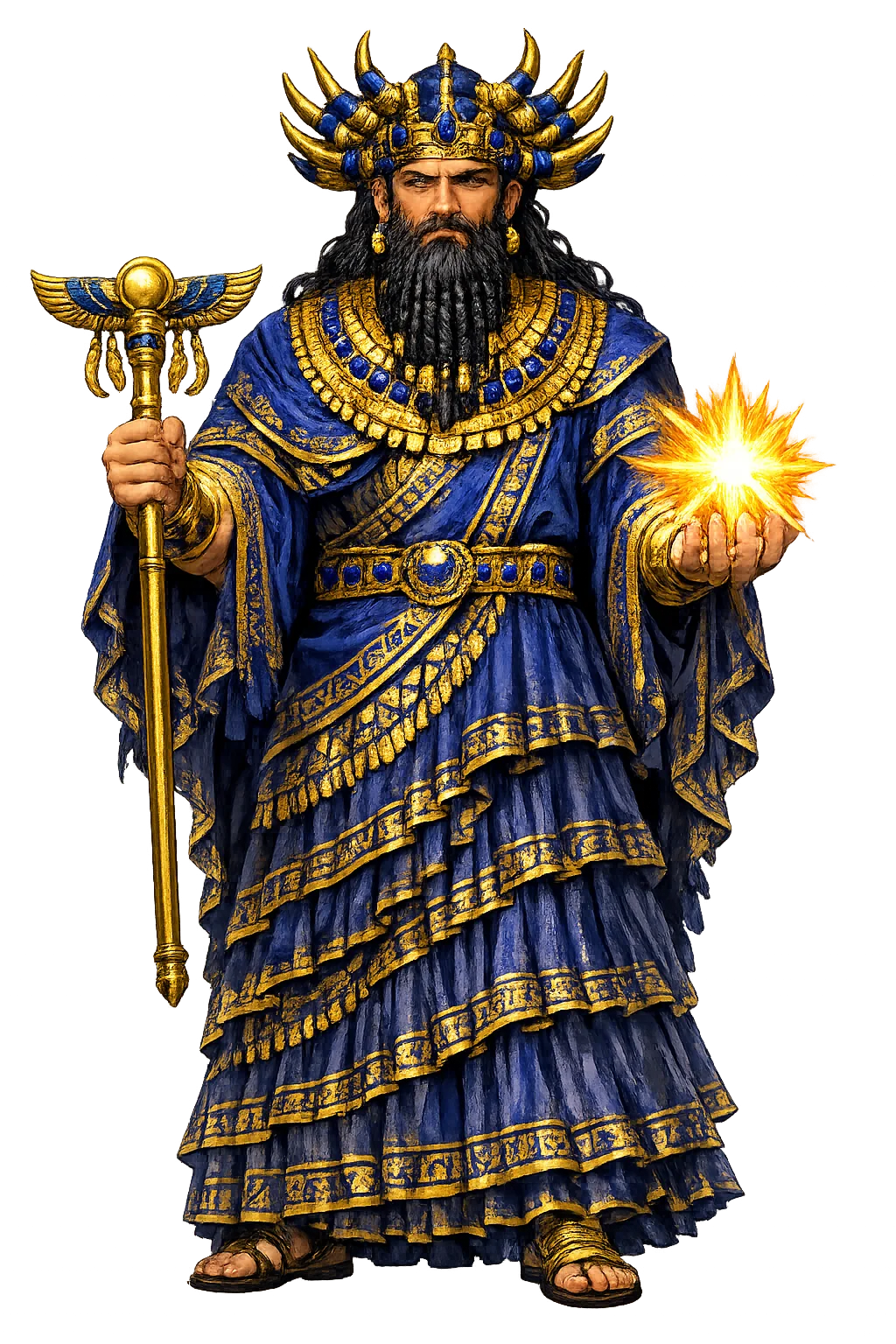
Anû: the stories first, then the spelling
The marks in Anû make the most sense standing next to the myths they have to carry. So the myths come first.
The Stories That Carry the Name
The Exaltation of Anû. Sumerian tradition opens with Anû already enthroned. The Sumerian King List begins human history with the descent of kingship: ‘When kingship descended from heaven, kingship was in Eridug’ — and the sphere from which it descends is Anû’s, whose name is simply the word for heaven itself. The god-lists make him father of Enlil, who rules earth and storm, and of Ea, lord of the subterranean fresh waters; the three divide the cosmos — Anû the sky, Enlil the command, Ea the deep (Sumerian King List 1–26; An = Anum god-list tradition).
The Tablet of Destinies. In the Babylonian creation epic, the Tablet of Destinies — the clay board on which the universe’s decrees are written — descends from Anû’s sphere through the generations of gods. When the primordial mother Tiamat arms her consort Kingu and fastens that tablet on his breast, she does what no god may do: she rewrites who holds the universe’s authority (Enuma Elish I 157–162). And when the young Marduk is chosen to face Tiamat, the divine assembly hands him the regalia of Anû himself — throne, crown, robe, and tablet — on condition that the decrees he wins be supreme (Enuma Elish IV).
The Bull of Heaven. Anû’s best narrative moment is a refusal that fails. Ishtar, rebuffed and insulted by Gilgamesh, climbs to her father’s heaven and demands the Bull of Heaven to avenge her. Anû refuses: if he sends the bull, seven years of famine will follow — the people will have neither grain nor sustenance for seven long years.
And Here Is What the Spelling Preserves
The restoration keeps one feature the ASCII form anu cannot show:
- u → û — Circumflex: a visible question mark — the length of Anu's final vowel is discussable, not certain: how long the vowel is held.
A storyteller pronouncing the name would restore every one of them by instinct. The file only writes down what the voice already knows.
At a Glance
- Restored name: Anû
- ASCII form: anu
- Meaning: "Reconstruction node for the Sumerian/Akkadian sky god Anu: the circumflex marks a discussable vowel length, not a canonical spelling claim."
- Domain of influence: Phonological Reconstruction, Sky, Heaven, Kingship
- Pantheon: Mesopotamian
- Classification: Tier 1
- Original script: 𒀭𒀀𒉡
- Series: The Restoration Files, No. 39 of 546
The Name Travels
The Unicode form Anû is a reconstruction node: standard Assyriology writes Anu, while the circumflex makes visible the open question of final-vowel length. In later Mesopotamian theology Anû was sometimes merged with Enlil or paired with Antu, his consort.
The Address It Earned
The temple of Anû stands at /anu/ — lore, scholars, patterns — because a name carrying this much story deserves more than a parking page. The restoration preserves more than the ASCII form can express — stress, length, or a letter the Latin keyboard lost — which places it, mechanically, in Tier-1.
The Sources Are Open
The myths above are retold from the temple's record; the primary voices are in the Sacred Texts: Enūma Eliš and The Epic of Gilgamesh. Nothing in this file outranks them.
The File Continues
Read the founding dispatch for the name's full story, the Resonance File for the archetype at work — or the whole archive in one sitting.
Continue the series — previous file: Annwn (read it here) · next file: ꜣnpw (read it here).
The Restoration Files are written from the same canonical record as the temples themselves: the lexicon, the lore catalog, the pattern atlas, and the cited scholarly sources. If a file ever disagrees with its temple, the temple is right — tell us, and the file will be corrected.