
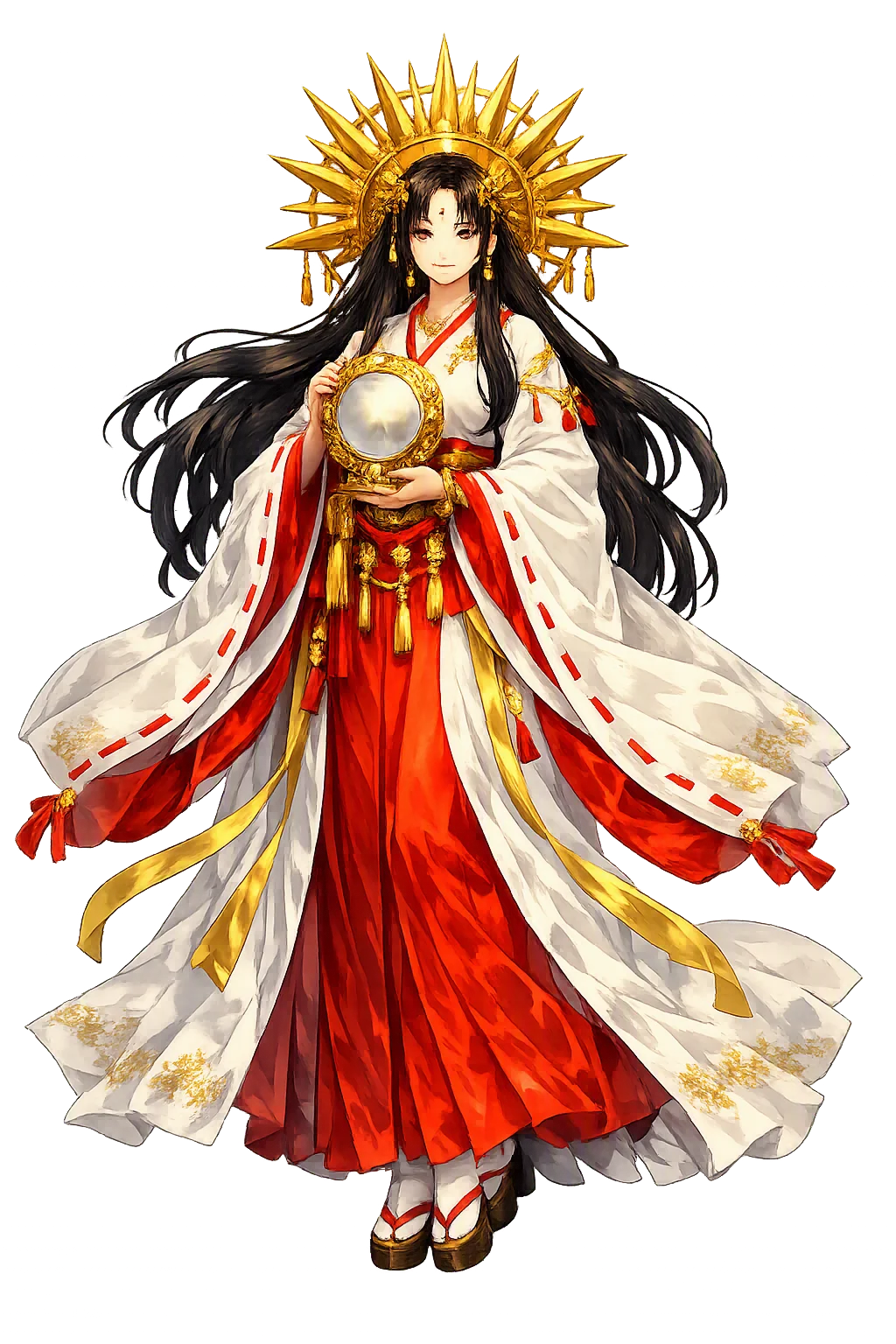
Why Amaterasu is spelled that way — and what it costs to get it right
There is a version of this name the early internet had to settle for: amaterasu. This is the file on how Amaterasu replaced it.
Amaterasu's mythology, told in the Kojiki and Nihon Shoki, is a theology of light, legitimacy, and the restoration of order after violence. It moves from her birth in purification to her withdrawal from a wounded heaven and her dispatch of the imperial line to earth.
At a Glance
- Restored name: Amaterasu
- ASCII form: amaterasu
- Meaning: "Sun goddess in Shinto"
- Domain of influence: Sun Goddess, Shintō
- Pantheon: Japanese
- Classification: Tier 2
- Original script: 天照
- Series: The Restoration Files, No. 21 of 548
The Name Before the Marks
The name is attested as 天照, on the evidence Kojiki 1 (birth, rampage, cave, Ninigi's descent) and Nihon Shoki 1–2 (variant births, Yamato-hime and the founding of Ise) set down. On the evidence, it means "Sun goddess in Shinto".
Spoken, the name runs `/a.ma.te.ɾa.sɯ/` — 'ah-mah-TEH-rah-soo' — the 'r' is a light tap, and the final 'u' is barely voiced.
The Temple That Stands Now
The restored name is not a plaque; it is an address. The temple of Amaterasu lives at /amaterasu/, with its mythology in the lore halls, its peer-reviewed record in the Scholarly Edition, and its place in the pattern atlas on the patterns floor.
The restoration keeps one feature the ASCII form drops. One is enough to matter, and the label says so plainly: Tier-2.
Where the Name Stood First
The Ise Grand Shrine (Mie Prefecture) is Amaterasu's principal dwelling: its Inner Shrine (Kōtai Jingū), traditionally founded in the reign of Suinin (1st century BCE), is rebuilt every twenty years (shikinen-zōtai) on alternating adjacent plots, a rite documented from 690 CE and continued without break. Architectural and documentary study of the precincts — the Uji Bridge, the Shōden, the treasure halls — makes Ise the best-documented ritual complex in Japan, though the mirror itself is never displayed. Heian ritual compendia (Engishiki) and shrine records (Shintōshū) list the annual offerings of cloth and first fruits presented by the court. The temple on the web is the newest of these addresses — the first one that fits in a pocket.
The Archetype at Work
The pattern atlas seats this temple in 4 industries, each match argued and weighted: Faith & Spiritual Organizations (the sun goddess at the apex of Shintō; the imperial line descends from her.); Leadership, Governance & Public Administration (the solar sovereign from whom the imperial line claims descent; Japan's highest kami.); Solar & Renewable Energy (the sun goddess whose retreat into the Ama-no-Iwato cave darkened the world until she was lured out — Shintō's solar sovereign.). The Resonance File reads those seats through the myths themselves.
In the Sacred Texts
The Japanese tradition is not a vibe; it is a library. The Sacred Texts collection holds Kojiki and Nihon Shoki — the primary sources the temple's scholarship is built on. The temple is the argument; the texts are the evidence.
The File Continues
The temple's founding dispatch tells the name's story; its Resonance File reads the myths into the industries; the blog index holds the whole archive.
Continue the series — previous file: Altjira (read it here) · next file: Ambikā (read it here).
The Restoration Files are written from the same canonical record as the temples themselves: the lexicon, the lore catalog, the pattern atlas, and the cited scholarly sources. If a file ever disagrees with its temple, the temple is right — tell us, and the file will be corrected.