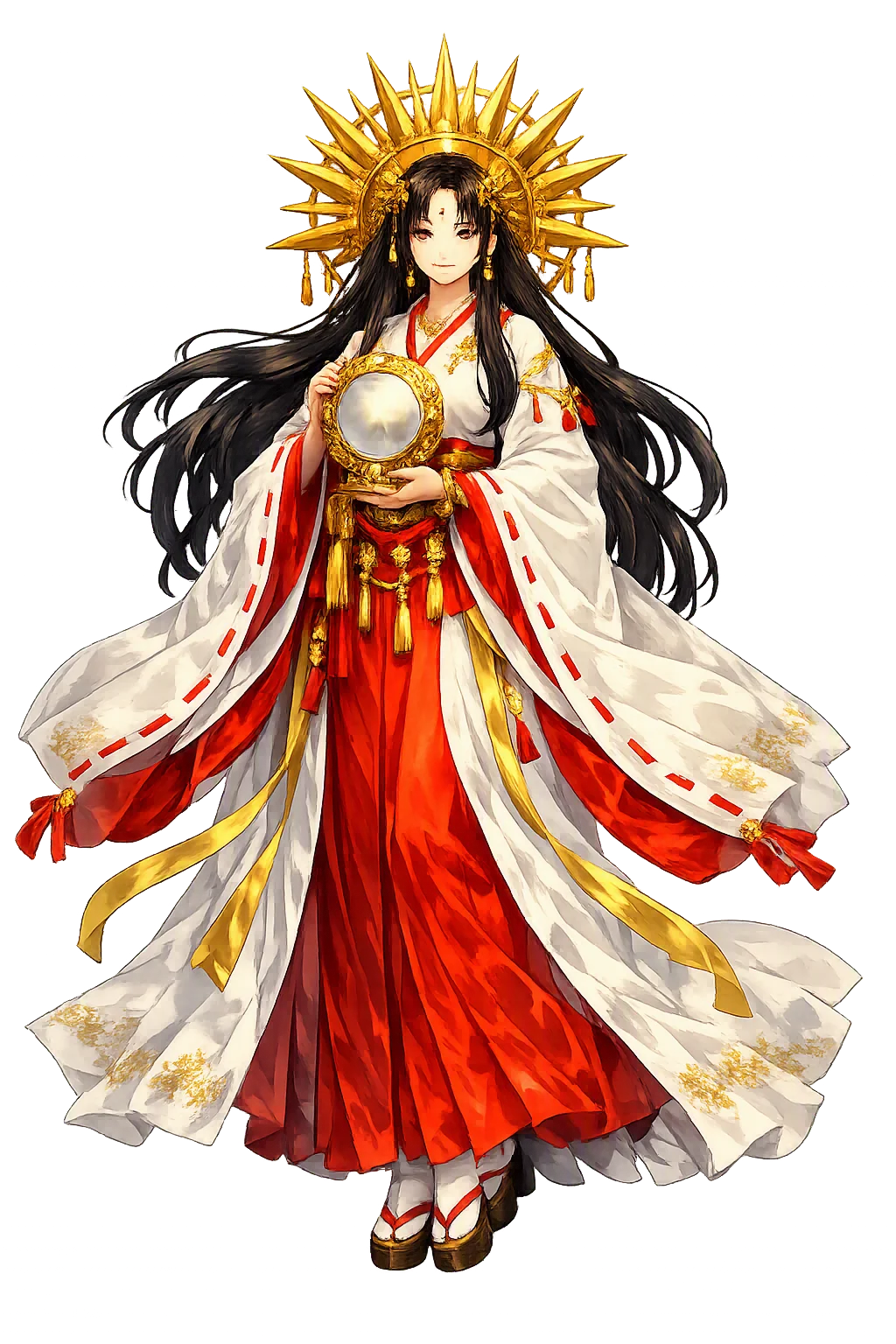
PuniCodex

Extended Lore

天照 Amaterasu

Etymology · Phonology · Orthography · Cultural Legacy · Primary Sources

Tier 2 Amaterasu
Amaterasu — Sun Goddess, Shintō
01

Quick Facts

Essential information about Amaterasu, Sun Goddess, Shintō

Original Script天照
Unicode RestorationAmaterasu
Reconstructed Pronunciation/a.ma.te.ɾa.sɯ/
PantheonJapanese
DomainSun Goddess, Shintō
MeaningSun goddess in Shinto
ClassificationTier 2
Primary DomainAmaterasu
Sacred SymbolsMirror (yata no kagami), Cave of Heaven (Ama-no-Iwato), Sun-disc, Magatama beads
02

Etymology & Word Family

From original script to Unicode restoration

Original Script 天照 Amaterasu — "Sun goddess in Shinto"
Unicode Restoration Amaterasu Restored stress, length, and script
Modern ASCII amaterasu Plain-ASCII fallback

Amaterasu is Tier 2 here: the ASCII form is identical to Hepburn romanization. Her authority is mythological and political, not phonetically distinctive.

03

Unicode Character Breakdown

Character-by-character philological analysis

CharacterUnicodeNameBlockPhonetic Role
AU+0041Latin Capital Letter ABasic LatinSame
mU+006DLatin Small Letter MBasic LatinSame
aU+0061Latin Small Letter ABasic LatinSame
tU+0074Latin Small Letter TBasic LatinSame
eU+0065Latin Small Letter EBasic LatinSame
rU+0072Latin Small Letter RBasic LatinSame
aU+0061Latin Small Letter ABasic LatinSame
sU+0073Latin Small Letter SBasic LatinSame
uU+0075Latin Small Letter UBasic LatinSame

The Tier 2 classification reflects how much of the original phonology this restoration preserves — stress and vowel length for Greek names, distinctive letters and diacritics for every other tradition.

04

Cultural Significance

From ancient cult to modern Unicode

Ancient Domain

Amaterasu is the central deity of the Japanese pantheon, the sun itself made divine and the ancestral kami of the imperial house. Her realm is Takamagahara, the High Plain of Heaven. Without her light, rice cannot grow, order collapses, and the world sinks into darkness.

Amaterasu in Later Traditions

Amaterasu absorbed and was absorbed by other solar powers. Medieval honji-suijaku theory identified her as a local manifestation of the cosmic Buddha Vairocana (Dainichi Nyorai), fusing Shinto and Buddhist cosmology. State Shinto later used her cult to unify imperial ideology, and the red circle of the Japanese flag is her descendant: a solar emblem of the rising land.

Modern Legacy

Amaterasu remains the most widely recognized kami in and beyond Japan. The Ise Grand Shrine, rebuilt every twenty years, is her principal dwelling. Imperial enthronement rites invoke her, and New Year shrine visits often turn toward the sun.

Unicode Restoration as Cultural Act

Restoring Amaterasu in a domain name is more than orthographic accuracy. It is a statement that the internet should recognize the full range of human writing — not only the ASCII keyboard.

05

Frequently Asked Questions

Common questions about Amaterasu, Sun Goddess, Shintō, and Unicode restoration

01How do you pronounce Amaterasu?

In reconstructed pronunciation, Amaterasu is /a.ma.te.ɾa.sɯ/ — approximately 'ah-mah-TEH-rah-soo' — the 'r' is a light tap, and the final 'u' is barely voiced..

02What does Amaterasu mean?

Amaterasu means Sun goddess in Shinto in the japanese tradition.

03What are the symbols of Amaterasu?

Amaterasu is associated with Mirror (yata no kagami) (One of the Three Imperial Regalia; the mirror that lured her from the cave), Cave of Heaven (Ama-no-Iwato) (The rock-door of withdrawal and return, marking cosmic crisis and renewal), Sun-disc (The radiant disk she embodies, often rendered as a red sun), Magatama beads (Curved sacred jewels associated with her and imperial legitimacy).

04Why restore Amaterasu in Unicode?

Plain ASCII amaterasu strips the stress, length, and script that make the name specific. Unicode restoration returns the name to its original written dignity.

05What is the most important myth about Amaterasu?

After escaping the underworld where his wife Izanami had died, Izanagi performed ritual purification (misogi) in a river. As he washed his left eye, Amaterasu was born; from his right eye came Tsukuyomi, the moon kami; and from his nose came Susanoo, the storm kami. Amaterasu was given rule over the high plain of heaven, making her the senior sibling and source of celestial order.

06

Scholarly Sources

The philological foundations of this restoration

Every claim on this page is grounded in established scholarship. The orthographic restorations follow disciplinary convention. The etymological chain follows the best available reference works. This is not invention — it is resurrection through scholarship.

Lexicography & Philology

  • Hepburn
  • Kojiki

Primary Texts

  • Kojiki (birth, cave myth, descent of Ninigi)
  • Nihon Shoki (alternative birth and descent accounts)
  • Philippi, Kojiki

Archaeology & Art History

  • Material evidence — iconography, inscriptions, and temple archaeology — for Amaterasu and related cults.
  • The Ise Grand Shrine (Ise Jingū) is Amaterasu's preeminent cult site, rebuilt every twenty years in the shikinen-zōtai tradition since at least the 7th century CE. The Inner Shrine (Kōtai Jingū) houses the mirror, one of the Three Imperial Regalia.

Religious Studies

  • Aston, Nihongi
Return

The Surface Awaits

You have traced the name from its earliest attestation to its Unicode restoration. Now return to the myth. The story is where the name lives.

Back to Lore
Amaterasu mascot