
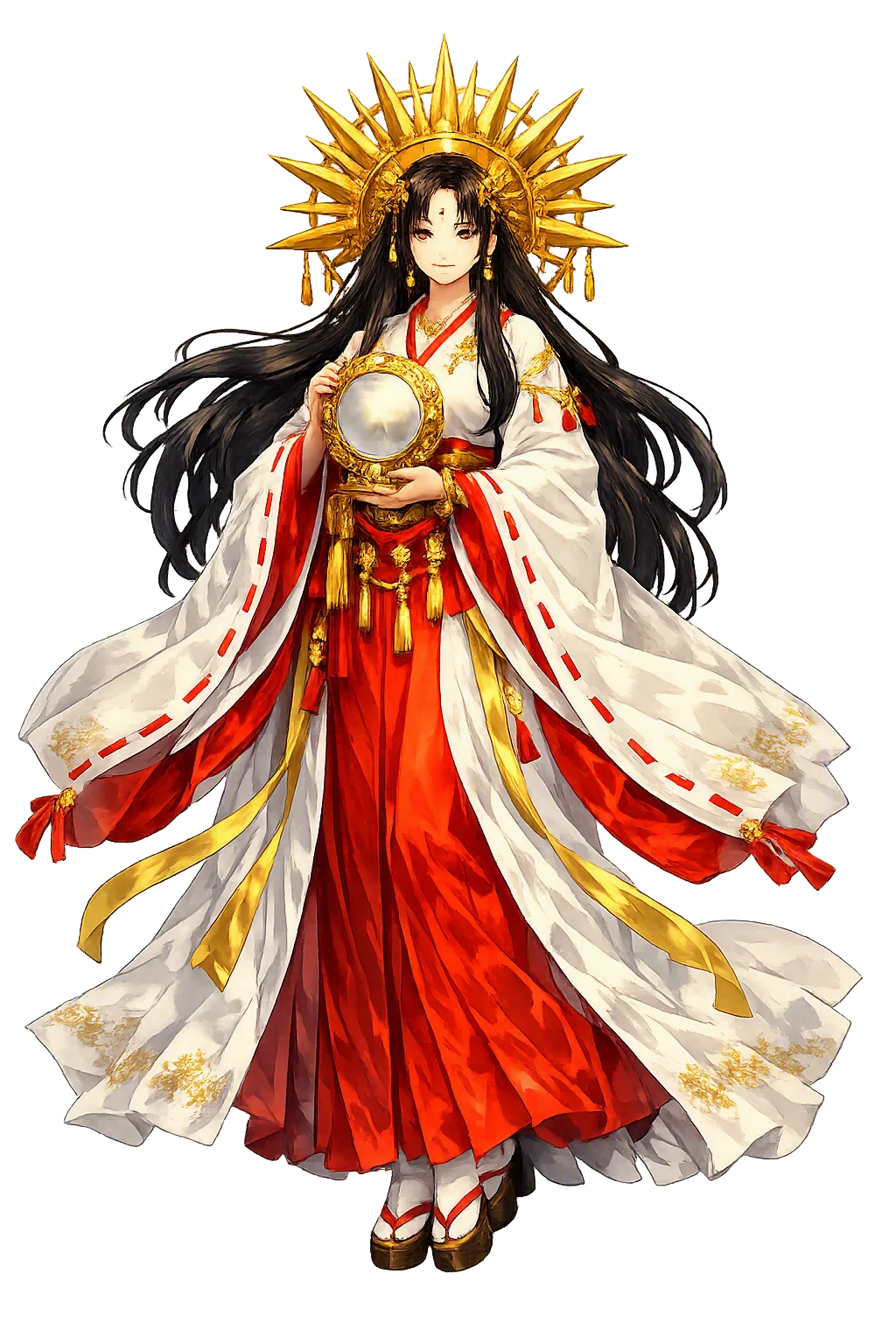
How Amaterasu found its canonical form
The ASCII form amaterasu is not missing anything that this name requires. Amaterasu is the canonical spelling supported by the Japanese characters evidence and the tradition's scholarly conventions. This post explains what that form preserves, how it is pronounced, which narratives surround it, and why consistency matters. There are no recovered accents to celebrate; there is something more useful — a spelling whose history can actually be checked.
At a Glance
- Canonical name: Amaterasu
- ASCII form: amaterasu
- Meaning: "Sun goddess in Shinto"
- Domain of influence: Sun Goddess, Shintō
- Pantheon: Japanese
- Restoration: ASCII-equivalent form
- Original script: 天照 (Japanese characters)
Overview
Amaterasu (amaterasu) — Sun Goddess, Shintō · Sun goddess in Shinto — belongs to the Japanese tradition, where it is catalogued under the domain "Sun Goddess, Shintō". The name means "Sun goddess in Shinto".
Amaterasu is the central deity of the Japanese pantheon, the sun itself made divine and the ancestral kami of the imperial house. Her realm is Takamagahara, the High Plain of Heaven. Without her light, rice cannot grow, order collapses, and the world sinks into darkness.
PuniCodex records the canonical scholarly spelling Amaterasu and serves its temple at its temple. The displayed form is ASCII-equivalent — a description computed from the displayed form itself. The plain ASCII form amaterasu contains the same letters: no recovered diacritics or special encoding is claimed. The work here is consistent citation, capitalization, provenance, and cultural context.
The Name
The name is attested in Japanese characters as 天照. Etymologically it means "Sun goddess in Shinto".
The canonical spelling Amaterasu matches the conventional scholarly romanization. The plain ASCII form amaterasu contains the same letters, so no lost diacritics or encoding transition is claimed. The editorial work is to fix one reviewed reference spelling, preserve capitalization and provenance, and keep the original evidence visible. The displayed form is ASCII-equivalent — a description computed from the displayed form itself.
The letter-by-letter transformation runs:
- a → A — Same
- m → m — Same
- a → a — Same
- t → t — Same
- e → e — Same
- r → r — Same
- a → a — Same
- s → s — Same
- u → u — Same
The Original Script
The name is written in Japanese characters as 天照. That attested script remains the primary evidence for the conventional romanization Amaterasu. The canonical Latin spelling does not pretend to recover marks it never contained: it fixes one reviewed reference form while leaving the original script visible for comparison.
The name is written 天照 — 天 'heaven' + 照 'to shine' — short for the fuller chronicle form 天照大神 (Amaterasu-ōmikami), 'Heaven-Shining Great August Deity'. The Kojiki (712) and Nihon Shoki (720) set the spelling down; both use the characters semantically, glossing a native Japanese theonym rather than transcribing a Sino-Japanese reading, and no phonetic man'yōgana spelling of the name survives. The characters preserve what the name means; the sound they were read with was that of eighth-century Yamato.
Pronunciation
The reconstructed pronunciation of the name is /a.ma.te.ɾa.sɯ/ — Modern Standard Japanese (Hepburn).
Phoneme by phoneme:
- Ama- — Open front [a], labiodental [m], open central [a]; from 天 'heaven/sky'
- -tera- — Alveolar tap [ɾ] between close-mid [e] and open central [a]; from 照 'to shine'
- -su — Voiceless alveolar fricative [s] plus close back unrounded [ɯ]; the final vowel is soft
For the modern speaker, the closest approximation is: 'ah-mah-TEH-rah-soo' — the 'r' is a light tap, and the final 'u' is barely voiced.
Kindred and historical forms of the name:
- Japanese — 天照 (Amaterasu), short for Amaterasu-ōmikami, 'Heaven-Illuminating Great August Deity' — 天 is the very character for sky
- Siblings — Tsukuyomi (moon) and Susanoo (storms), born with her in Izanagi's misogi
- Lineage — Grandmother of Ninigi; divine ancestress of the imperial line through Jimmu
Amaterasu is a plain restoration here: the ASCII form is identical to Hepburn romanization. Her authority is mythological and political, not phonetically distinctive.
Mythology
Amaterasu's mythology, told in the Kojiki and Nihon Shoki, is a theology of light, legitimacy, and the restoration of order after violence. It moves from her birth in purification to her withdrawal from a wounded heaven and her dispatch of the imperial line to earth.
From the Left Eye of Izanagi (The Birth)
When Izanami died giving birth to the fire god and Izanagi failed to bring her back from Yomi, the grieving creator purified himself in a river. As he washed his face, three sovereign deities were born: Amaterasu from his left eye, Tsukuyomi from his right eye, and Susanoo from his nose (Kojiki 1). Delighted, Izanagi removed his own necklace of magatama and gave it to her, charging her with rule of Takamagahara, the High Plain of Heaven. Her full style, Amaterasu-ōmikami — the Heaven-Illuminating Great August Deity — is written with the very character for sky. The Nihon Shoki preserves several variant birth accounts, a reminder that these texts were compiled at court rather than received as fixed scripture. The myth makes the sun the eldest child of purification: light is what emerges once pollution has been washed away.
Susanoo's Rampage in Heaven (The Outrage)
Susanoo wept so violently at the death of his mother that mountains shook and rivers swelled; when Izanagi expelled him from the land, the storm god climbed to heaven to bid his sister farewell. Wary, Amaterasu went out armed, but Susanoo protested his innocence and proposed an ukei, a test by which the siblings exchanged ornaments and produced divine children (Kojiki 1). No sooner was the pledge sealed than he reversed the ridges of her rice-fields, filled the ditches, and flayed the heavenly piebald horse, hurling its carcass through the roof of her weaving hall. The shock killed her weaving-maiden. Enraged and grieving, Amaterasu withdrew into the rock cave and sealed the door. The myth insists that the gravest danger to cosmic order is not foreign invasion but violence inside the family — the sun itself can be driven out by her own brother.
The Rock Cave of Heaven (The Withdrawal)
With Amaterasu hidden, the world went dark and the eight hundred myriad deities gathered on the bed of the tranquil heavenly river to devise a remedy. The goddess Ame-no-Uzume overturned a tub, stamped upon it, and danced so bawdily that the assembled gods roared with laughter (Kojiki 1). Curious, Amaterasu opened the rock-door a crack: why did they rejoice in darkness? Uzume answered that they had found a deity more splendid than her — and held up the yata mirror. As the sun leaned out to look, the strong-handed Ame-no-Tajikarao, concealed behind the door, seized her wrist and drew her into the light; Ame-no-Futodama stretched the first shimenawa across the cave mouth so she could never withdraw again. The myth is a charter for communal restoration: light returns not through force but through laughter, cunning, and a mirror that lets the goddess see her own radiance.
Ninigi and the Three Regalia (The Descent)
To bring order to the unruly land below, Amaterasu resolved to send her grandson Ninigi-no-mikoto to rule the earth (Nihon Shoki 2). The embassy had not been easy: her first envoy lingered in heaven, the second was charmed by the earthly god Ōkuninushi, and a third chose marriage over mission. At last she entrusted Ninigi with the Three Sacred Regalia — the curved magatama jewel, the yata mirror, and the sword Kusanagi — instructing him to revere the mirror as if it were herself. Ninigi descended to Mount Takachiho, wed Konohanasakuya-hime, and from their line sprang Jimmu, first emperor of Japan. The myth is transparently political — a charter in which the ruling house descends from the sun — yet its mechanism is veneration: heaven does not rule the earth directly; it sends a sign the earth must honor.
The Mirror Goes to Ise (The Journey)
Though born in heaven, Amaterasu did not remain in the palace. The Nihon Shoki (reign of Suinin) tells how the goddess longed for the land of Yamato, 'the land of fair rice-ears of the fertile reed-plain,' and commanded that a sanctuary be built for her there. In the Kojiki's account she had first taken up residence inside the imperial palace itself, troubling the emperor's house, until she declared her wish to leave. The emperor's daughter, the princess Yamato-hime, wandered the provinces carrying the divine mirror, divining for a dwelling-place, until she received the oracle on the banks of the Isuzu river. There rose the Ise Grand Shrine, where the mirror is enshrined to this day and the sanctuary is renewed every twenty years. The myth moves the sun out of the palace and into a perpetual sanctuary: sovereignty becomes devotion, and devotion requires a building that never ages.
Symbols & Iconography
The iconography associated with Amaterasu concentrates in a small set of recurring attributes, each a compressed statement about the name:
- Mirror (yata no kagami) — One of the Three Imperial Regalia; the mirror hung outside the cave showed Amaterasu her own light, and its dwelling at Ise is her own
- Cave of Heaven (Ama-no-Iwato) — The rock-door of her withdrawal; in ritual memory the sealed cave marks every crisis in which order must be coaxed back
- Sun-disc — The radiant disk she embodies, echoed today in the red circle of the Japanese flag
- Magatama beads — The curved jewels Izanagi gave her; her own necklace generated the gods of the ukei rite with Susanoo
- Shimenawa rope — The sacred rope Ame-no-Futodama stretched across the cave mouth — the first boundary between retreat and the common world
Archaeology & Evidence
The Ise Grand Shrine (Mie Prefecture) is Amaterasu's principal dwelling: its Inner Shrine (Kōtai Jingū), traditionally founded in the reign of Suinin (1st century BCE), is rebuilt every twenty years (shikinen-zōtai) on alternating adjacent plots, a rite documented from 690 CE and continued without break. Architectural and documentary study of the precincts — the Uji Bridge, the Shōden, the treasure halls — makes Ise the best-documented ritual complex in Japan, though the mirror itself is never displayed. Heian ritual compendia (Engishiki) and shrine records (Shintōshū) list the annual offerings of cloth and first fruits presented by the court.
Realm & Domain
Amaterasu is the central deity of the Japanese pantheon, the sun itself made divine and the ancestral kami of the imperial house. Her realm is Takamagahara, the High Plain of Heaven. Without her light, rice cannot grow, order collapses, and the world sinks into darkness.
Sun Sovereign
Ruler of Takamagahara; her light ripens the rice and orders the day.
Imperial Ancestor
Grandmother of Ninigi, whose line produced Jimmu, first emperor of Japan.
Weaver and Cultivator
She presides over the heavenly weaving hall; Susanoo's outrage there triggered the cave crisis.
Withdrawal and Return
Her seclusion in Ama-no-Iwato and the ruse of the mirror remain the pattern of every restored order.
Across Cultures
In the medieval honji-suijaku system Amaterasu was identified with the cosmic Buddha Vairocana (Dainichi Nyorai) — the sun of the Dharma itself — and Buddhist chapels and sutras stood within Ise's precincts until the Meiji separation edicts. State Shinto then stripped away these Buddhist layers, taught the descent of Ninigi as national history, and made her the theological center of imperial ideology; overseas shrines carried her cult into the empire. Her modern reception extends to the video game Ōkami, whose wolf-goddess is drawn from her iconography — evidence that the sun still needs a face.
Kindred figures in the PuniCodex cross-tradition index include Ise (shrine and enshrined sun goddess), Izanagi (father and sun goddess), Ninigi (solar grandmother and divine grandson), Rꜥ (sun / light), Susanō (storm-sun sibling rivalry), and Tajikarao (strong hand opens the cave of the sun).
Cultural Legacy
Ise Grand Shrine remains the supreme sanctuary of Shinto, its twenty-year rebuilding unbroken since the seventh century, and the Daijōsai enthronement rite of each new emperor reenacts Ninigi's descent. The red disc of the flag keeps her sign on every public building, and pilgrims stream across the Uji Bridge at New Year. In the countryside, folk religion still addresses her as the guarantor of the harvest sun. Abroad, Ōkami introduced her to millions who will never visit Ise — the newest link in an unbroken chain of sunlight made visible.
The Scholarly Record
The account of Amaterasu given in this edition rests on the witnesses and reference works listed below. Lexica and etymological dictionaries secure the form and meaning of the name; the literary and religious texts supply the narrative evidence.
- Kojiki 1 (birth, rampage, cave, Ninigi's descent).
- Nihon Shoki 1–2 (variant births, Yamato-hime and the founding of Ise).
- Philippi, Kojiki.
- Aston, Nihongi.
- Bock, Classical Learning and Taoist Practices in Early Japan.
A Meditation
Amaterasu teaches that light is not automatic. Her withdrawal shows that even the sun can be wounded into silence, and her return shows what it takes to heal her: not argument, not force, but the laughter of Uzume and the honesty of a mirror. The community of gods succeeds precisely because each plays a part — the dancer, the strong-arm, the ritualist, the mirror-bearer.
To read the myth politically is correct but incomplete: it is also a psychology of withdrawal and return. Everyone who has sealed themselves behind a rock door knows that the way back is not a plea but a celebration worth peeking at. And the mirror matters most of all: she returns not because others praise her, but because she is allowed to see her own radiance reflected.
The Canonical Spelling
Amaterasu is the canonical spelling used by this temple. The plain ASCII form amaterasu contains the same letters, so there are no lost diacritics to recover and no special encoding transition to explain. What the temple preserves is the reviewed reference form: capitalization, conventional romanization, original evidence, and a stable place to inspect them. The value here is not added decoration; it is fidelity to the attested record.
Character by Character
The canonical form Amaterasu and the plain ASCII form amaterasu share the same letters. The character list therefore documents continuity rather than recovery: every character is carried forward deliberately, with capitalization serving as the proper-noun convention. No additional mark is inserted merely to make the restoration appear more elaborate.
The Japanese Pantheon
Amaterasu is one of 45 entries the PuniCodex lexicon catalogues under the Japanese pantheon. The Pantheon page gathers the tradition's major figures in one place, and the Lexicon lets you filter all 983 restorations by tradition or script — the fastest way to see where this name sits among its kin.
Frequently Asked Questions
What does Amaterasu mean? The traditional gloss is "Sun goddess in Shinto."
Which tradition does Amaterasu belong to? Amaterasu is catalogued in the Japanese pantheon of the PuniCodex lexicon.
Does this name need recovered diacritics? No. Amaterasu is already an ASCII-form canonical spelling. The scholarly work is to preserve the attested convention and its evidence, not to add marks.
Can I use Amaterasu in a normal browser? Yes. The spelling works directly in an ordinary browser, and the type tool can confirm and copy the canonical form.
Where does the scholarly information come from? The entry is built from lexica, inscriptional evidence, and reviewed scholarly sources listed in the Scholarly Edition.
Typing Amaterasu
You do not need a special keyboard to use this name. Amaterasu already uses ordinary Latin letters. The PuniCodex Type Tool lets you confirm the canonical spelling and copy it cleanly, while the original-script notes in the temple show the evidence behind the romanization.
Sister Temples
Other temples in the Japanese pantheon include Hokkaidō, Izanami, and Kumano — each with its own restoration story, its own scholarly record, and its own place in the lexicon.
Why This Record Matters
The letters in Amaterasu were never lost, and no replacement marks are needed to make them whole. The burden is instead one of fidelity: every use should carry the same attested spelling and the history attached to it. The PuniCodex temple keeps that form in circulation — as a digital address, a dataset entry, and a scholarly argument — so consistency becomes the easy choice rather than an accident of citation.
Explore Further
This post is one doorway into the temple. The home page carries the full character breakdown and the ambient canvas; the lore page tells the myths in long form; the Scholarly Edition preserves the sources, pronunciation data, and revision history; and the patron wall supports the restoration directly. For the wider map, browse the Lexicon, explore the Pantheon, or return to the PuniCodex blog.
Related Names
Sources
The full scholarly apparatus — every citation, revision, and review — lives in the Scholarly Edition. Key references for this post:
- Kojiki 1 (birth, rampage, cave, Ninigi's descent).
- Nihon Shoki 1–2 (variant births, Yamato-hime and the founding of Ise).
- Philippi, Kojiki.
- Aston, Nihongi.
- Lexicon authorities for this entry: Hepburn, Kojiki.