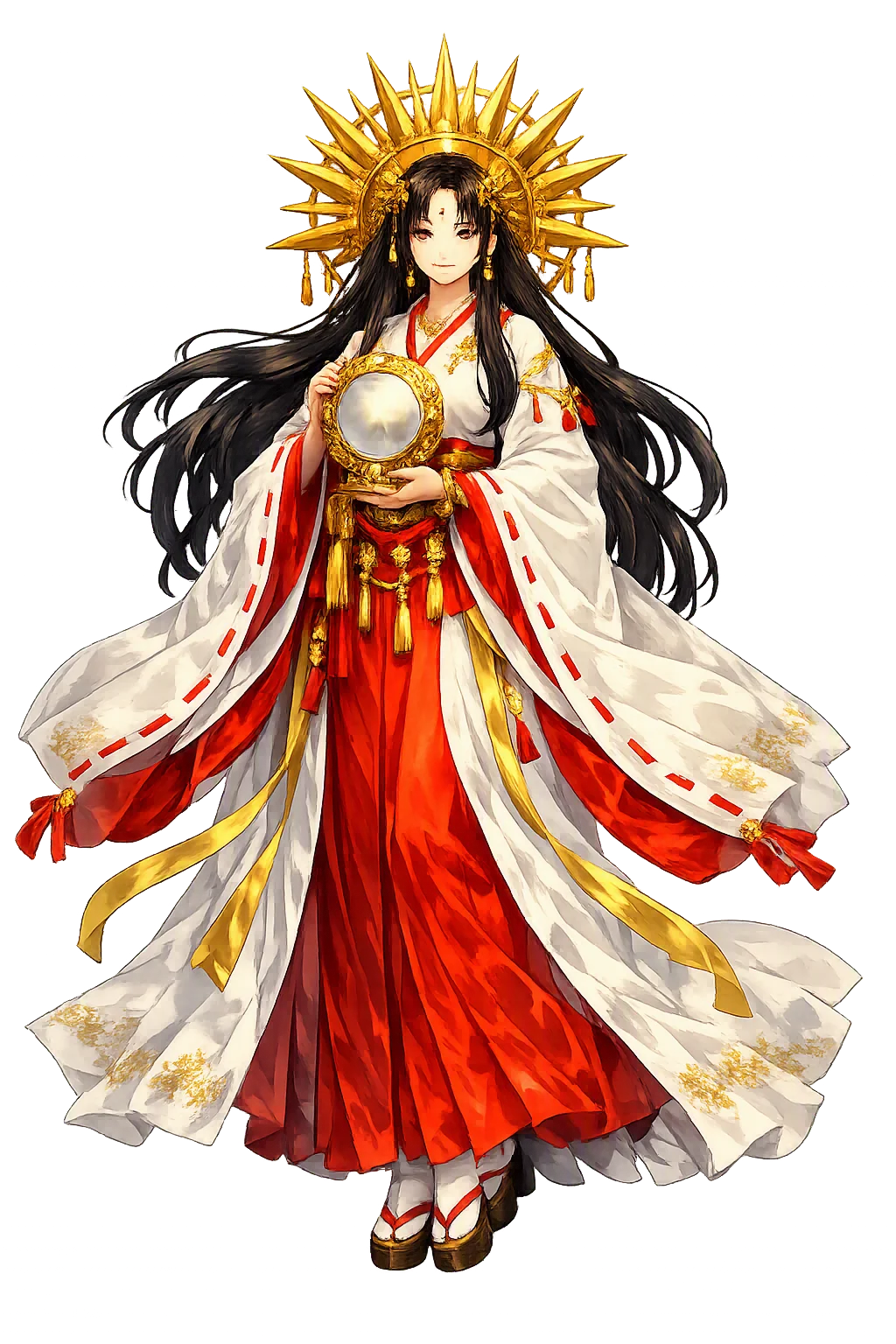
Stories of Amaterasu
Amaterasu's mythology, told in the Kojiki and Nihon Shoki, is a theology of light, legitimacy, and the restoration of order after violence. It moves from her birth in purification to her withdrawal from a wounded heaven and her dispatch of the imperial line to earth.
When Izanami died giving birth to the fire god and Izanagi failed to bring her back from Yomi, the grieving creator purified himself in a river. As he washed his face, three sovereign deities were born: Amaterasu from his left eye, Tsukuyomi from his right eye, and Susanoo from his nose (Kojiki 1). Delighted, Izanagi removed his own necklace of magatama and gave it to her, charging her with rule of Takamagahara, the High Plain of Heaven. Her full style, Amaterasu-ōmikami — the Heaven-Illuminating Great August Deity — is written with the very character for sky. The Nihon Shoki preserves several variant birth accounts, a reminder that these texts were compiled at court rather than received as fixed scripture. The myth makes the sun the eldest child of purification: light is what emerges once pollution has been washed away.
Susanoo wept so violently at the death of his mother that mountains shook and rivers swelled; when Izanagi expelled him from the land, the storm god climbed to heaven to bid his sister farewell. Wary, Amaterasu went out armed, but Susanoo protested his innocence and proposed an ukei, a test by which the siblings exchanged ornaments and produced divine children (Kojiki 1). No sooner was the pledge sealed than he reversed the ridges of her rice-fields, filled the ditches, and flayed the heavenly piebald horse, hurling its carcass through the roof of her weaving hall. The shock killed her weaving-maiden. Enraged and grieving, Amaterasu withdrew into the rock cave and sealed the door. The myth insists that the gravest danger to cosmic order is not foreign invasion but violence inside the family — the sun itself can be driven out by her own brother.
With Amaterasu hidden, the world went dark and the eight hundred myriad deities gathered on the bed of the tranquil heavenly river to devise a remedy. The goddess Ame-no-Uzume overturned a tub, stamped upon it, and danced so bawdily that the assembled gods roared with laughter (Kojiki 1). Curious, Amaterasu opened the rock-door a crack: why did they rejoice in darkness? Uzume answered that they had found a deity more splendid than her — and held up the yata mirror. As the sun leaned out to look, the strong-handed Ame-no-Tajikarao, concealed behind the door, seized her wrist and drew her into the light; Ame-no-Futodama stretched the first shimenawa across the cave mouth so she could never withdraw again. The myth is a charter for communal restoration: light returns not through force but through laughter, cunning, and a mirror that lets the goddess see her own radiance.
To bring order to the unruly land below, Amaterasu resolved to send her grandson Ninigi-no-mikoto to rule the earth (Nihon Shoki 2). The embassy had not been easy: her first envoy lingered in heaven, the second was charmed by the earthly god Ōkuninushi, and a third chose marriage over mission. At last she entrusted Ninigi with the Three Sacred Regalia — the curved magatama jewel, the yata mirror, and the sword Kusanagi — instructing him to revere the mirror as if it were herself. Ninigi descended to Mount Takachiho, wed Konohanasakuya-hime, and from their line sprang Jimmu, first emperor of Japan. The myth is transparently political — a charter in which the ruling house descends from the sun — yet its mechanism is veneration: heaven does not rule the earth directly; it sends a sign the earth must honor.
Though born in heaven, Amaterasu did not remain in the palace. The Nihon Shoki (reign of Suinin) tells how the goddess longed for the land of Yamato, 'the land of fair rice-ears of the fertile reed-plain,' and commanded that a sanctuary be built for her there. In the Kojiki's account she had first taken up residence inside the imperial palace itself, troubling the emperor's house, until she declared her wish to leave. The emperor's daughter, the princess Yamato-hime, wandered the provinces carrying the divine mirror, divining for a dwelling-place, until she received the oracle on the banks of the Isuzu river. There rose the Ise Grand Shrine, where the mirror is enshrined to this day and the sanctuary is renewed every twenty years. The myth moves the sun out of the palace and into a perpetual sanctuary: sovereignty becomes devotion, and devotion requires a building that never ages.
Light, Imperial Ancestry, and Cosmic Order
Amaterasu is the central deity of the Japanese pantheon, the sun itself made divine and the ancestral kami of the imperial house. Her realm is Takamagahara, the High Plain of Heaven. Without her light, rice cannot grow, order collapses, and the world sinks into darkness.
Ruler of Takamagahara; her light ripens the rice and orders the day.
Grandmother of Ninigi, whose line produced Jimmu, first emperor of Japan.
She presides over the heavenly weaving hall; Susanoo's outrage there triggered the cave crisis.
Her seclusion in Ama-no-Iwato and the ruse of the mirror remain the pattern of every restored order.
From the original script to the living URL
天照
The name in its original Japanese form. Amaterasu (天照) is attested in the source tradition — “Sun goddess in Shinto”. Its original diacritics and script distinctions carry the full phonetic and orthographic weight of the source tradition.
amaterasu
The plain amaterasu form is identical to the Unicode restoration. Because this name is already written in Latin letters, no diacritics, stress, or script information were lost — only capitalization differs.
Amaterasu
The Unicode restoration does not need to recover lost marks for Amaterasu. Its value is canonical spelling and consistent cataloguing, not the reconstruction of erased orthography. The domain is readable as-is to both DNS and humanity.
Amaterasu.com
This restoration is written entirely in ASCII letters — no Punycode encoding stands between Amaterasu and the DNS. The domain reads identically to machines and to human eyes.
Owned, ideal, and ASCII forms of Amaterasu
Amaterasu
Restores 天照. The full Unicode restoration. amaterasu.com is not in the PuniCodex collection — it is watched for release; if it drops, this temple upgrades to an owned flagship.
How Amaterasu was spoken
How Amaterasu is preserved in writing
A bespoke provenance study for Amaterasu is being prepared by the PUNICODEX scholarly team.
Contribute scholarly provenance →The lore you have read is the living myth. Extended Lore opens the scholarly vault beneath it: the cult and its material remains, a history of the image, the name after antiquity, a meditation on what the name still means, and the full scholarly apparatus — etymology, orthography, sources.
Enter Extended Lore