
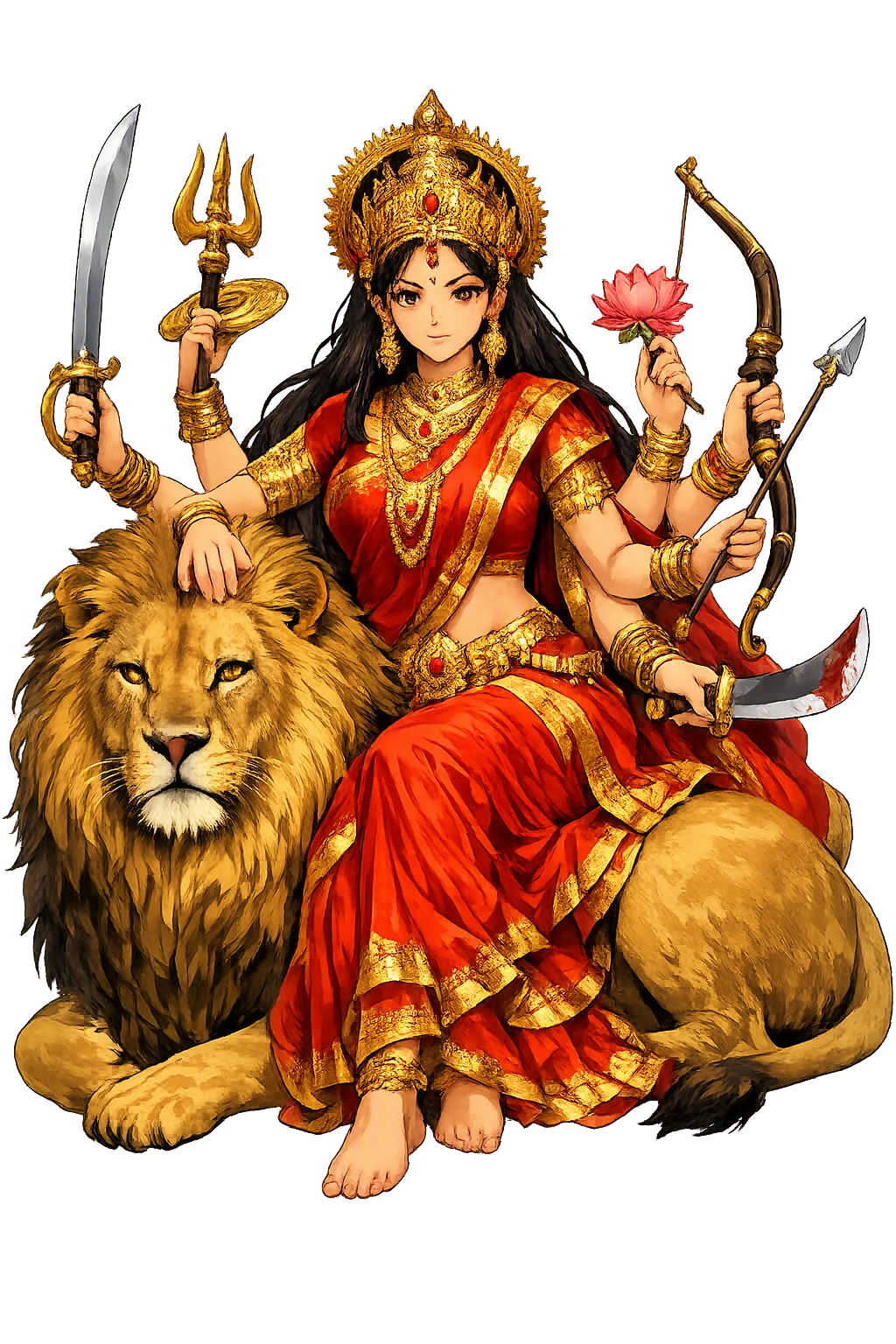
How Ambikā was rebuilt, mark by mark
The workshop file for Ambikā. Every rejected form is recorded here too — that is the point of keeping notes.
What We Found
The attestation runs through the tradition's own sources: अम्बिका. Meaning: "Mother; epithet of Pārvatī/Durgā, the multi-armed goddess with lion".
The figure behind the name: Ambikā's mythology is not separate from that of Pārvatī and Durgā; it is one mask of the Great Goddess, the one who becomes a mother to the cosmos and a warrior to its enemies.
What the Name Carried In
Ambikā as Pārvatī. In the Śiva Purāṇa, when Śiva addresses Pārvatī in her aspect of the devoted consort and cosmic mother, he calls her Ambikā — 'little mother', the diminutive of ambā, 'mother'. The grammar is the theology: the awe-inspiring goddess of the mountains, daughter of Himavat and Menā, is also everyone's mother, and the scriptures keep both truths in a single name.
Born of the Gods' Radiance. When the buffalo-demon Mahiṣāsura usurped the throne of heaven, the gods' defeat was so complete that only their own radiance remained to fight with. The Devī Māhātmya (chapters 2–3) describes how a tejas — a blaze of combined energy — streamed from the bodies of Brahmā, Śiva, Viṣṇu, Indra, and the rest, and from that blaze a woman stepped forth, bearing the face of each god who had given himself to her.
A spelling that has to carry stories like these is not a label. It is equipment.
Where It Stood Before Us
The finest material witness is the Ambikā Mātā temple at Jagat, ten kilometres north of Udaipur (10th–11th century, Mewar): a pillared hall whose sculptured walls swarm with Devīs, apsarases, and narrative friezes, among the best-preserved medieval goddess temples in Rajasthan. Jain evidence is equally rich: the Solanki-era marble temples of Kumbhāria (Gujarat, 11th–12th centuries) house celebrated images of Ambikā as Neminātha's yakṣiṇī, and Ambikā appears across Śvetāmbara temple sculpture with her children and lion. Bronze and stone images of the lion-riding, multi-armed goddess from sites across western India carry the Ambikā-Durgā type from the Gupta centuries onward — the armed mother as one of the subcontinent's oldest and most continuous iconographies. The bench inherits all of it — the web temple is the newest site, not the first.
What We Kept
The evidence, mark by mark — 1 feature the keyboard form ambika cannot hold:
- a → ā — Long ā (macron). Kept.
What We Rejected
The plain ASCII ambika — admissible as a fallback, never as the primary. A wrong accent would have been worse: the rulebook is explicit that a misplaced mark is worse than none.
What We Set Down
Ambikā — The restoration preserves more than the ASCII form can express — stress, length, or a letter the Latin keyboard lost — which places it, mechanically, in Tier-1.
For the voice: 'um-bee-KAH' — the final syllable is long and carries the weight of the name.
The temple stands at /ambika/ — the notes above are public in its Scholarly Edition, sources and all.
At a Glance
- Restored name: Ambikā
- ASCII form: ambika
- Meaning: "Mother; epithet of Pārvatī/Durgā, the multi-armed goddess with lion"
- Domain of influence: Divine Mother, Power, Protection
- Pantheon: Sanskrit
- Classification: Tier 1
- Original script: अम्बिका
- Series: The Restoration Files, No. 22 of 548
The File Continues
The temple's founding dispatch tells the name's story; its Resonance File reads the myths into the industries; the blog index holds the whole archive.
Continue the series — previous file: Amaterasu (read it here) · next file: Amərətāt (read it here).
The Restoration Files are written from the same canonical record as the temples themselves: the lexicon, the lore catalog, the pattern atlas, and the cited scholarly sources. If a file ever disagrees with its temple, the temple is right — tell us, and the file will be corrected.