
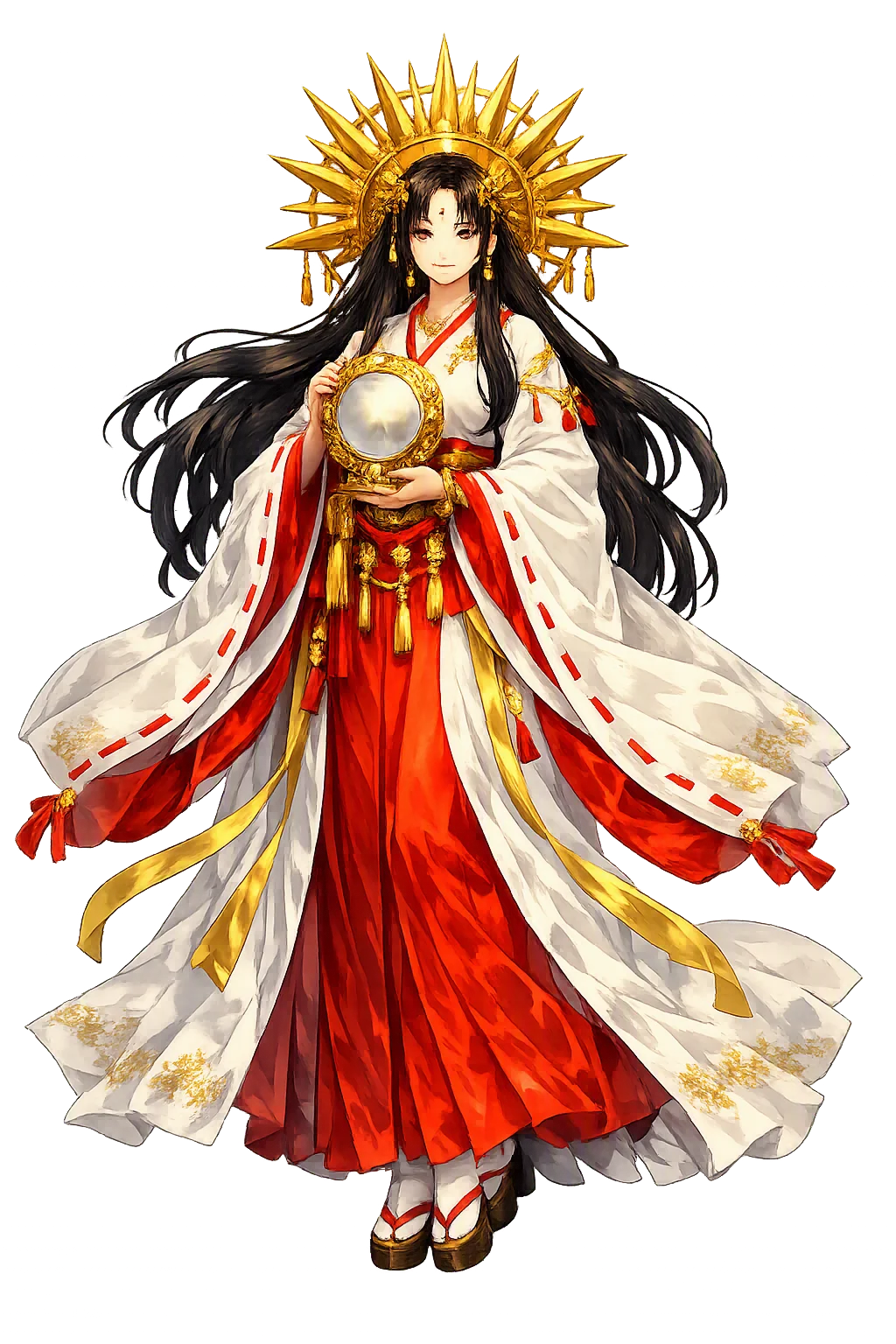
How Amaterasu got its accent back
The ASCII form amaterasu is missing something. Amaterasu restores the marks the source language used to distinguish this name from a thousand others — and those marks change how the name is read, pronounced, and understood. This post explains, with the full scholarly record behind it, what each restored mark preserves: the Japanese characters evidence, the reconstructed sound, the myths the name carries, and the classification logic that separates Tier 1 restorations from Tier 2. By the end, the marks in Amaterasu will look less like ornaments and more like what they are — recovered evidence, pinned back in its proper place.
At a Glance
- Restored name: Amaterasu
- ASCII form: amaterasu
- Meaning: "Sun goddess in Shinto"
- Domain of influence: Sun Goddess, Shintō
- Pantheon: Japanese
- Classification: Tier 2
- Original script: 天照 (Japanese characters)
Overview
Amaterasu (amaterasu) — Sun Goddess, Shintō — belongs to the Japanese tradition. The name means "Sun goddess in Shinto".
Amaterasu is the sun itself made kami — the great august kami who illuminates heaven and the ancestor of the imperial house. Her withdrawal into the Heavenly Rock Cave and her restoration by dance and persuasion form the central crisis of Shinto cosmology.
PuniCodex restores the name as Amaterasu. The plain ASCII form amaterasu is the modern Hepburn romanization; the restoration capitalizes the conventional spelling. Because the Japanese source script uses logographic characters whose distinctive visual form cannot be conveyed in the basic Latin alphabet, and because no diacritic or special letter is added in this restoration, the name is placed in Tier 2. The Unicode form remains the philologically complete reference, while the ASCII spelling is a practical convenience for the domain-name system.
The Name
The name is attested in Japanese characters as 天照. Etymologically it means "Sun goddess in Shinto".
The name is usually analyzed as ama-terasu, "shining in heaven," from ama (heaven) and terasu (to shine, to illuminate). The fuller cult name is Amaterasu-ōmikami, "the great august kami who illuminates heaven." She is the ancestral kami (sojin) of the imperial house and the central deity of the Shinto pantheon.
The ASCII form amaterasu survives only because the early domain-name system could not carry Japanese characters or diacritics; it is a technological compromise, not an ancient spelling. The Unicode restoration Amaterasu gives the conventional Hepburn romanization with initial capitalization, the standard scholarly way to cite a proper name in romanized Japanese. The name is Tier 2 because the restoration does not add a distinctive diacritic or special letter absent from the ASCII form.
The letter-by-letter transformation runs:
- a → A — Same
- m → m — Same
- a → a — Same
- t → t — Same
- e → e — Same
- r → r — Same
- a → a — Same
- s → s — Same
- u → u — Same
The Original Script
The name is written in Japanese characters as 天照 — Japanese logographic and syllabic script (kanji plus kana where attested), attested in the classical Japanese sources. The script is written top-to-bottom in traditional contexts and left-to-right in modern reproductions.
The scholarly transliteration is Amaterasu (Hepburn romanization with initial capitalization), giving the normalized reading //a.ma.te.ɾa.sɯ//.
The two characters 天 (ama, heaven) and 照 (terasu, to illuminate) compose a classic Japanese ateji or semantic transcription of the divine name. The form 天照大神 (Amaterasu-ōmikami) is the full cult title used in ritual and imperial sources.
Pronunciation
The conventional reading of the name is /a.ma.te.ɾa.sɯ/ — Modern Japanese (Standard Japanese).
For the modern speaker, the closest approximation is: 'AMATERASU' — pronounce each vowel clearly and avoid English diphthongs. Japanese is mora-timed, so each syllable receives roughly equal weight.
Amaterasu is Tier 2 because the ASCII form amaterasu already represents the same phonemic sequence; no stress mark, length mark, or distinctive letter is required to recover the spoken name.
Mythology
The central myth of Amaterasu is the episode of the Heavenly Rock Cave. After Susanō rampaged through her rice fields and desecrated her weaving hall, Amaterasu withdrew into a cave and sealed it with a boulder, plunging the world into darkness. The eight hundred myriad kami gathered outside; the goddess Ame-no-Uzume performed an ecstatic dance on an overturned tub, exposing herself and making the assembled gods laugh. Curious, Amaterasu peeked out; Tajikarao seized her hand and pulled her into the light. A rope (shimenawa) was stretched before the cave to prevent her return. The myth establishes kagura (sacred dance), divination, and communal ritual as the means by which cosmic order is restored.
Birth from Izanagi's Purification (Kojiki / Nihon Shoki)
After escaping the underworld where his wife Izanami had died, Izanagi performed ritual purification (misogi) in a river. As he washed his left eye, Amaterasu was born; from his right eye came Tsukuyomi, the moon kami; and from his nose came Susanoo, the storm kami. Amaterasu was given rule over the high plain of heaven, making her the senior sibling and source of celestial order.
The Cave of Heaven (Kojiki)
When Susanoo rampaged through heaven, destroying her rice-fields and terrifying her weaving-maiden, Amaterasu withdrew into the Ama-no-Iwato cave and sealed it with a great rock. The world fell into darkness. The eight hundred myriads of kami gathered and performed a raucous dance (kagura). The goddess Ame-no-Uzume danced on an overturned tub, exposing herself and making the assembly laugh. Curious, Amaterasu peeked out; a mirror was held before her, and the strong-handed Tajikarao pulled her into the light.
The Descent of Ninigi (Nihon Shoki)
Amaterasu sent her grandson Ninigi-no-mikoto to rule the terrestrial world, entrusting him with the Three Sacred Regalia: the curved jewel, the mirror, and the sword. Ninigi's great-grandson Jimmu became the first emperor of Japan, establishing the imperial house as descended from the sun.
Symbols & Iconography
- Mirror (Yata no Kagami) — one of the three imperial regalia, said to have been used to lure her from the cave; it embodies the sun and the emperor's divine reflection.
- Magatama curved jewel — another imperial regalia, associated with her mythic pact.
- Sword (Kusanagi) — recovered from the tail of Yamata no Orochi by Susanō and presented to her, later passed to Ninigi.
- Cock — the crowing bird that announces dawn and marks the successful lure from the cave.
- Sakaki tree — the evergreen (Cleyera japonica) to which the shide streamers were fastened during the kagura dance.
- Cave of Heaven (Ama-no-Iwato) — The rock-door of withdrawal and return, marking cosmic crisis and renewal
- Sun-disc — The radiant disk she embodies, often rendered as a red sun
- Magatama beads — Curved sacred jewels associated with her and imperial legitimacy
Archaeology & Evidence
The Ise Grand Shrine (Ise Jingū) in Mie Prefecture is the principal material cult site of Amaterasu. Rebuilt on adjacent plots every twenty years since at least the seventh century CE, the shrine preserves the shinmei-zukuri architectural style, thought to reproduce ancient raised-granary forms. The Shikinen Sengū cycle of 2013 was the sixty-second recorded rebuilding. Archaeological work in the Ise region has clarified the pre-shrine landscape and the historical development of the saikū, the imperial princesses' residence that administered the shrine.
Realm & Domain
Amaterasu is the sun itself made kami. Her realm is Takamagahara, the High Plain of Heaven, from which she bestows light and fertility upon the world. As ancestor of the imperial line, she also guarantees political legitimacy: the emperor rules as her direct descendant. Her withdrawal into the Heavenly Rock Cave (Ama-no-Iwato) is the primal Shinto myth of cosmic crisis and restoration.
Sun Sovereign
Ruler of Takamagahara and source of light, warmth, and agricultural fertility.
Imperial Ancestor
Great-grandmother of Ninigi, who descended to earth with the regalia of rule.
Weaver and Cultivator
In the Kojiki she weaves divine garments in the heavenly weaving hall.
Withdrawal and Return
Her retreat into the Ama-no-Iwato cave is the primal Japanese myth of restored order.
Across Cultures
Amaterasu was historically identified with Buddhist solar deities, most notably Dainichi Nyorai (Mahāvairocana), in the shinbutsu-shūgō system of medieval Japan. At Ise, however, the outer shrine (Gekū) dedicated to Toyouke and the inner shrine (Naikū) dedicated to Amaterasu maintained a Shinto-centred cult that resisted complete Buddhist assimilation. The Meiji separation of kami and buddhas (shinbutsu bunri) restored her purely Shinto identity. In the modern period she remains the symbol of the Japanese state in imperial ritual and the national emblem of the rising sun.
Cultural Legacy
Amaterasu is the namesake of Japan itself — Nihon or Nippon, "origin of the sun." The Ise Grand Shrine, rebuilt every twenty years in the shikinen-zōtai ceremony, is her principal cult centre and one of the most important religious sites in Japan. The imperial regalia (sanshu no jingi) descended from her form the legitimating treasures of the Chrysanthemum Throne. She appears constantly in anime, manga, video games, and contemporary fiction as the archetype of the benevolent solar deity.
The Scholarly Record
The account of Amaterasu given in this edition rests on the witnesses and reference works listed below. The primary chronicles secure the form and meaning of the name; the secondary studies supply historical, archaeological, and ritual context.
- Kojiki (Records of Ancient Matters), 712. Full text
- Nihon Shoki (Chronicles of Japan), 720. Full text
- Shinto: The Kami Way, Ono Sokyo, 1962.
- Breen, John, and Mark Teeuwen, A New History of Shinto (Wiley-Blackwell, 2010).
A Meditation
Amaterasu embodies sun goddess, shintō in the Japanese imagination. The name's restoration is not merely cosmetic: it preserves the capitalized scholarly romanization by which the figure is cited in academic and ritual contexts. The ASCII form flattens the visual identity of the original characters into plain letters, but the spoken name and the mythic role remain intact.
The Unicode Restoration
Amaterasu is classified as Tier 2: the restoration needs no distinctive letters or diacritics its ASCII form would lose. The ASCII fallback amaterasu still resolves everywhere, but it is the restored form that carries the name's full information. That is the whole thesis of this temple: the marks are the message.
Character by Character
The journey from amaterasu to Amaterasu, one character at a time:
- a → A — Same
- m → m — Same
- a → a — Same
- t → t — Same
- e → e — Same
- r → r — Same
- a → a — Same
- s → s — Same
- u → u — Same
The Japanese Pantheon
Amaterasu is one of 45 entries the PuniCodex lexicon catalogues under the Japanese pantheon. The Pantheon page gathers the tradition's major figures in one place, and the Lexicon lets you filter all 981 restorations by tradition, tier, or script — the fastest way to see where this name sits among its kin.
Frequently Asked Questions
What does Amaterasu mean? The traditional gloss is "Sun goddess in Shinto."
Which tradition does Amaterasu belong to? Amaterasu is catalogued in the Japanese pantheon of the PuniCodex lexicon.
Why is Amaterasu classified as Tier 2? Because the restoration needs no distinctive letters or diacritics its ASCII form would lose — and the marks in the restored spelling preserve exactly that evidence.
Can I use Amaterasu in a normal browser? Yes. The DNS resolves the punycode form automatically, and the type tool on this site converts amaterasu to Amaterasu for copying and pasting.
Where does the scholarly information come from? The entry is built from lexica, inscriptional evidence, and reviewed scholarly sources listed in the Scholarly Edition. Every claim is traceable to a canonical source.
Typing Amaterasu
You do not need a special keyboard to use this restoration. The PuniCodex Type Tool converts the ASCII form amaterasu into Amaterasu as you type, and the browser extension offers the same conversion inside any text field. Copy the restored form, paste it into the address bar, and the DNS does the rest.
Sister Temples
Other temples in the Japanese pantheon include Honshū, Jizō, and Kyōto — each with its own restoration story, its own scholarly record, and its own place in the lexicon.
Why This Restoration Matters
The marks in Amaterasu were never lost; they were only waiting for a carrier that could hold them. Now that the carrier exists, the burden flips: every use of amaterasu is a choice to leave evidence on the table. The PuniCodex temple keeps the restored form in circulation — as a domain, a dataset entry, and a scholarly argument — so that the choice to use it stays easy. Accent by accent, macron by macron, that is how the original names come back: not with a single grand gesture, but with a spelling that finally works everywhere.
Explore Further
This post is one doorway into the temple. The home page carries the full character breakdown and the ambient canvas; the lore page tells the myths in long form; the Scholarly Edition preserves the sources, pronunciation data, and revision history; and the patron wall supports the restoration directly. For the wider map, browse the Lexicon, explore the Pantheon, or return to the PuniCodex blog.
Amaterasu in Its Tradition
Amaterasu does not stand alone. It belongs to the Japanese tradition, where it is counted among 45 names in the PuniCodex lexicon. Its sphere — Sun Goddess, Shintō — places it beside other figures who govern similar aspects of experience. The restored spelling is therefore not only a philological decision; it is a way of keeping the name in the company of its kin. When the address bar shows Amaterasu, it marks the boundary between a generic search term and a named entry in a living catalog of myth. That catalog is the point of the project. Every restored name is a vote for specificity: the web should know the difference between a figure and a keyword, between a tradition and a trend. Amaterasu is one such vote.
What You Will Find in the Temple
The temple page for Amaterasu is more than a landing page. The home tab presents the character breakdown, the pronunciation guide, and the live domain status in a single view. The lore tab gathers the myths and narratives that give the name its depth. The Scholarly Edition tab publishes the sources, variant forms, and review history that justify the restoration. Industry patterns show where the name appears in modern commerce and culture, while the gallery and creatives tabs collect visual and sponsor material. The patron wall lets visitors support the restoration directly. Each tab is generated from the same canonical sources, so the domain, the blog, the scholars page, and the search index all agree. The result is a single source of truth about a name, delivered through several doors.
The Restoration on the Live Web
A domain name is a kind of publication. When Amaterasu resolves, it proves that the restored spelling is not a theoretical exercise; it is a working address on the public internet. Search engines can index it, language models can encounter it, and anyone who copies it from a manuscript can paste it into a browser. That practical reality changes the status of the restoration. Before Unicode domains, a scholar could write the name correctly in an article while the public web flattened it to amaterasu. Now the public web can carry the correct form end to end. The punycode translation happens silently, so the infrastructure remains compatible while the visible name keeps its marks. That compromise — human-readable restoration, machine-readable encoding — is the foundation of every PuniCodex temple.
Related Names
Sources
The full scholarly apparatus — every citation, revision, and review — lives in the Scholarly Edition. Key references for this post:
- Kojiki (Records of Ancient Matters), 712.
- Nihon Shoki (Chronicles of Japan), 720.
- Hepburn, James Curtis, A Japanese-English and English-Japanese Dictionary, 1867.
- Shinto: The Kami Way, Ono Sokyo, 1962.
- Breen, John, and Mark Teeuwen, A New History of Shinto (Wiley-Blackwell, 2010).
- Lexicon authorities for this entry: Hepburn, Kojiki.