
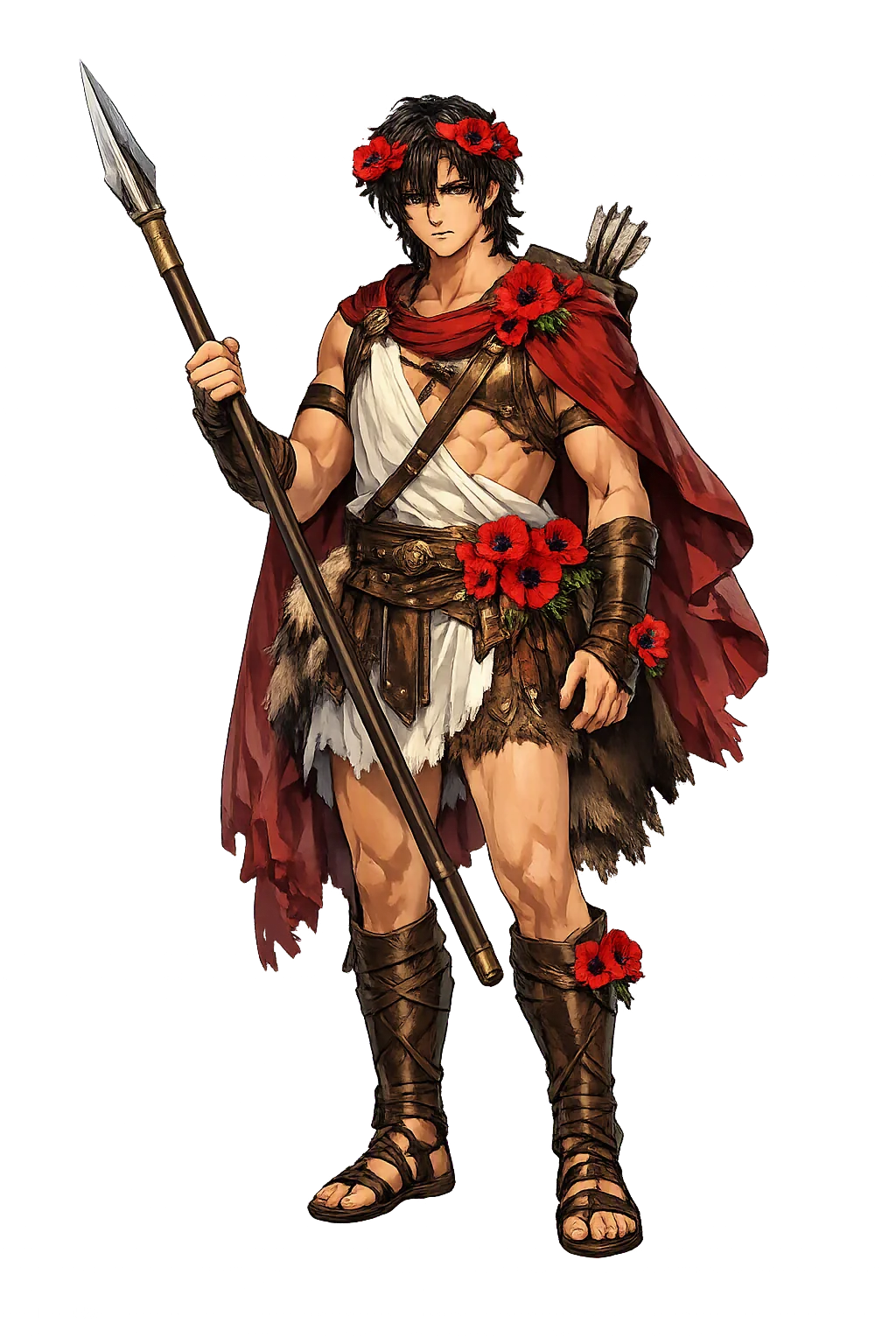
The hidden history behind Ádōnis
Behind the modern ASCII form adonis hides a much longer story. Ádōnis reaches back through manuscripts, inscriptions, and oral tradition long before it ever touched a keyboard, and every mark in the restored spelling is a receipt from that journey. In what follows we trace the name from its Greek attestations through its mythology, its cult, its symbols, and its afterlife in other cultures — and we show how the PuniCodex project turned that philological record into a Unicode domain that resolves today. The history was never lost. It was only waiting for the infrastructure to catch up.
At a Glance
- Restored name: Ádōnis
- ASCII form: adonis
- Meaning: "Lord (from Semitic ʾādōn)"
- Domain of influence: Beauty, Desire, Renewal
- Pantheon: Greek
- Classification: Tier 1
- Original script: Ἄδωνις (Greek)
- Live domain: ádōnis.com
Overview
Ádōnis (adonis) — Beautiful hunter youth · Lord from Semitic ʾādōn · anemones — belongs to the Greek tradition, where it is catalogued under the domain "Beauty, Desire, Renewal". The name means "Lord (from Semitic ʾādōn)".
Ádōnis is the beautiful youth whom love and death divide. Born from the grief of Myrrha and the myrrh tree, desired by Aphrodítē and Persephonē alike, he embodies the fragile glory of spring: flowers that bloom brilliantly and die young. His cult spread across the Greek East as a women's rite of lament and rebirth.
PuniCodex restores the name as Ádōnis and serves its temple at ádōnis.com. The original carries both stress and vowel length, and exactly one historically valid Unicode restoration exists, which places the name in Tier 1. The plain ASCII form adonis survives as a modern convenience imposed by the early domain-name system; the restoration, not the fallback, is the form the project defends as philologically complete.
The Name
The name is attested in Greek as Ἄδωνις. Etymologically it means "Lord (from Semitic ʾādōn)".
The ASCII form adonis survives only because the early domain-name system could not carry diacritics; it is a technological compromise, not an ancient spelling. The Unicode restoration Ádōnis recovers both the stress accent and the vowel length of the original directly in the address bar. The original carries both stress and vowel length, and exactly one historically valid Unicode restoration exists, which places the name in Tier 1.
The letter-by-letter transformation runs:
- a → Á — Alpha
- d → d — Delta
- o → ō — Omega: long omicron
- n → n — Nu
- i → i — Iota
- s → s — Sigma
The project holds the domain ádōnis.com (xn--dnis-4na36d.com) as the canonical home of this name.
The Original Script
The name is written in Greek as Ἄδωνις. This original script is the form against which the ASCII fallback adonis and the PuniCodex restoration Ádōnis are measured: the restoration preserves both its pitch accent and its vowel quantity of the written form, so that a reader typing the modern address still speaks the ancient name.
The name is attested in Greek as Ἄδωνις. The initial alpha carries an acute, and the omega is long. PUNICODEX restores these features as Ádōnis; the Semitic original ʾādōn is not registrable in the .com IDN table and is preserved here as scholarly annotation.
Pronunciation
The reconstructed pronunciation of the name is /ˈa.doː.nis/ — Attic Greek Reconstruction.
Phoneme by phoneme:
- Á- — Initial alpha with acute: a high-pitched, open [a].
- -dō- — Delta followed by long omega [oː], the stressed length of the name.
- -nis — Nu-iota-sigma, a gentle closing.
For the modern speaker, the closest approximation is: 'AH-doh-nis' — pitch falls on the first syllable, and the middle vowel is long.
Kindred and historical forms of the name:
- Semitic — ʾādōn, 'lord', the likely origin of the Greek name
- Akkadian — adannu, 'power, time, festival'
The Greek form Ἄδωνις reproduces the Semitic title ʾādōn ('lord') with Greek inflection. The restoration Ádōnis preserves both the acute stress and the long omega.
Mythology
Ádōnis's myth turns on beauty that cannot be kept. He is desired, born, killed, and divided — a story the Greeks borrowed from the Near East and made their own.
Born from Myrrh (Origin)
Myrrha, daughter of King Kinyras, conceived an incestuous passion for her father. When she was transformed into a myrrh tree as punishment, the tree split open after ten months and Ádōnis was born. Aphrodítē, pierced by Eros's arrow, hid the infant in a chest and gave him to Persephonē to raise.
Divided Between Queens (Judgment)
When Persephonē opened the chest and saw Ádōnis, she refused to return him. Zeus decreed that he would spend a third of the year with Aphrodítē, a third with Persephonē, and a third where he chose — he chose Aphrodítē, for love of beauty and the living world.
The Boar (Death)
Despite Aphrodítē's warnings, Ádōnis hunted a boar. The beast gored him in the thigh. From his blood the anemone rose, and Aphrodítē's grief became the template for the women's Adṓnia festival.
The Adṓnia (Cult)
Across the Greek world women planted 'Gardens of Adonis' — lettuces and herbs in shallow trays that sprouted quickly and withered. They carried images of the dead god to the sea, lamenting and celebrating the cycle of growth and loss.
Symbols & Iconography
The iconography associated with Ádōnis concentrates in a small set of recurring attributes, each a compressed statement about the name:
- Anemone — The flower that sprang from Ádōnis's blood, red and short-lived
- Myrrh tree — His mother Myrrha's metamorphosis; the tree from whose bark he was born
- Boar — The animal that killed him in the hunt
- Hunter's gear — Spear and nets; the masculine pursuit that leads to his death
Vase painting, sculpture, and votive reliefs disseminate the visual identity of Ádōnis. Artists returned to attributes such as Anemone, Myrrh tree, Boar, creating a recognizable iconographic shorthand.
The restored spelling Ádōnis reproduces in text the same precision that painters sought in image. Each attribute encodes a claim about power, identity, or function.
Epithets & Cult Titles
Greek gods and heroes accumulate epithets — cultic titles that specify place, function, or quality. For Ádōnis, the tradition preserves epithets that stress beauty.
Epicleses connected with Anemone, Myrrh tree, Boar sharpen the name for local worship and literary invocation. The restored form Ádōnis carries the same vowel quantities that these epithets inherited in oral performance.
The Homeric Hymns
The Homeric Hymns, a collection of ancient Greek hexameter poems, include invocations and narratives that shape the reception of Ádōnis. While Ádōnis does not always receive a separate, surviving hymn, the figure appears in the broader epic and hymnic environment that celebrates the Olympian order.
The hymns map divine genealogy, power, and cultic honor, and Ádōnis's role as beauty places the name within that hexameter world. The PuniCodex restoration Ádōnis preserves the prosodic features that rhapsodes would have articulated.
Oracle Sites & Sanctuaries
Sanctuaries and oracular centers anchored the cult of Ádōnis in the Greek landscape. Major sites include locations where the domain of beauty was ritually honored.
Pilgrims, offerings, and festival calendars tied the name to specific topography. The restoration Ádōnis gives the figure a stable address in the digital landscape analogous to those ancient centers.
Archaeology & Evidence
No monument, inscription, or artifact in the current PuniCodex corpus is yet assigned to Ádōnis with certainty. That absence should be read honestly: for a Greek name of this type the material record is expected to be thin, and the primary evidence remains the textual testimony gathered in the Scholarly Sources section.
Were such evidence to surface, it would take recognizable forms: votive or dedicatory inscriptions naming Ἄδωνις, sanctuary or cult remains tied to beauty and iconography matching its traditional attributes (anemone and myrrh tree). Each candidate would be weighed against the reconstructed form of the name before entering the scholarly record.
Realm & Domain
Ádōnis is the beautiful youth whom love and death divide. Born from the grief of Myrrha and the myrrh tree, desired by Aphrodítē and Persephonē alike, he embodies the fragile glory of spring: flowers that bloom brilliantly and die young. His cult spread across the Greek East as a women's rite of lament and rebirth.
Beauty and Desire
A youth of such beauty that the goddess of love herself cannot leave him.
Vegetation and Renewal
The anemone and the myrrh tree mark his blood and birth; his death is the death of the green year.
Women's Lament
The Adṓnia was a rite of mourning women, planting gardens that withered to enact grief.
Hunter Hunted
A boar, the animal of Aphrodítē's anger or of his own hubris, tears him open.
Across Cultures
Ádōnis is transparently the Greek adaptation of the Semitic Tammuz (Sumerian Dumuzi), the dying-and-rising vegetation god mourned by women in Mesopotamia and the Levant. The name itself comes from the Canaanite/Phoenician ʾādōn, 'lord'. In Roman poetry he becomes a byword for youthful male beauty — Venus and Adonis is a staple of Ovid and later painters. The figure also overlaps with Near Eastern dying-god typologies studied by Frazer, though modern scholars resist collapsing every vegetation deity into a single pattern.
Within the Greek tradition, closely related names in the corpus include Achérōn, Achilleús, Adámas, Aḗr, Aígyptos, and Aithḗr.
Cultural Legacy
Ádōnis survives in the anemone, in the phrase 'Adonis' applied to handsome young men, and in the long Western tradition of Venus and Adonis from Ovid to Shakespeare to Titian. His cult is one of the clearest cases of religious borrowing across the Aegean and Levant, and the Adṓnia gives rare evidence for women's religious practice in classical Greece. In modern wellness and beauty branding, his name still signals youth, desire, and the fleeting bloom of physical perfection.
The Scholarly Record
The account of Ádōnis given in this edition rests on the witnesses and reference works listed below. Lexica and etymological dictionaries secure the form and meaning of the name; the literary and religious texts supply the narrative evidence.
- Apollodorus, Bibliotheca.
- Ovid, Metamorphoses.
- Liddell-Scott-Jones Greek-English Lexicon, 9th ed. with 1996 supplement, 1940. Full text
- Burkert, Greek Religion.
A Meditation
Ádōnis is the god of what cannot last. Every spring his myth asks: why do the most beautiful things die first? The answer is not theological; it is seasonal. He is the flower, the harvest, the young lover, the grief that returns every year. To worship Ádōnis is to consent to love something you will lose.
Yet the loss is not final. The anemone returns. The women plant new gardens. The rite enacts not despair but cyclical hope — beauty dies, beauty returns, and the lament itself becomes the vessel of return. Ádōnis is therefore a god not of endings but of the interval between endings, the green moment before the heat of summer takes it away.
The Unicode Restoration
Ádōnis is classified as Tier 1: the original carries both stress and length, and only one valid Unicode restoration exists. The ASCII fallback adonis still resolves everywhere, but it is the restored form that carries the name's full information. Across the 6 characters of the name, the restoration adjusts 2: 1 mark of stress (Á); 1 mark of length (ō). That is the whole thesis of this temple: the marks are the message.
Character by Character
The journey from adonis to Ádōnis, one character at a time:
- a → Á — Alpha
- d → d — Delta
- o → ō — Omega: long omicron
- n → n — Nu
- i → i — Iota
- s → s — Sigma
The Domain Name
The restored name is live as a working domain: ádōnis.com, which the DNS carries in punycode form as xn--dnis-4na36d.com — an ASCII-compatible encoding that lets a non-ASCII name travel the global network without breaking older infrastructure. The visitor sees Ádōnis; the machines see the encoding. That duality is the engineering compromise on which the entire restoration rests, and it is why a name written the way its own tradition wrote it in Greek can now be typed into any browser on earth.
The Greek Pantheon
Ádōnis is one of 279 entries the PuniCodex lexicon catalogues under the Greek pantheon. The Pantheon page gathers the tradition's major figures in one place, and the Lexicon lets you filter all 983 restorations by tradition, tier, or script — the fastest way to see where this name sits among its kin.
Frequently Asked Questions
What does Ádōnis mean? The traditional gloss is "Lord (from Semitic ʾādōn)."
Which tradition does Ádōnis belong to? Ádōnis is catalogued in the Greek pantheon of the PuniCodex lexicon.
Why is Ádōnis classified as Tier 1? Because the original carries both stress and length, and only one valid Unicode restoration exists — and the marks in the restored spelling preserve exactly that evidence.
Is Ádōnis a working domain? Yes — ádōnis.com resolves today and routes to this temple.
What is the punycode for ádōnis.com? The DNS encoding is xn--dnis-4na36d.com; browsers perform the translation automatically, so visitors only ever see the restored name.
Can I use Ádōnis in a normal browser? Yes. The DNS resolves the punycode form automatically, and the type tool on this site converts adonis to Ádōnis for copying and pasting.
Where does the scholarly information come from? The entry is built from lexica, inscriptional evidence, and reviewed scholarly sources listed in the Scholarly Edition. Every claim is traceable to a canonical source.
Typing Ádōnis
You do not need a special keyboard to use this restoration. The PuniCodex Type Tool converts the ASCII form adonis into Ádōnis as you type, and the browser extension offers the same conversion inside any text field. Copy the restored form, paste it into the address bar, and the DNS does the rest.
Sister Temples
Other temples in the Greek pantheon include Drákōn, Elpís, and Eratṓ — each with its own restoration story, its own scholarly record, and its own place in the lexicon.
Why This Restoration Matters
The story of Ádōnis did not end in antiquity; it changed medium. Names that survive for millennia do so because each generation finds a new carrier for them — clay, papyrus, print, and now DNS. The PuniCodex restoration simply makes the carrier honest: the spelling that resolves is the spelling the evidence supports. If this post showed anything, it is that adonis and Ádōnis are not the same name with different styling. They are a summary and the text it summarizes. The web can now serve the text.
Explore Further
This post is one doorway into the temple. The home page carries the full character breakdown and the ambient canvas; the lore page tells the myths in long form; the Scholarly Edition preserves the sources, pronunciation data, and revision history; and the patron wall supports the restoration directly. For the wider map, browse the Lexicon, explore the Pantheon, or return to the PuniCodex blog.
A Closer Look at the Marks
A restored name is a small map. In Ádōnis, the journey from the ASCII fallback adonis to the Unicode form can be read letter by letter, and each letter tells a story. Of the 6 characters, 4 remain unchanged; they anchor the name to its modern shape. The remaining adjustments recover marks the source tradition used to distinguish this name from every other word built from the same letters.
The a becomes Á — Alpha.
The d stays as it is — Delta.
The o becomes ō — Omega: long omicron.
The n stays as it is — Nu.
The i stays as it is — Iota.
The s stays as it is — Sigma.
Together these changes are not decoration. They are the minimum set of marks needed to keep the name legible in its own tradition. Remove them and you still have a string of letters; you no longer have the name as it was written.
Ádōnis in Its Tradition
Ádōnis does not stand alone. It belongs to the Greek tradition, where it is counted among 279 names in the PuniCodex lexicon. Its sphere — Beauty, Desire, Renewal — places it beside other figures who govern similar aspects of experience. The restored spelling is therefore not only a philological decision; it is a way of keeping the name in the company of its kin. When the address bar shows Ádōnis, it marks the boundary between a generic search term and a named entry in a living catalog of myth. That catalog is the point of the project. Every restored name is a vote for specificity: the web should know the difference between a figure and a keyword, between a tradition and a trend. Ádōnis is one such vote.
Related Names
Sources
The full scholarly apparatus — every citation, revision, and review — lives in the Scholarly Edition. Key references for this post:
- Liddell-Scott-Jones Greek-English Lexicon, 9th ed. with 1996 supplement, 1940.
- Apollodorus, Bibliotheca.
- Ovid, Metamorphoses.
- Burkert, Greek Religion.
- Lexicon authorities for this entry: Apollodorus, Ovid, LSJ, Pape-Benseler, Beekes.