PuniCodex

Extended Lore

Ἄδωνις Ádōnis

Etymology · Orthography · Cult · Iconography · Reception · Sources

Tier 1 Ádōnis.com
Ádōnis — Beauty, Desire, Renewal
01

Quick Facts

Essential information about Ádōnis, Beauty, Desire, Renewal

Original ScriptἌδωνις
Unicode RestorationÁdōnis
Reconstructed Pronunciation/ˈa.doː.nis/
PantheonGreek
DomainBeauty, Desire, Renewal
MeaningLord (from Semitic ʾādōn)
ClassificationTier 1
Primary DomainÁdōnis.com
Sacred SymbolsAnemone, Myrrh tree, Boar, Hunter's gear
02

Etymology & Word Family

From original script to Unicode restoration

Original Script Ἄδωνις Ádōnis — "Lord (from Semitic ʾādōn)"
Unicode Restoration Ádōnis Restored stress, length, and script
Modern ASCII adonis Plain-ASCII fallback

The name Ádōnis carries the orthographic signature of the greek tradition: Ἄδωνις. Unicode restoration recovers what ASCII flattens.

03

Unicode Character Breakdown

Character-by-character philological analysis

CharacterUnicodeNameBlockPhonetic Role
ÁU+00C1Latin Capital Letter A with AcuteLatin-1 SupplementAlpha
dU+0064Latin Small Letter DBasic LatinDelta
ōU+014DLatin Small Letter O with MacronLatin Extended-AOmega: long omicron
nU+006ELatin Small Letter NBasic LatinNu
iU+0069Latin Small Letter IBasic LatinIota
sU+0073Latin Small Letter SBasic LatinSigma

The Tier 1 classification reflects how much of the original phonology this restoration preserves — stress and vowel length for Greek names, distinctive letters and diacritics for every other tradition.

04

Cult & Worship

How the sacred was kept — rites, sanctuaries, remains

The Cult

Adonis received no civic temple in Greece — the silence is itself evidence — but his festival, the Adonia, was among the most distinctive rites of the Greek world: a women's rite, sung from rooftops. At Athens by the mid-fifth century BCE women raised the “gardens of Adonis”, trays of quick-sprouting herbs forced into brief leaf, and keened over laid-out effigies of the dead youth; Plutarch recalls the night of the Sicilian fleet's departure in 415 BCE filled with their lament, images of the god carried through the streets. Alexandria's court staged the festival in splendour under the Ptolemies. At Byblos, the cult's Syrian stronghold, Lucian describes women shearing their hair for the dead god — with fines, he adds, for those who refused — before his resurrection was acclaimed. No priesthood and no excavated sanctuary are attested; the rite's stage was the roof, the garden, and the shore, and its celebrants were women classical religion otherwise left unheard.

In the Earth

Adonis has left no excavated sanctuary in the Greek world — the Adonia were rooftop and garden rites that leave no foundations — but his cult has a concrete Levantine landscape. At Afqa in the mountains above Byblos, a great grotto and spring burst from the cliff: the source of the river the Greeks called Adonis, the modern Nahr Ibrahim, whose floodwaters stained red with mountain clay were read as the god's annual blood (Lucian, On the Syrian Goddess 6). Roman remains at the site include temple platforms and aqueduct lines of the sanctuary of Venus and Adonis. Below, the harbours of Byblos — whose royal house claimed kinship with Adonis's father Kinyras — anchor the myth to one of the oldest continuously inhabited cities on earth.

05

Iconography

How Ádōnis was imaged across the ages

The Image

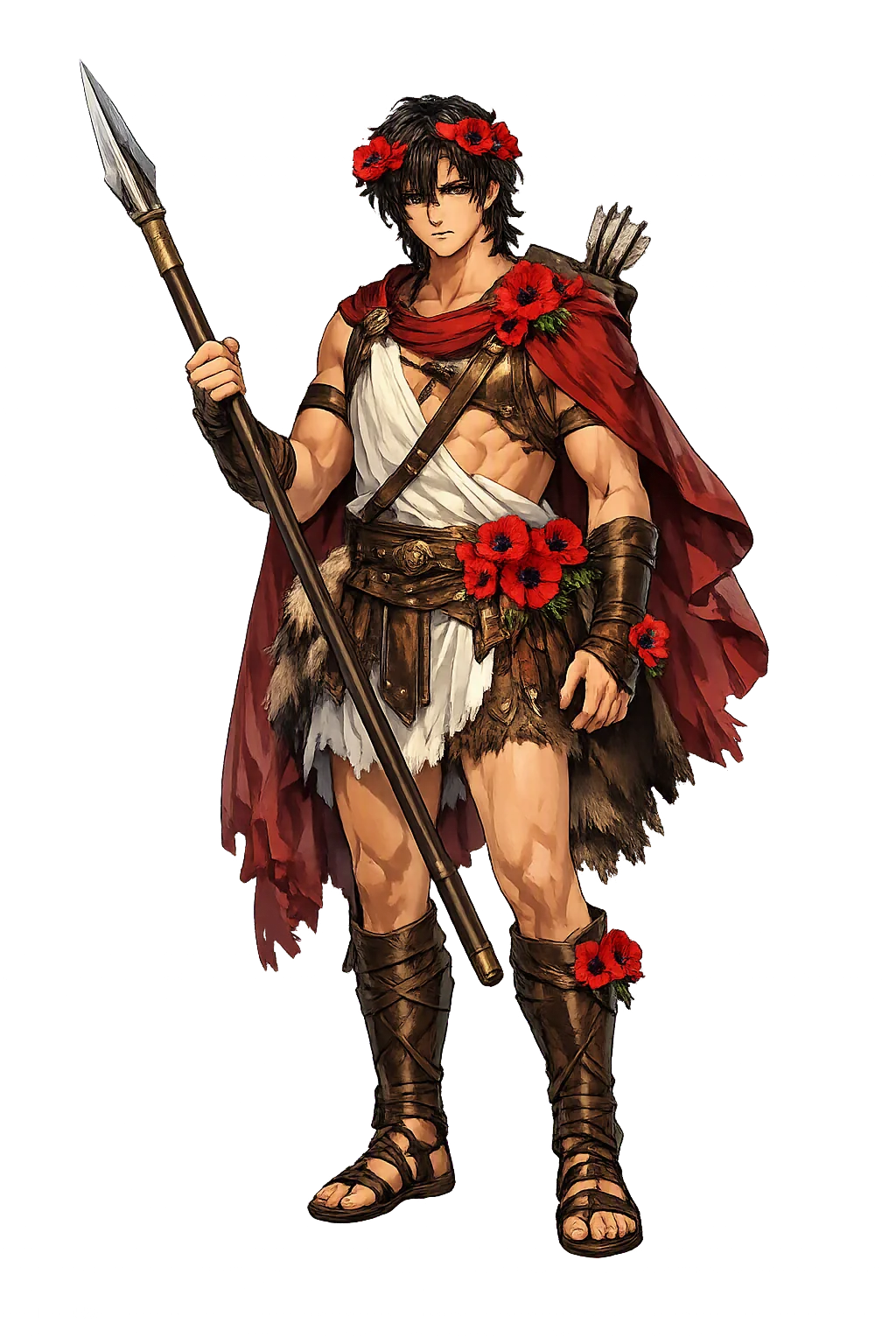
Adonis enters Greek art late and stays typecast as the beautiful hunter. Attic red-figure of the later fifth century BCE shows Aphrodite beside a youthful, armed Adonis — departure for the hunt staged as erotic leave-taking; fourth-century South Italian vases take up the death, the gored youth sinking into the goddess's arms while Eros hovers helpless. Ancient image-makers never gave him attributes of his own: the spear and lyre are the hunter's; the boar belongs to the story. The canonical image is post-classical — Titian's Venus and Adonis (Prado, 1550s), the dog straining at its lead while the goddess clings to a hip already turned toward the mountains — and Rubens' version (Metropolitan Museum, c. 1609) gives the parting its full Flemish weight. From vase to canvas the story barely changed: beauty, warned, departing anyway.

06

Reception & Transformation

The name after its own age — transmission, translation, survival

Afterlives

Adonis travelled from Semitic title to Greek song and never settled. Sappho's threnody — “tender Adonis is dying” — is the earliest surviving treatment; classical Athens made the mourning proverbial, and “gardens of Adonis” passed into Greek, then Latin, as shorthand for anything showy and rootless, a proverb Erasmus collected in his Adagia for every Renaissance schoolboy. The Hellenistic age gave the god his literary apotheosis: Theocritus staged his festival at Alexandria, and Bion's Lament for Adonis became the model of bucolic elegy, echoing down through the pastoral tradition to Milton's Lycidas. Ovid fixed the whole narrative for the Latin West in Metamorphoses 10. The nineteenth-century comparative mythologists made him the test case of the “dying god”: Frazer built a volume of The Golden Bough around him, and Jonathan Z. Smith later dismantled the category itself. Marcel Detienne's Les jardins d'Adonis (1972) then turned the rooftop gardens into a structuralist classic — the women's rite, after two thousand years, finally getting its close reading.

Identifications Across Traditions

Ádōnis is transparently the Greek adaptation of the Semitic Tammuz (Sumerian Dumuzi), the dying-and-rising vegetation god mourned by women in Mesopotamia and the Levant. The name itself comes from the Canaanite/Phoenician ʾādōn, 'lord'. In Roman poetry he becomes a byword for youthful male beauty — Venus and Adonis is a staple of Ovid and later painters, and Shakespeare's poem and Titian's canvases carry the pair into the modern canon. The figure also overlaps with Near Eastern dying-god typologies studied by Frazer, though modern scholars resist collapsing every vegetation deity into a single pattern.

Modern Legacy

Ádōnis survives in the anemone, in the word 'Adonis' applied to handsome young men, and in the long Western tradition of Venus and Adonis from Ovid to Shakespeare to Titian. His cult is one of the clearest cases of religious borrowing across the Aegean and Levant, and the Adṓnia gives rare evidence for women's religious practice in classical Greece. In modern wellness and beauty branding, his name still signals youth, desire, and the fleeting bloom of physical perfection.

07

The Meditation

What Ádōnis means — beyond the dictionary

Ádōnis is the god of what cannot last. Every spring his myth asks: why do the most beautiful things die first? The answer is not theological; it is seasonal. He is the flower, the harvest, the young lover, the grief that returns every year. To worship Ádōnis is to consent to love something you will lose.

Yet the loss is not final. The anemone returns. The women plant new gardens. The rite enacts not despair but cyclical hope — beauty dies, beauty returns, and the lament itself becomes the vessel of return. Ádōnis is therefore a god not of endings but of the interval between endings, the green moment before the heat of summer takes it away.

08

Frequently Asked Questions

Common questions about Ádōnis, Beauty, Desire, Renewal, and Unicode restoration

01How do you pronounce Ádōnis?

In reconstructed pronunciation, Ádōnis is /ˈa.doː.nis/ — approximately 'AH-doh-nis' — pitch falls on the first syllable, and the middle vowel is long.

02What does Ádōnis mean?

Ádōnis means Lord (from Semitic ʾādōn) in the greek tradition.

03What are the symbols of Ádōnis?

Ádōnis is associated with Anemone (The flower that sprang from Ádōnis's blood, red and short-lived), Myrrh tree (His mother Myrrha's metamorphosis; the tree from whose bark he was born), Boar (The animal that killed him in the hunt), Hunter's gear (Spear and nets; the masculine pursuit that leads to his death).

04Why restore Ádōnis in Unicode?

Plain ASCII adonis strips the stress, length, and script that make the name specific. Unicode restoration returns the name to its original written dignity.

05What is the most important myth about Ádōnis?

“The Myrrh Tree Splits” — the Origin story that anchors the mythology of Ádōnis, told in full on the lore page.

09

Scholarly Sources

The philological foundations of this restoration

Every claim on this page is grounded in established scholarship. The orthographic restorations follow disciplinary convention. The etymological chain follows the best available reference works. This is not invention — it is resurrection through scholarship.

◈

Lexicography & Philology

  • Liddell, H. G., Scott, R., & Jones, H. S. A Greek-English Lexicon. Oxford: Clarendon Press, 9th ed. 1996.
  • Pape, W., & Benseler, G. E. Wörterbuch der griechischen Eigennamen. Braunschweig: Vieweg, 1884.
  • Beekes, R. S. P. Etymological Dictionary of Greek. Leiden: Brill, 2010.
◎

Primary Texts

  • Apollodorus
  • Ovid
  • Apollodorus, Bibliotheca 3.14.3–4
  • Ovid, Metamorphoses 10.298–739
◉

Archaeology & Art History

  • Material evidence — iconography, inscriptions, and temple archaeology — for Ádōnis and related cults.
✦

Religious Studies

  • Theocritus, Idyll 15
  • Lucian, On the Syrian Goddess 6
  • Burkert, Greek Religion (1985)
Return

The Surface Awaits

You have traced the name from its earliest attestation to its Unicode restoration. Now return to the myth. The story is where the name lives.

Back to Lore
Ádōnis mascot