
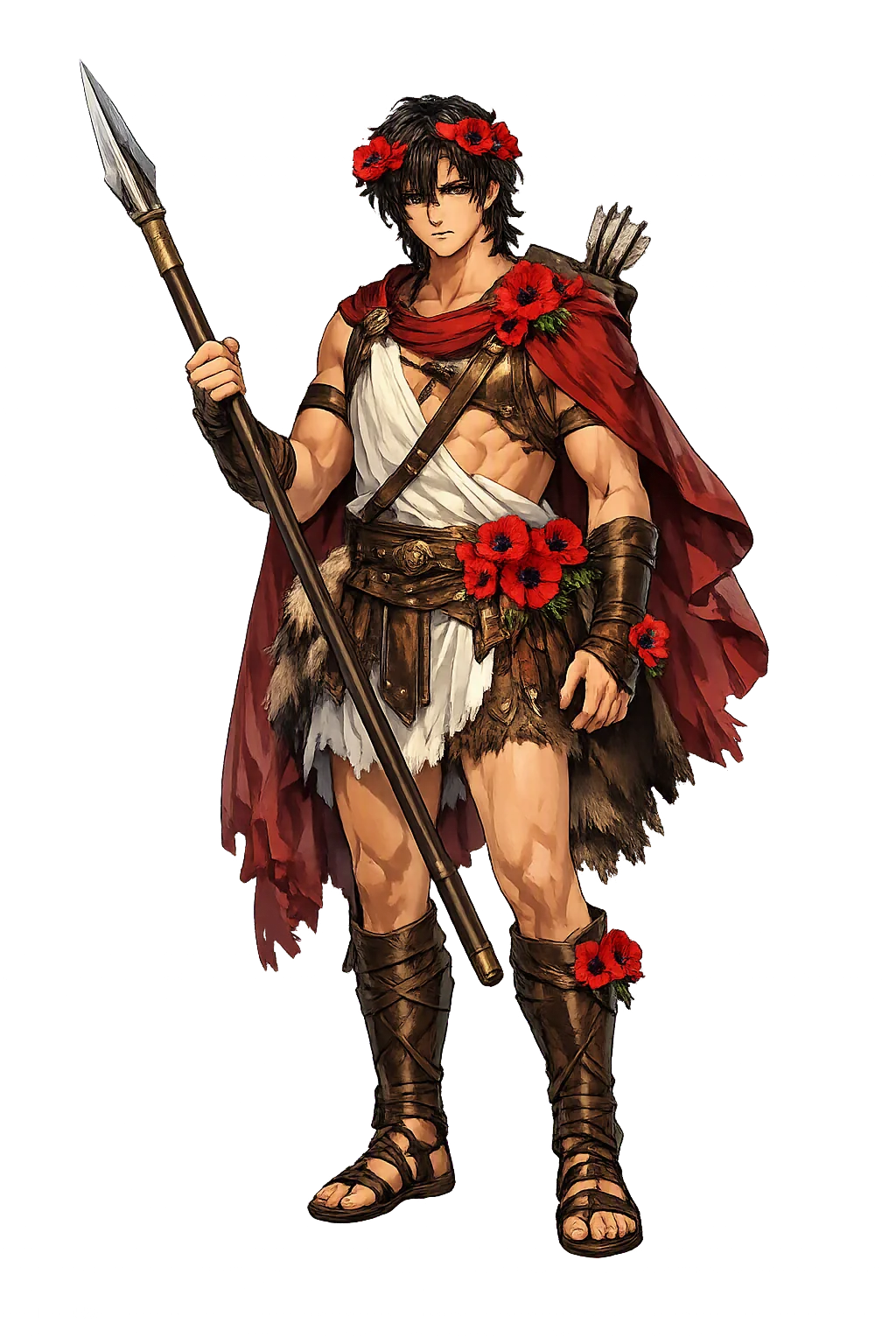
Ádōnis: the stories first, then the spelling
You cannot weigh an accent without knowing what it carries. Here is what Ádōnis has been carrying.
The Stories That Carry the Name
The Myrrh Tree Splits. Myrrha, daughter of King Kinyras of Cyprus — or of Assyria, in the older eastern versions — conceived a hopeless passion for her own father. Her nurse smuggled her into the royal bed on a night when the king's wife was away at a festival of Demeter; when Kinyras discovered the truth by lamplight he reached for his sword, and the gods transformed the fleeing girl into a myrrh tree (Apollodorus, Bibliotheca 3. 14.
Divided Between Two Queens. Aphrodite hid the infant in a chest and entrusted him to Persephone, queen of the dead — but Persephone opened the chest, looked, and refused to give him back. Zeus judged between the goddesses: Adonis would spend a third of the year with Persephone below, a third with Aphrodite above, and a third as he chose — and he chose Aphrodite, for love of her beauty and the living world (Apollodorus 3. 14.
The Boar on the Mountain. Despite Aphrodite's warnings, Adonis hunted a wild boar. The beast gored him in the thigh — some say the boar was Aphrodite's own anger made flesh, or the jealous Ares in animal shape; others blame the youth's recklessness, for he hunted what his protector feared (Ovid, Metamorphoses 10. 705–739).
And Here Is What the Spelling Preserves
Against those stories, the attestation: Ἄδωνις, on the evidence Apollodorus, Bibliotheca 3.14.3–4 and Ovid, Metamorphoses 10.298–739 set down. The name means "Lord (from Semitic ʾādōn)".
The restoration keeps 2 features the ASCII form adonis cannot show:
- a → Á — Alpha: where the voice peaks.
- o → ō — Omega: long omicron: how long the vowel is held.
A storyteller pronouncing the name would restore every one of them by instinct. The file only writes down what the voice already knows.
At a Glance
- Restored name: Ádōnis
- ASCII form: adonis
- Meaning: "Lord (from Semitic ʾādōn)"
- Domain of influence: Beauty, Desire, Renewal
- Pantheon: Greek
- Classification: Tier 1
- Original script: Ἄδωνις
- Series: The Restoration Files, No. 7 of 548
The Name Travels
Ádōnis is transparently the Greek adaptation of the Semitic Tammuz (Sumerian Dumuzi), the dying-and-rising vegetation god mourned by women in Mesopotamia and the Levant. The name itself comes from the Canaanite/Phoenician ʾādōn, 'lord'.
The Address It Earned
The temple of Ádōnis stands at /adonis/ — lore, scholars, patterns — because a name carrying this much story deserves more than a parking page. What survives here cannot be shown in ASCII: a feature of the original that the fallback alphabet flattens. That is the Tier-1 test, and this name passes it without argument.
The Sources Are Open
The myths above are retold from the temple's record; the primary voices are in the Sacred Texts: Theogony, Homeric Hymns, and Works and Days. Nothing in this file outranks them.
The File Continues
Read the founding dispatch for the name's full story, the Resonance File for the archetype at work — or the whole archive in one sitting.
Continue the series — previous file: Adámas (read it here) · next file: Aengus (read it here).
The Restoration Files are written from the same canonical record as the temples themselves: the lexicon, the lore catalog, the pattern atlas, and the cited scholarly sources. If a file ever disagrees with its temple, the temple is right — tell us, and the file will be corrected.