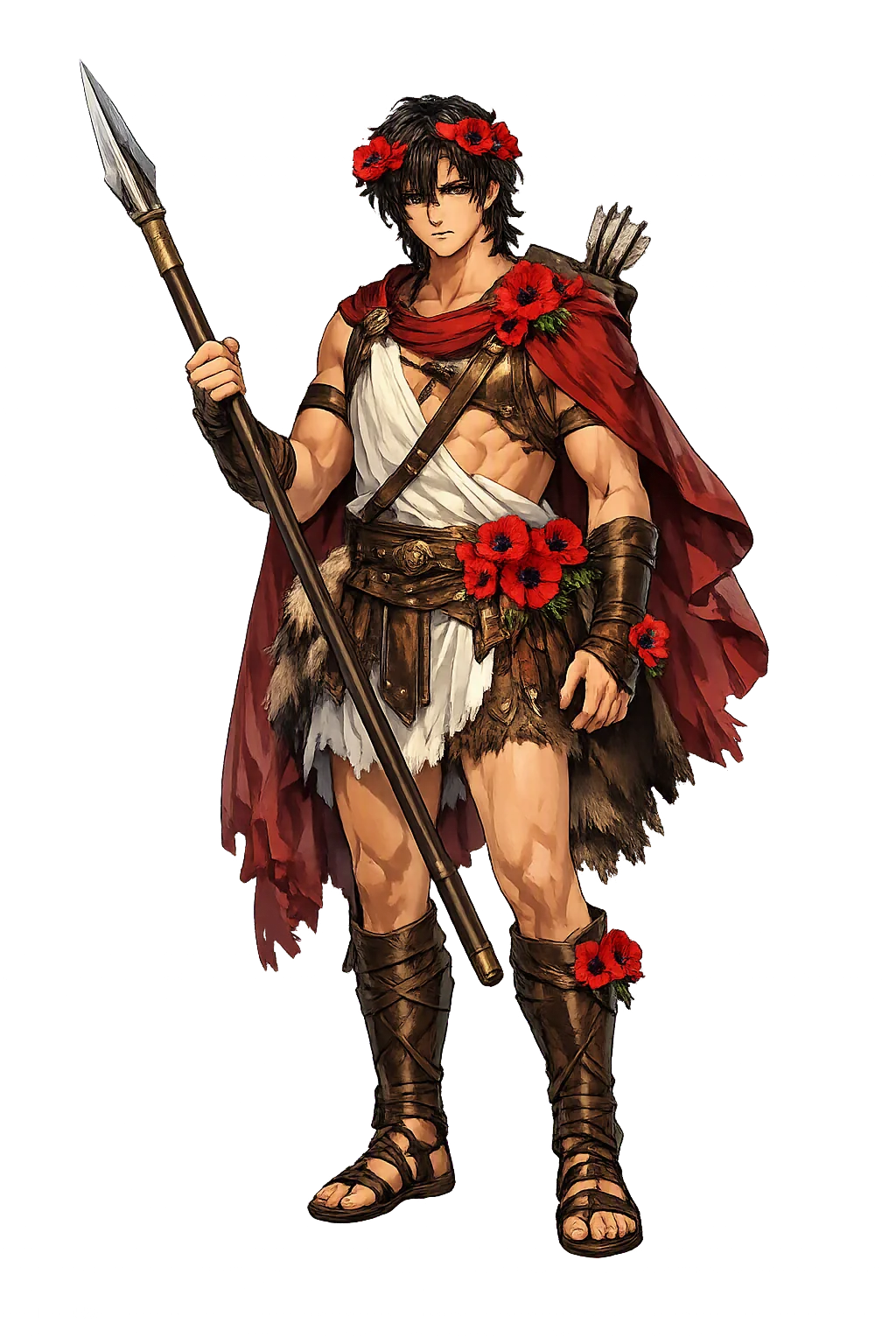
Stories of Ádōnis
Ádōnis's myth turns on beauty that cannot be kept. He is desired, born, killed, and divided — a story the Greeks borrowed from the dying-god cults of the Near East and made their own, and a women's rite of lament that gives rare direct voice to female grief in the classical city.
Myrrha, daughter of King Kinyras of Cyprus — or of Assyria, in the older eastern versions — conceived a hopeless passion for her own father. Her nurse smuggled her into the royal bed on a night when the king's wife was away at a festival of Demeter; when Kinyras discovered the truth by lamplight he reached for his sword, and the gods transformed the fleeing girl into a myrrh tree (Apollodorus, Bibliotheca 3.14.4; Ovid, Metamorphoses 10.298–502). Ten months later the bark split and the infant Adonis was born — Ovid's loveliest detail has the tree tear 'like a girl's body opening in childbirth'. The tale makes his beauty the fruit of transgression: he is born where the boundary of the family was crossed, and his whole career will be spent on boundaries — between women and men, love and death, the earth and the underworld.
Aphrodite hid the infant in a chest and entrusted him to Persephone, queen of the dead — but Persephone opened the chest, looked, and refused to give him back. Zeus judged between the goddesses: Adonis would spend a third of the year with Persephone below, a third with Aphrodite above, and a third as he chose — and he chose Aphrodite, for love of her beauty and the living world (Apollodorus 3.14.4). Sappho preserves the women's lament for the dying season — 'tender Adonis is dying, Cyprian; what shall we do?' (fr. 140a) — and a variant has the division decided by lots weighed on a scale, Aphrodite cheating with her girdle to tip the outcome. The myth is transparent seasonal allegory: the year itself divided between the queen of life and the queen of death. Its honesty is the point — desire and mortality get exactly equal terms.
Despite Aphrodite's warnings, Adonis hunted a wild boar. The beast gored him in the thigh — some say the boar was Aphrodite's own anger made flesh, or the jealous Ares in animal shape; others blame the youth's recklessness, for he hunted what his protector feared (Ovid, Metamorphoses 10.705–739). He died in Aphrodite's arms, and where his blood struck the earth the anemone sprang up — red, wind-shaken, and short-lived, a flower that nods in the slightest breeze, as Ovid says, 'because it grew from tears'. Persephone received him below, and the goddess's grief became the template for the women's rite. The death of the beautiful hunter is one of antiquity's most retold scenes precisely because it refuses consolation: not resurrection, not apotheosis — only a flower, and a goddess weeping over it every year.
The Adonia was the women's festival of Adonis, attested across the Greek world: at Athens the rooftop ritual mocked by Aristophanes (Lysistrata 387–398); at Alexandria the grand procession of a wax effigy that Theocritus sets in the mouths of two Syracusan women (Idyll 15); and in Syria the temple rites at Byblos that Lucian describes, where the god's death is mourned and his resurrection celebrated (On the Syrian Goddess 6). Its signature rite was the 'gardens of Adonis': lettuces, fennel, and quick-sprouting herbs planted in shallow trays, forced into brief green life, then carried to the rooftops to wither in the sun — miniature lives enacted and lost within days. Plato's Socrates borrows the image (Phaedrus 276b) to dismiss writing itself: the written word, he says, is like a garden of Adonis — pretty, rootless, dead quickly. The cult gives rare direct evidence of women's religious life in the classical city.
Desire, Vegetation, and the Cycle of Death and Renewal
Ádōnis is the beautiful youth whom love and death divide. Born from the grief of Myrrha and the myrrh tree, desired by Aphrodítē and Persephonē alike, he embodies the fragile glory of spring: flowers that bloom brilliantly and die young. His cult spread across the Greek East as a women's rite of lament and rebirth.
A youth of such beauty that the goddess of love herself cannot leave him.
The anemone and the myrrh tree mark his blood and birth; his death is the death of the green year.
The Adṓnia was a rite of mourning women, planting gardens that withered to enact grief.
A boar, the animal of Aphrodítē's anger or of his own hubris, tears him open.
From the original script to the living URL
Ἄδωνις
The name in its original Greek form. Ádōnis (Ἄδωνις) is attested in the source tradition — “Lord (from Semitic ʾādōn)”. Its long vowels and acute accents carry the full phonetic and orthographic weight of the source tradition.
adonis
Reduced to plain adonis, the name loses everything that made it specific: long vowels and acute accents. What remains is an ASCII string that machines can parse but that no longer speaks with its original voice.
Ádōnis
The Unicode restoration recovers what ASCII flattened. Ádōnis restores long vowels and acute accents, returning the name to its original written dignity. The domain encodes to Punycode, but the browser displays the truth.
Ádōnis.com → xn--dnis-4na36d.com
The non-ASCII characters in Ádōnis are encoded while the ASCII remains visible. To the DNS, it is Punycode. To humanity, it is Ádōnis.
Owned, ideal, and ASCII forms of Ádōnis
Ádōnis
Restores Ἄδωνις. The live temple domain — ádōnis.com.
adonis
Flattens Ἄδωνις. The plain ASCII fallback — what DNS and legacy systems see.
How Ádōnis was spoken
How Ádōnis is preserved in writing
A bespoke provenance study for Ádōnis is being prepared by the PUNICODEX scholarly team.
Contribute scholarly provenance →The lore you have read is the living myth. Extended Lore opens the scholarly vault beneath it: the cult and its material remains, a history of the image, the name after antiquity, a meditation on what the name still means, and the full scholarly apparatus — etymology, orthography, sources.
Enter Extended Lore