
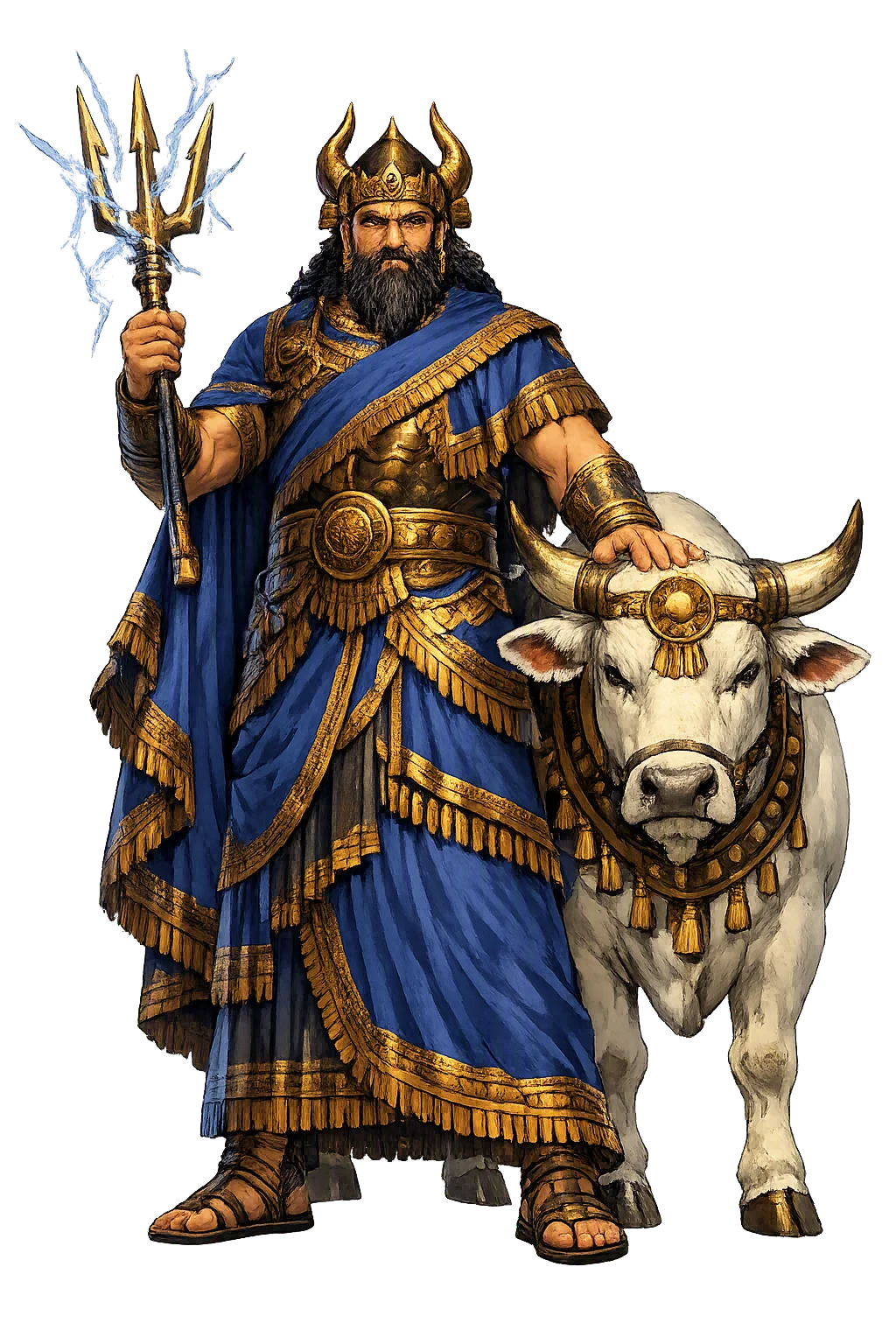
Adad walks into a meteorology & weather intelligence firm
Walk into any meteorology & weather intelligence outfit and watch for ten minutes. You will see a very old act performed with newer props. The act has a name. It is Adad.
Before the Office, the Story
The Hymn to Adad. The Akkadian hymn literature gives the storm a liturgy. When Adad comes, the darkening heavens thunder, the earth quakes, and his lightning “flashes from the horizon of heaven to the horizon of earth”; the mountains are seized with fear before his storm-wind, and the Tigris and Euphrates run high at his command. The hymns give him an office title found on no other god's dossier: “canal-inspector of heaven and earth” — the bureaucrat of rain, who opens the furrows and decides whether the year's seed will drink.
Adad in the Deluge. When the divine council resolved to drown mankind, it was the storm god who carried the sentence. In the Atrahasis epic the gods order the flood and Adad's voice is the storm within it — his thunder rolls over the drowning land, and “Adad rumbled in the clouds” while the windows of heaven poured down (Atrahasis III). Utnapištim's account in the Standard Babylonian Epic of Gilgamesh, Tablet XI, remembers the same terror from inside the boat: Ninurta makes the weirs overflow, Erragal tears out the moorings, the Anunnaki raise torches — and “Adad's terror reached to the heavens, he turned all that was light to darkness.
At a Glance
- Temple: Adad
- Pantheon: Mesopotamian
- Domain of influence: Storm, Thunder
- Pattern seats: 4
- Sectors touched: Energy & Natural World · Commerce & Governance
- Strongest seat: Meteorology & Weather Intelligence
- Series: The Resonance Files, No. 5 of 548
The Reveal, Seat by Seat
Meteorology & Weather Intelligence
Now read the why-line with the office in mind: Adad is the Mesopotamian storm and thunder god; his temple naturally serves weather forecasting, storm tracking, and atmospheric-data platforms. The people doing this work did not borrow the archetype. They re-derived it — the way Adad was always going to be re-derived wherever storm, thunder matters.
Agriculture, Food & Harvest
Adad's winter rains were the source of agricultural fertility in Mesopotamia; the name fits irrigation, crop-planning, and harvest-tech brands. The match is not poetic license. Strip the trade to its function and the function is the myth.
Disaster Resilience & Recovery
As the deity of flood and tempest, Adad maps onto flood alerts, catastrophe modeling, and emergency-response tooling. The match is not poetic license. Strip the trade to its function and the function is the myth.
Insurance & Protection Services
Now read the why-line with the office in mind: The storm god's unpredictable power aligns with risk underwriting, weather-index insurance, and asset-protection products. The people doing this work did not borrow the archetype. They re-derived it — the way Adad was always going to be re-derived wherever storm, thunder matters.
Not the First Rebrand
The Sumerian storm god Iškur and the Akkadian Adad were identified with one another from an early date; in bilingual texts and god lists they function as a single deity with two names. In the West Semitic world he was Addu or Hadad, a major god of Aleppo and the Syrian steppe, and his imagery influenced the Canaanite storm-god Baal. The office is only the latest translation.
The Method, Stated Plainly
None of this is numerology. A seat exists only where the match can be argued from the deity’s documented domains and deeds — weighted, published, and falsifiable. The derivation, the weights, and the challenge process are public on the methodology page. If a seat in this file reads wrong, the atlas itself tells you how to prove it — and the correction becomes part of the record.
For the Ones Who Work There
For a sponsor in meteorology & weather intelligence, the fit here is not adjacency — it is inheritance. Your trade already tells this story every working day; the temple simply holds the original. The patron tier and the advertising terms carry the mechanics; the myths above carry the reason.
The File Continues
This is one of 548 Resonance Files — the third dispatch from every flagship temple, where the myths meet the markets. The temple's founding dispatch tells the name's story; its Restoration File tells the spelling's; the blog index holds the whole archive.
Continue the series — previous: Achilleús (read it) · next: Adámas (read it).
The Resonance Files are argued from the same canonical record as the pattern atlas itself: the lexicon, the lore catalog, and the cited sources. Every seat can be challenged at the methodology page — and the challenge is the point.