
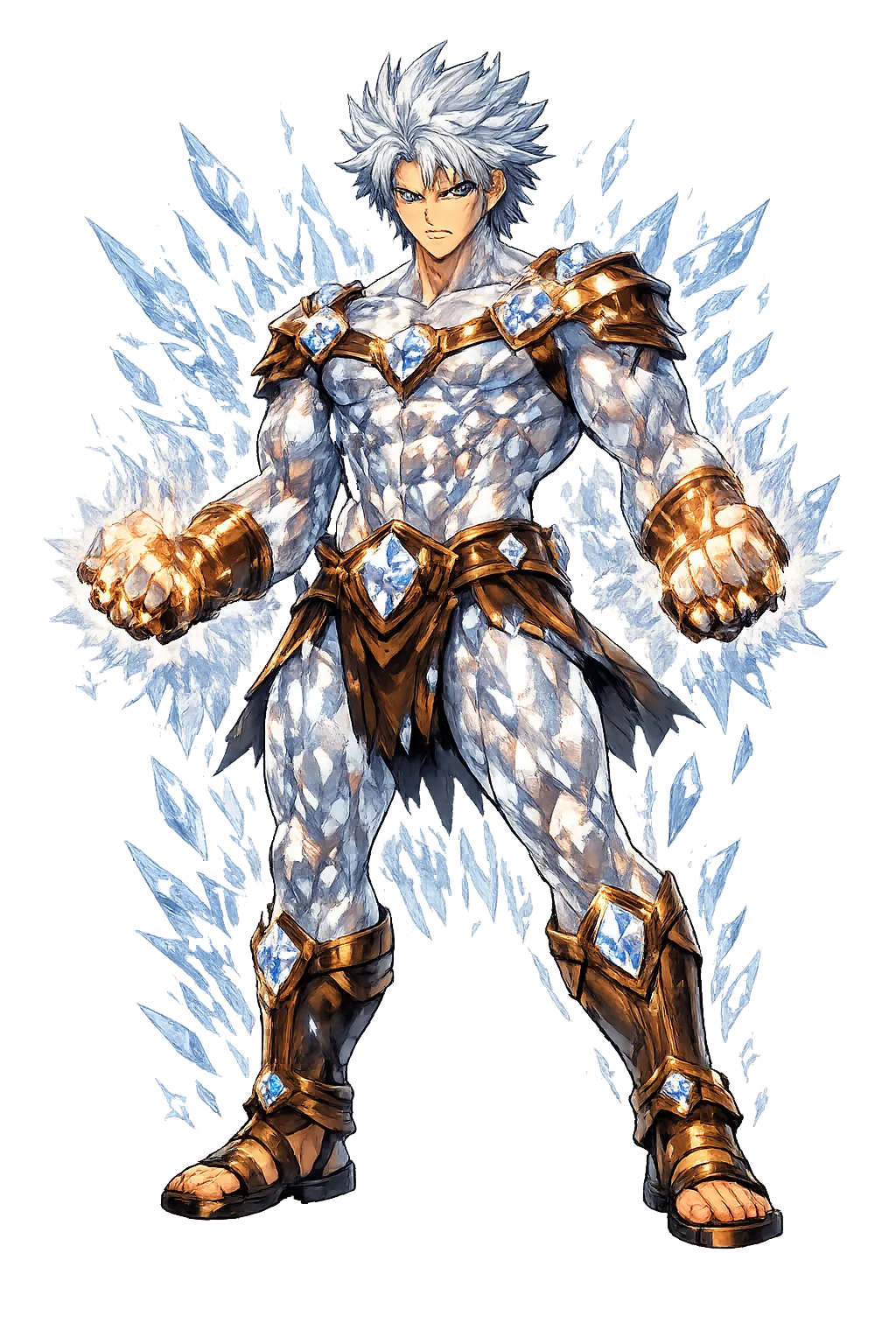
The appointments Adámas made — and who is keeping them
One myth is a story. A cycle of myths is a specification. Read Adámas's cycle in order and the industries fall out of it one by one.
At a Glance
- Temple: Adámas
- Pantheon: Greek
- Domain of influence: Gem, Concept, Invincibility
- Pattern seats: 3
- Sectors touched: Home & Lifestyle · Energy & Natural World · Technology & Innovation
- Strongest seat: Gems, Jewelry & Luxury Materials
- Series: The Resonance Files, No. 6 of 546
The Cycle, Read Forward
Gems, Jewelry & Luxury Materials — through The Sickle That Wounded the Sky
Gaia, weary of Ouranos pressing down upon her and hiding their children inside her depths, fashioned a plan and set her youngest, Kronos, to ambush his father. She made a great long sickle with jagged teeth — of adamant, ἅρπη ἀδάμαντος (Hesiod, Theogony 161) — and bade Kronos wait in a hidden place.
The atlas states the seat in one line: The adamant stone; the literal etymon of the diamond trade. The story above is the long version of the same sentence. Industries do not invent their archetypes; they inherit them and call them best practice.
Mining & Natural Resources — through Chains That Hold a Titan
Aeschylus opens Prometheus Bound at the edge of the world, where Hephaistos, ordered by Strength and Force, must rivet the rebel Titan to the crags of the Caucasus. His bonds are adamantine — the material whose name means 'unconquerable' — and Hephaistos grieves as he works: his own craft, the fire he gave the world, is being turned to chain the god who gave it to men.
The atlas states the seat in one line: Diamond is mined before it is set; the earth's hardest yield is his namesake stone. The story above is the long version of the same sentence. That is the cycle working: story becomes duty, duty becomes trade.
Manufacturing, Craft & Automation — through The Spindle of Necessity
In the great myth that closes Plato's Republic (616b–617d), the soul journeys beyond the heavens and sees the cosmos from outside: a column of light binding the sky together, and Necessity — Anankē — enthroned, with her daughters the Fates, turning the spindle that carries the whorls of the planetary spheres. 'The shaft and the hook of the spindle were of adamant,' Plato writes, while the great whorl mixed adamant with other materials.
The atlas states the seat in one line: Only divine smiths can work him; Hephaistos forged adamantine bonds to hold Prometheus. The story above is the long version of the same sentence. The trade thinks it is optimizing a process. It is re-enacting a charter.
The Theme That Runs the Cycle
Adámas appears in Greek myth not as a character but as a substance that binds, wounds, or pivots the cosmos itself. Its hardness creates the drama: what can hold an immortal must be stronger than the divine. From the sickle that cuts the sky to the spindle that turns the heavens, the unbreakable metal marks the exact points where Greek imagination needed something stronger than god.
The Method, Stated Plainly
The atlas is not a horoscope. Seats are earned from the sources — argued, weighted, published — and every one of them can be challenged at the methodology page. A match that cannot survive an argument does not survive review. That is the whole trick: the patterns are claims, and claims can be tested.
For the Ones Who Work There
If you work in gems, jewelry & luxury materials, mining & natural resources, or any trade this temple holds a seat in, this is the honest version of what a placement means: your industry beside the story it has been re-telling all along — on the temple floor itself, before an audience that came specifically to read it. The patron tier and the advertising terms describe the mechanics; the resonance above describes the fit.
The File Continues
One of 546 Resonance Files — the series where the pantheon goes to work. Read the founding dispatch for the name, the Restoration File for the spelling, or the whole archive end to end.
Continue the series — previous: Adad (read it) · next: Ádōnis (read it).
The Resonance Files are argued from the same canonical record as the pattern atlas itself: the lexicon, the lore catalog, and the cited sources. Every seat can be challenged at the methodology page — and the challenge is the point.