
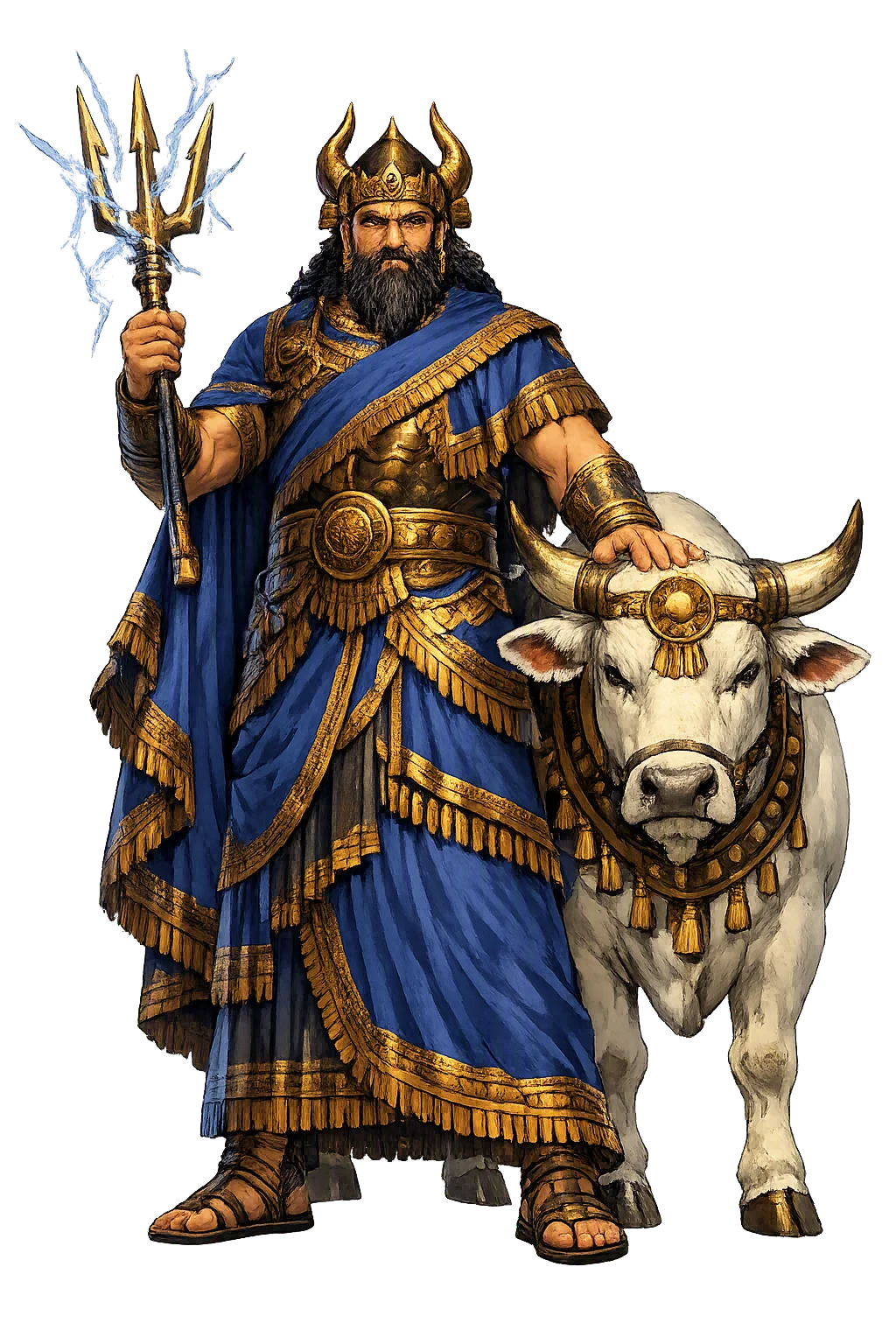
Adad: the stories first, then the spelling
The marks in Adad make the most sense standing next to the myths they have to carry. So the myths come first.
The Stories That Carry the Name
The Hymn to Adad. The Akkadian hymn literature gives the storm a liturgy. When Adad comes, the darkening heavens thunder, the earth quakes, and his lightning “flashes from the horizon of heaven to the horizon of earth”; the mountains are seized with fear before his storm-wind, and the Tigris and Euphrates run high at his command. The hymns give him an office title found on no other god's dossier: “canal-inspector of heaven and earth” — the bureaucrat of rain, who opens the furrows and decides whether the year's seed will drink.
Adad in the Deluge. When the divine council resolved to drown mankind, it was the storm god who carried the sentence. In the Atrahasis epic the gods order the flood and Adad's voice is the storm within it — his thunder rolls over the drowning land, and “Adad rumbled in the clouds” while the windows of heaven poured down (Atrahasis III). Utnapištim's account in the Standard Babylonian Epic of Gilgamesh, Tablet XI, remembers the same terror from inside the boat: Ninurta makes the weirs overflow, Erragal tears out the moorings, the Anunnaki raise torches — and “Adad's terror reached to the heavens, he turned all that was light to darkness.
Addu of Aleppo, Guarantor of Oaths. West of the Euphrates the storm god wore his most political mask. At Aleppo — Halab of the ancient texts — Addu was the greatest god of the Bronze Age Levant, and the royal archives of Mari preserve his voice in his own words: prophetesses deliver his oracles to King Zimri-Lim, reminding him that “I gave you the weapons with which I fought the Sea, and I anointed you with the oil of my victory” (the Mari letters, ARM 10). Treaties of the age invoke Addu of Aleppo among the gods who witness the oaths; his thunder is the enforcement clause.
And Here Is What the Spelling Preserves
At a Glance
- Restored name: Adad
- ASCII form: adad
- Meaning: "The thunderer"
- Domain of influence: Storm, Thunder
- Pantheon: Mesopotamian
- Classification: Tier 2
- Original script: 𒀭𒅎
- Series: The Restoration Files, No. 5 of 548
The Name Travels
The Sumerian storm god Iškur and the Akkadian Adad were identified with one another from an early date; in bilingual texts and god lists they function as a single deity with two names. In the West Semitic world he was Addu or Hadad, a major god of Aleppo and the Syrian steppe, and his imagery influenced the Canaanite storm-god Baal.
The Address It Earned
The temple of Adad stands at /adad/ — lore, scholars, patterns — because a name carrying this much story deserves more than a parking page. The restoration keeps one feature the ASCII form drops. One is enough to matter, and the label says so plainly: Tier-2.
The Sources Are Open
The myths above are retold from the temple's record; the primary voices are in the Sacred Texts: Enūma Eliš and The Epic of Gilgamesh. Nothing in this file outranks them.
The File Continues
Read the founding dispatch for the name's full story, the Resonance File for the archetype at work — or the whole archive in one sitting.
Continue the series — previous file: Achilleús (read it here) · next file: Adámas (read it here).
The Restoration Files are written from the same canonical record as the temples themselves: the lexicon, the lore catalog, the pattern atlas, and the cited scholarly sources. If a file ever disagrees with its temple, the temple is right — tell us, and the file will be corrected.