
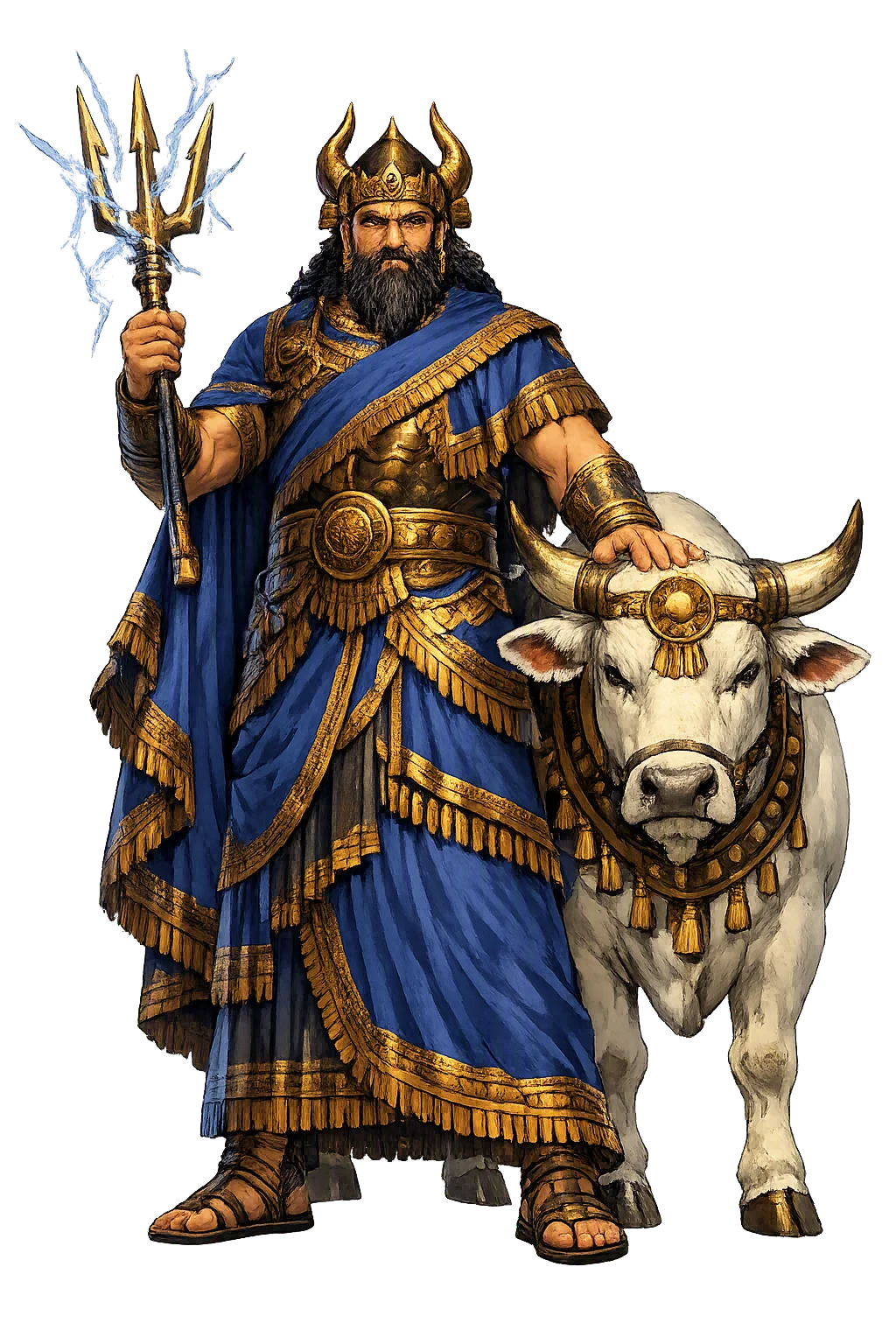
The name Adad and the world it opens
A name is a door. Adad opens onto an entire world: the domain of storm, thunder, a Mesopotamian tradition, and centuries of storytelling, worship, and scholarship. This post walks through that world room by room — the name and its roots, the original script, the sound of it, the myths, the symbols, the sites, the afterlife across cultures — and ends at the newest room of all: a Unicode domain that makes the whole structure addressable. adad gets you to the same building, but only the restored form tells you why it was built.
At a Glance
- Restored name: Adad
- ASCII form: adad
- Meaning: "The thunderer"
- Domain of influence: Storm, Thunder
- Pantheon: Mesopotamian
- Classification: Tier 2
- Original script: 𒀭𒅎 (Cuneiform)
Overview
Adad (adad) — Storm, Thunder · The thunderer — belongs to the Mesopotamian tradition, where it is catalogued under the domain "Storm, Thunder". The name means "The thunderer".
Adad is the Akkadian storm god, the lord of thunder and the divine voice that speaks in wind, rain, and lightning. In Sumerian he is Iškur; in the West Semitic world he is Addu or Hadad. Where Enlīl governs the wind and the cosmic decree, Adad is the storm's immediate, destructive, and life-giving power: the thunder that splits mountains, the flood that renews the plain, and the rain on which every Mesopotamian harvest depended.
This temple is a domainless flagship: the ASCII adad.com is unregistrable, so the restoration is displayed here without claiming ownership. The page functions as a philological and atmospheric reconstruction hub for one of the ancient Near East's most widely worshipped deities.
PuniCodex restores the name as Adad and serves its temple at its temple. The restoration needs no distinctive letters or diacritics its ASCII form would lose, which places the name in Tier 2. The plain ASCII form adad survives as a modern convenience imposed by the early domain-name system; the restoration, not the fallback, is the form the project defends as philologically complete.
The Name
The name is attested in Cuneiform as 𒀭𒅎. Etymologically it means "The thunderer".
The ASCII form adad survives only because the early domain-name system could not carry diacritics; it is a technological compromise, not an ancient spelling. The Unicode restoration Adad recovers the full diacritic detail of the scholarly transliteration directly in the address bar. The restoration needs no distinctive letters or diacritics its ASCII form would lose, which places the name in Tier 2.
The letter-by-letter transformation runs:
- a → A — Same, capitalized
- d → d — Same
- a → a — Same
- d → d — Same
The Original Script
The name is preserved in Cuneiform as 𒀭𒅎 — Sumero-Akkadian cuneiform, attested Sumerian / Old Babylonian – Neo-Assyrian, c. 2600–600 BCE, in Mesopotamia. The script is written left-to-right / top-to-bottom.
The scholarly transliteration is Adad (Sumerian logogram + Akkadian scholarly), giving the normalized reading /ˈa.dad/.
The rendering proceeds step by step:
- The storm-god logogram IM (𒅎)
- Prefixed with divine determinative 𒀭
- Akkadian Adad / Sumerian Ishkur
Pronunciation
The reconstructed pronunciation of the name is /ˈa.dad/ — Akkadian Reconstruction.
Phoneme by phoneme:
- A- — Open vowel [a] with primary stress — the first roll of thunder that opens the name.
- -dad — Voiced alveolar stop [d], open vowel [a], and final [d] — a doubled, percussive close that mimics the sound of the storm god's tread.
For the modern speaker, the closest approximation is: 'AH-dad' — stress the first syllable; the name is short, sharp, and rolls like distant thunder.
Kindred and historical forms of the name:
- Sumerian — 𒀭𒅎 (Iškur), the storm god whose name probably means 'lord of the winds'
- Akkadian — 𒀭𒀀𒁕𒀜 (Adad), 'the thunderer'; written with the divine determinative dingir
- West Semitic — Addu / Hadad, the storm-god of Aleppo (Halab) and the Levantine steppe
Adad is Tier 2: the Unicode restoration adds only capitalization and preserves no distinctive diacritic or non-Latin letter. The ASCII form 'adad' is historically identical to the standard Assyriological transliteration. PuniCodex keeps the capitalized form Adad as the canonical display name, but the temple is a reconstruction hub for the Mesopotamian storm god rather than a claim of domain ownership.
Mythology
Adad's myths are not narratives of courtship and descent like Ištar's; they are theophanies — descriptions of the storm's arrival, its terror, and its necessity. He appears in hymns, royal inscriptions, and the great flood epics as the voice that makes the earth tremble and the rain that decides whether a year will bring famine or plenty.
The Hymn to Adad (Theophany)
The Akkadian Hymn to Adad describes the god's arrival in the storm: the heavens thunder, the earth shakes, and his lightning flashes from one horizon to the other. He rides the storm winds; the mountains tremble before him. When Adad speaks in thunder, both gods and mortals listen. The hymn is not only praise but propaganda for kings who ruled by the god's mandate: to control Adad's cult was to claim access to the storm itself.
Adad in the Deluge (Flood)
In the Standard Babylonian Epic of Gilgamesh, Tablet XI, Utnapištim recounts the great flood: 'The gods of the abyss rose up; Nergal tore out the dam's bolt; Ninurta marched on and made the weirs overflow.' Adad's voice is the storm within the deluge; his thunder is the signal that the divine council has unleashed destruction upon the land. The storm god who brings rain in due season here becomes the agent of cosmic cleansing.
Adad of Aleppo and Royal Treaty (Kingship)
At Aleppo (Halab), the West Semitic storm god Addu was one of the most powerful deities of the Bronze Age Levant. The great kings of Mari, Yamkhad, and Hatti invoked him in treaties and royal correspondence; his thunder guaranteed oaths and his absence meant disaster. In the Middle Assyrian period Adad appears beside Aššur as a national god, granting the king victory in the field as surely as he granted rain to the field.
Marduk Receives the Name Ramman (Enuma Elish)
In the Babylonian Enuma Elish, Tablet VII, the gods bestow fifty names upon Marduk. One of them is Ramman, 'Thunderer' — an ancient epithet of Adad. By absorbing the storm god's name, Marduk assimilates the power of thunder and rain into his own kingship. The text is a theological charter: the local deity of Babylon becomes lord of the storm because the older storm god's essence has been transferred to him.
Symbols & Iconography
The iconography associated with Adad concentrates in a small set of recurring attributes, each a compressed statement about the name:
- Forked lightning — The visible sign of Adad's power and his weapon against chaos
- Bull and lion — The animals that embody the storm's roaring voice and untamed force
- Rain and flood waters — The life-giving and destructive aspect of the storm; the source of agricultural fertility
- Thunderbolt or mace — The weapon with which the storm god strikes mountains and enemies
- Storm cloud — The chariot or throne from which Adad makes the heavens thunder
Archaeology & Evidence
Storm-god imagery is widespread across Mesopotamia and the Levant. At Aleppo, the temple of the storm god Addu was a major Bronze Age sanctuary; cylinder seals and stelae show the god brandishing a forked lightning or standing on a bull. In Assyria, Adad appears in royal inscriptions and palace reliefs as a patron of the king's wars. Cuneiform copies of the Enuma Elish and Akkadian hymns from Nineveh, Assur, and Babylon preserve the theological tradition by which Adad's thunder was transferred to Marduk as the name Ramman.
Realm & Domain
Adad is the Akkadian storm god, the lord of thunder and the divine voice that speaks in wind, rain, and lightning. In Sumerian he is Iškur; in the West Semitic world he is Addu or Hadad. Where Enlīl governs the wind and the cosmic decree, Adad is the storm's immediate, destructive, and life-giving power: the thunder that splits mountains, the flood that renews the plain, and the rain on which every Mesopotamian harvest depended.
This temple is a domainless flagship: the ASCII adad.com is unregistrable, so the restoration is displayed here without claiming ownership. The page functions as a philological and atmospheric reconstruction hub for one of the ancient Near East's most widely worshipped deities.
Forked Lightning
The thunderbolt that splits the sky and reveals the god's presence in the storm cloud.
The Thunder Bull
Bull and lion are Adad's animals; the bull's bellow is the thunder that rolls across the plain.
Life-Giving Rain
Without Adad's winter rains the fields of Assyria and Babylonia would fail; the storm is also a fertility god.
Thunder as Oracle
Adad and Šamaš preside over divination; thunder and lightning were read as the god's answer to human questions.
Across Cultures
The Sumerian storm god Iškur and the Akkadian Adad were identified with one another from an early date; in bilingual texts and god lists they function as a single deity with two names. In the West Semitic world he was Addu or Hadad, a major god of Aleppo and the Syrian steppe, and his imagery influenced the Canaanite storm-god Baal. The Hurrian and Hittite storm god Teššub was equated with Adad in diplomatic and religious correspondence. In later periods Adad's thundering role was absorbed into Marduk (as Ramman in the Enuma Elish) and, through cultural diffusion, into the broader ancient Near Eastern image of the storm-god who rides the clouds and wields the lightning.
Kindred figures in the PuniCodex cross-tradition index include Baꜥal, Enlīl, Keraunós, Marduk, Ninurta, and Ọya, each linked through thunder / storm sovereignty.
Cultural Legacy
Adad's legacy is the idea that weather is a form of speech. In Mesopotamian thought thunder was not mere noise but the god's voice; rain was not mere hydrology but a divine gift. This theology shaped royal ideology across the Near East: the king who maintained Adad's cult could claim that the skies themselves endorsed his rule. The name survives in biblical and later Semitic studies as Hadad/Adad, and the imagery of the storm-god — bull, lightning, and rain — passed into Canaanite, Israelite, and eventually classical iconography. PuniCodex restores Adad as a Tier-2 reconstruction: there are no hidden diacritics, only the name itself, still rolling like thunder across four thousand years.
The Scholarly Record
The account of Adad given in this edition rests on the witnesses and reference works listed below. Lexica and etymological dictionaries secure the form and meaning of the name; the literary and religious texts supply the narrative evidence.
- ETCSL (Electronic Text Corpus of Sumerian Literature).
- CAD (Chicago Assyrian Dictionary).
- Black & Green, Gods, Demons and Symbols of Ancient Mesopotamia.
- Foster, Before the Muses.
- Dalley, Myths from Mesopotamia.
- Enuma Elish: The Babylonian Epic of Creation, Standard Babylonian version, 1200 BCE. Full text
- Epic of Gilgamesh, Tablet XI (Standard Babylonian flood account).
- Atrahasis (Akkadian Flood Story).
- Akkadian Hymn to Adad (storm-theophany hymns in royal and cultic context).
- Royal archives of Mari (letters invoking Addu of Aleppo and storm-oracles).
A Meditation
Every storm is a theophany for those who know how to read it. Adad is the deity of that reading: the god whose presence is announced by darkening sky, by the first cold drop, by the flash that divides the horizon and the silence that follows before the thunder. He is not a god of hidden places but of open air; his temple is the whole sky above the Mesopotamian plain.
The name Adad is onomatopoeic in its way — two sharp syllables, the second echoing the first, like thunder answering lightning. The Sumerians called him Iškur, the Akkadians Adad, the people of Aleppo Addu, and the Hittites saw him in Teššub. Each name is a local dialect of the same overwhelming experience: the sky has a voice, and it is not indifferent. To restore Adad in Unicode is not to add a diacritic but to keep the capital letter upright against the wind, a small flag claiming that even a name without fancy marks deserves its temple.
The Unicode Restoration
Adad is classified as Tier 2: the restoration needs no distinctive letters or diacritics its ASCII form would lose. The ASCII fallback adad still resolves everywhere, but it is the restored form that carries the name's full information. That is the whole thesis of this temple: the marks are the message.
Character by Character
The journey from adad to Adad, one character at a time:
- a → A — Same, capitalized
- d → d — Same
- a → a — Same
- d → d — Same
The Mesopotamian Pantheon
Adad is one of 30 entries the PuniCodex lexicon catalogues under the Mesopotamian pantheon. The Pantheon page gathers the tradition's major figures in one place, and the Lexicon lets you filter all 980 restorations by tradition, tier, or script — the fastest way to see where this name sits among its kin.
Frequently Asked Questions
What does Adad mean? The traditional gloss is "The thunderer."
Which tradition does Adad belong to? Adad is catalogued in the Mesopotamian pantheon of the PuniCodex lexicon.
Why is Adad classified as Tier 2? Because the restoration needs no distinctive letters or diacritics its ASCII form would lose — and the marks in the restored spelling preserve exactly that evidence.
Can I use Adad in a normal browser? Yes. The DNS resolves the punycode form automatically, and the type tool on this site converts adad to Adad for copying and pasting.
Where does the scholarly information come from? The entry is built from lexica, inscriptional evidence, and reviewed scholarly sources listed in the Scholarly Edition. Every claim is traceable to a canonical source.
Typing Adad
You do not need a special keyboard to use this restoration. The PuniCodex Type Tool converts the ASCII form adad into Adad as you type, and the browser extension offers the same conversion inside any text field. Copy the restored form, paste it into the address bar, and the DNS does the rest.
Sister Temples
Other temples in the Mesopotamian pantheon include Inanna, Marduk, and Ninurta — each with its own restoration story, its own scholarly record, and its own place in the lexicon.
Why This Restoration Matters
A door only matters if people walk through it. The temple is open, and everything behind it — the myths, the scholarship, the canvas, the patrons — hangs on the restored spelling. The PuniCodex project bets that the web will make room for names as they were actually written, and Adad is one of its standing proofs. Visit, share, cite, type it yourself: each use is a small rehearsal for a web where no name has to hide its marks to be found.
Explore Further
This post is one doorway into the temple. The home page carries the full character breakdown and the ambient canvas; the lore page tells the myths in long form; the Scholarly Edition preserves the sources, pronunciation data, and revision history; and the patron wall supports the restoration directly. For the wider map, browse the Lexicon, explore the Pantheon, or return to the PuniCodex blog.
A Closer Look at the Marks
A restored name is a small map. In the case of Adad, the map does not lead through diacritics or special letters, because the source tradition wrote the name in Cuneiform rather than in the Latin alphabet. The ASCII form adad and the restored form share the same letters; the restoration is a decision about which conventional spelling should serve as the public reference.
That decision is not cosmetic. The original script attestation carries semantic and phonetic information that no romanization can fully reproduce. By fixing one conventional spelling as the canonical domain form, the project prevents the drift that happens when a name is romanized differently in every article, map, and database. The breakdown still lists each character — a, d, a, d — so visitors can see exactly what is being carried forward and what is not. What looks like "no change" is, in fact, a deliberate choice to keep the name stable, searchable, and addressable.
Adad in Its Tradition
Adad does not stand alone. It belongs to the Mesopotamian tradition, where it is counted among 30 names in the PuniCodex lexicon. Its sphere — Storm, Thunder — places it beside other figures who govern similar aspects of experience. The restored spelling is therefore not only a philological decision; it is a way of keeping the name in the company of its kin. When the address bar shows Adad, it marks the boundary between a generic search term and a named entry in a living catalog of myth. That catalog is the point of the project. Every restored name is a vote for specificity: the web should know the difference between a figure and a keyword, between a tradition and a trend. Adad is one such vote.
Related Names
Sources
The full scholarly apparatus — every citation, revision, and review — lives in the Scholarly Edition. Key references for this post:
- Enuma Elish: The Babylonian Epic of Creation, Standard Babylonian version, 1200 BCE.
- ETCSL (Electronic Text Corpus of Sumerian Literature).
- CAD (Chicago Assyrian Dictionary).
- Black & Green, Gods, Demons and Symbols of Ancient Mesopotamia.
- CAD, Adad.
- Lexicon authorities for this entry: ETCSL, Black-Green.