Stories of Adad
Adad's myths are not narratives of courtship and descent like Ištar's; they are theophanies — descriptions of the storm's arrival, its terror, and its necessity. He appears in hymns, royal inscriptions, and the great flood epics as the voice that makes the earth tremble and the rain that decides whether a year will bring famine or plenty.
The Akkadian hymn literature gives the storm a liturgy. When Adad comes, the darkening heavens thunder, the earth quakes, and his lightning “flashes from the horizon of heaven to the horizon of earth”; the mountains are seized with fear before his storm-wind, and the Tigris and Euphrates run high at his command. The hymns give him an office title found on no other god's dossier: “canal-inspector of heaven and earth” — the bureaucrat of rain, who opens the furrows and decides whether the year's seed will drink. Kings of Assyria quoted the theology back at the sky: royal inscriptions credit Adad with thundering against the enemy's host as reliably as he waters the field. The hymn is praise and propaganda at once — to control Adad's cult was to claim access to the storm itself, the one voice in nature that speaks to peasant and king in the same syllables.
When the divine council resolved to drown mankind, it was the storm god who carried the sentence. In the Atrahasis epic the gods order the flood and Adad's voice is the storm within it — his thunder rolls over the drowning land, and “Adad rumbled in the clouds” while the windows of heaven poured down (Atrahasis III). Utnapištim's account in the Standard Babylonian Epic of Gilgamesh, Tablet XI, remembers the same terror from inside the boat: Ninurta makes the weirs overflow, Erragal tears out the moorings, the Anunnaki raise torches — and “Adad's terror reached to the heavens, he turned all that was light to darkness.” The storm god who brings the winter rain on schedule, that the furrows may fill, here brings it out of season until the world is a waste of water: the difference between blessing and annihilation is not the god but the calendar.
West of the Euphrates the storm god wore his most political mask. At Aleppo — Halab of the ancient texts — Addu was the greatest god of the Bronze Age Levant, and the royal archives of Mari preserve his voice in his own words: prophetesses deliver his oracles to King Zimri-Lim, reminding him that “I gave you the weapons with which I fought the Sea, and I anointed you with the oil of my victory” (the Mari letters, ARM 10). Treaties of the age invoke Addu of Aleppo among the gods who witness the oaths; his thunder is the enforcement clause. Northward, the campaigns of the Hittite king Hattušili I against Halpa carried the god's fame to Hattuša, where the storm god of Aleppo received his own cult. Across three languages and two millennia the theology is identical: thunder is the signature on a contract — the only guarantor of oaths whose notary office cannot be bribed, because it is the sky itself.
The Babylonian Enuma Elish ends not with a battle but with a naming. When Marduk has bound Tiāmat and built the world from her, the gods assemble and bestow on him fifty names, each one an annexation of an older god's province; already in Tablet IV he has taken the storm-winds for weapons and made the flood his ally. Among the fifty stands Ramman, “Thunderer” — the ancient name of Adad — by which “he makes the thunderbolt flash” and the land is watered (EE VII). To bestow the name is to transfer the essence: the local god of Babylon becomes lord of the storm because the storm god's oldest title now belongs to him. The text is a theological charter written in the grammar of annexation — and it preserves Adad in the act of being absorbed, his thunder rolling on inside a younger god's greater name, the way older empires survive inside newer ones.
Storm · Lightning · Rain · Divine Voice
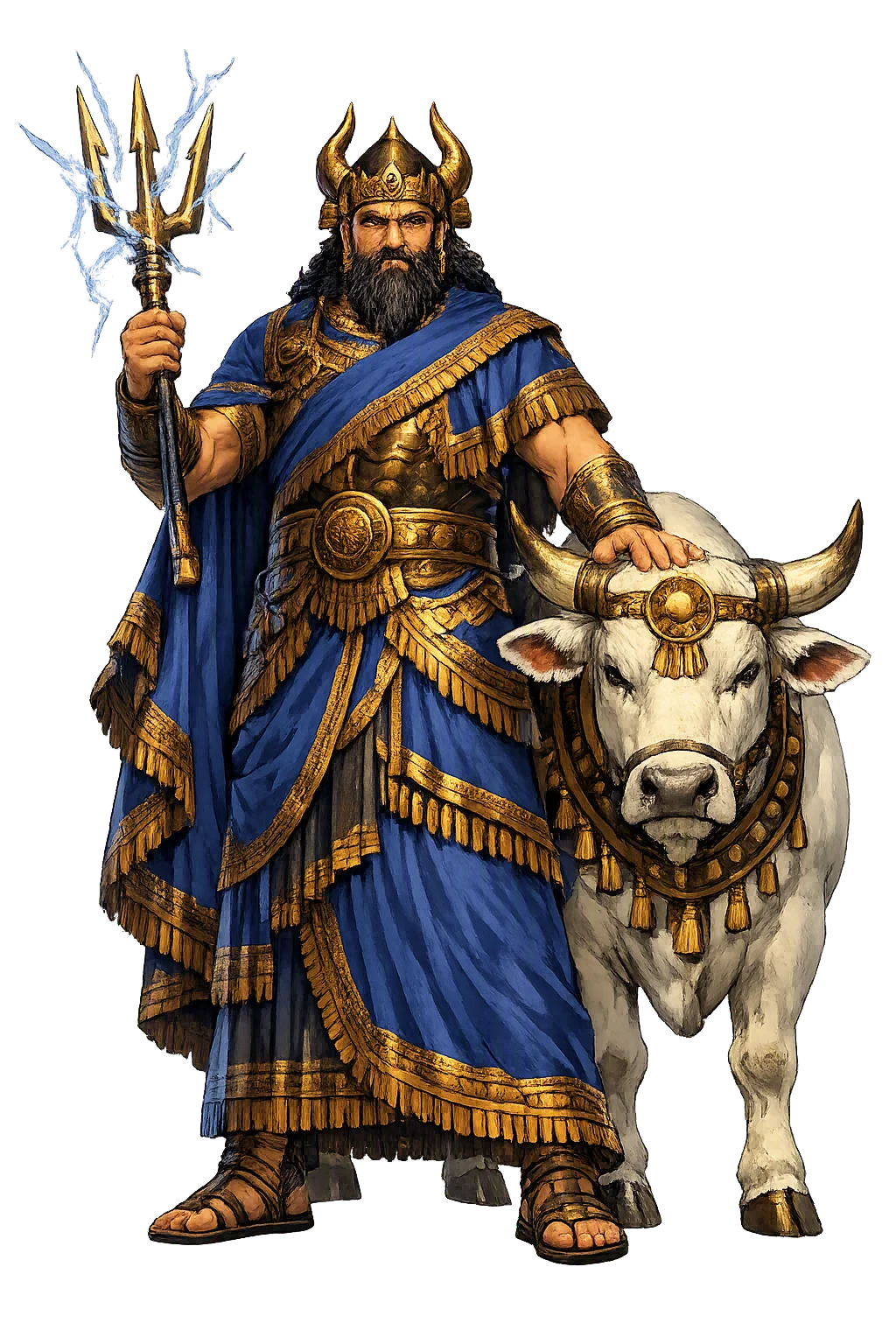
Adad is the Akkadian storm god, the lord of thunder and the divine voice that speaks in wind, rain, and lightning. In Sumerian he is Iškur; in the West Semitic world he is Addu or Hadad. Where Enlīl governs the wind and the cosmic decree, Adad is the storm's immediate, destructive, and life-giving power: the thunder that splits mountains, the flood that renews the plain, and the rain on which every Mesopotamian harvest depended.
This temple is a domainless flagship: the ASCII adad.com is unregistrable, so the restoration is displayed here without claiming ownership. The page functions as a philological and atmospheric reconstruction hub for one of the ancient Near East's most widely worshipped deities.
The thunderbolt that splits the sky and reveals the god's presence in the storm cloud.
Bull and lion are Adad's animals; the bull's bellow is the thunder that rolls across the plain.
Without Adad's winter rains the fields of Assyria and Babylonia would fail; the storm is also a fertility god.
Adad and Šamaš preside over divination; thunder and lightning were read as the god's answer to human questions.
From the original script to the living URL
𒀭𒅎
The name in its original Mesopotamian form. Adad (𒀭𒅎) is attested in the source tradition — “The thunderer”. Its original diacritics and script distinctions carry the full phonetic and orthographic weight of the source tradition.
adad
The plain adad form is identical to the Unicode restoration. Because this name is already written in Latin letters, no diacritics, stress, or script information were lost — only capitalization differs.
Adad
The Unicode restoration does not need to recover lost marks for Adad. Its value is canonical spelling and consistent cataloguing, not the reconstruction of erased orthography. The domain is readable as-is to both DNS and humanity.
Adad.com
This restoration is written entirely in ASCII letters — no Punycode encoding stands between Adad and the DNS. The domain reads identically to machines and to human eyes.
Owned, ideal, and ASCII forms of Adad
Adad
Restores 𒀭𒅎. The full Unicode restoration. adad.com is not in the PuniCodex collection — it is watched for release; if it drops, this temple upgrades to an owned flagship.
How Adad was spoken
How Adad travels from ancient script to the modern URL
Akkadian Adad (Sumerian Iškur) is the storm-god; the name probably belongs to a Semitic root for thunder/storm.
The lore you have read is the living myth. Extended Lore opens the scholarly vault beneath it: the cult and its material remains, a history of the image, the name after antiquity, a meditation on what the name still means, and the full scholarly apparatus — etymology, orthography, sources.
Enter Extended Lore