
How Yùhuáng got its accent back
The ASCII form yuhuang is missing something. Yùhuáng restores the marks the source language used to distinguish this name from a thousand others — and those marks change how the name is read, pronounced, and understood. This post explains, with the full scholarly record behind it, what each restored mark preserves: the Chinese characters evidence, the reconstructed sound, the myths the name carries, and the mechanical logic of what each restored mark preserves. By the end, the marks in Yùhuáng will look less like ornaments and more like what they are — recovered evidence, pinned back in its proper place.
At a Glance
- Restored name: Yùhuáng
- ASCII form: yuhuang
- Meaning: "Jade Emperor"
- Domain of influence: Jade Emperor, Heaven, Sovereignty
- Pantheon: Chinese
- Restoration: Preserves stress
- Original script: 玉皇 (Chinese characters)
- Live domain: yùhuáng.com
Overview
Yùhuáng (yuhuang) — Jade Emperor, Heaven, Sovereignty · Jade Emperor — belongs to the Chinese tradition, where it is catalogued under the domain "Jade Emperor, Heaven, Sovereignty". The name means "Jade Emperor".
Yùhuáng belongs to the Chinese tradition, where it is associated with jade emperor, heaven, sovereignty.
PuniCodex restores the name as Yùhuáng and serves its temple at yuhuang.com. The restoration preserves at least one distinctive feature — a diacritic or a distinctive letter — that the ASCII form loses, and exactly one historically valid Unicode restoration exists. The plain ASCII form yuhuang survives as a modern convenience imposed by the early domain-name system; the restoration, not the fallback, is the form the project defends as philologically complete.
The Name
The name is attested in Chinese characters as 玉皇. Etymologically it means "Jade Emperor".
Yù (玉) 'jade'; Huáng (皇) 'emperor, sovereign' — the supreme deity of Chinese folk religion and Taoist cosmology.
The ASCII form yuhuang survives only because the early domain-name system could not carry diacritics; it is a technological compromise, not an ancient spelling. The Unicode restoration Yùhuáng recovers the stress accent of the original directly in the address bar. The restoration preserves at least one distinctive feature — a diacritic or a distinctive letter — that the ASCII form loses, and exactly one historically valid Unicode restoration exists.
The letter-by-letter transformation runs:
- y → Y — Same, capitalized
- u → ù — Grave tone mark
- h → h — Same
- u → u — Same
- a → á — Acute tone mark
- n → n — Same
- g → g — Same
The canonical temple for this name is served at yuhuang.com.
Etymology & Roots
The recorded derivation reads: Yù (玉) 'jade'; Huáng (皇) 'emperor, sovereign' — the supreme deity of Chinese folk religion and Taoist cosmology.
The root gloss is "jade emperor."
The reconstruction is classed as attested.
The Original Script
The name is written in Chinese characters as 玉皇. This original script is the form against which the ASCII fallback yuhuang and the PuniCodex restoration Yùhuáng are measured: the restoration preserves its pitch accent of the written form, so that a reader typing the modern address still speaks the ancient name.
Pronunciation
The reconstructed pronunciation of the name is /yuhuang/ — Chinese Reconstruction.
Phoneme by phoneme:
- Y — Initial character of the restored form Yùhuáng.
- ùhuáng — Remainder of the name, preserving the distinctive marks of the Chinese tradition.
For the modern speaker, the closest approximation is: 'YUHUANG' — pronounce the restored form with attention to the preserved diacritics and length.
Kindred and historical forms of the name:
- Chinese — Yùhuáng, the restored Unicode form of the name
Yùhuáng preserves both features because the Chinese form preserves distinctive features that ASCII loses: stress, length, or special characters.
Mythology
The stories of Yùhuáng circulate within the Chinese corpus, where the figure embodies jade emperor, heaven, sovereignty.
Primary Attestation (Sources)
Yùhuáng is attested in the canonical Chinese sources as a figure associated with jade emperor, heaven, sovereignty.
Name and Meaning (Etymology)
The name means "Jade Emperor" and reflects the figure's role in the tradition. Yùhuáng, the Jade Emperor, is the supreme ruler of the Daoist celestial bureaucracy. He presides over the Three Realms—heaven, earth, and the underworld—and judges the dead at the Chinese New Year. His authority is administrative rather than creative; he delegates cosmic functions to a vast pantheon of ministers and generals. His birthday, celebrated on the ninth day of the first lunar month, involves offerings of incense, paper money, and vegetarian food across Chinese communities.
The Making of a Sovereign (Yuhuang benxing jijing)
The Daoist canon answers the obvious question — where does Heaven's emperor come from? — with a full sacred biography. The Scripture of the Jade Sovereign's Former Deeds (Gaoshang Yuhuang benxing jijing, in the Ming Daozang) tells of the childless king of the Kingdom of Wondrous Bliss, whose queen, after years of prayer to the Dao, dreams that the supreme Lord hands her an infant wrapped in radiance. The prince, grown, marvels that even his happy kingdom cannot spare him from death; he gives the throne to a worthy minister and withdraws to the mountain to cultivate the Way — through kalpas of austerity, service to prior immortals, and ordeal after ordeal, until he ascends as Yùhuáng, the Jade Sovereign of the clearest heaven.
The scripture thus gives the celestial throne a curriculum vitae: Heaven's ruler is not born but made, refined like an alchemist's elixir across ages no chronicle can hold.
The War Against the Demon Host (Benxing jijing · Popular Canon)
The same scripture and the popular tradition that grew from it give the future emperor his proving war. While the radiant prince still rules in his father's kingdom, a demon king — lord of black clouds, master of hosts — brings plague and darkness upon the world, and the gods of the older heavens cannot end him. The prince arms himself, and in the great battle that follows his radiance alone routs the demon armies; the defeated host swears fealty, and the victor — refusing even the throne of the conquered — returns to his mountain and his cultivation. Later novels, above all the Ming Investiture of the Gods (Fengshen yanyi), pour the same pattern over heaven itself, where the mandate passes from defeated tyrants to a righteous successor.
The myth's grammar is that of every dynastic founding: the old order falls not because the gods fail, but because the throne must change hands before its holder can be seen at all.
The Monkey and the Throne (Journey to the West, chs. 3–7)
In chapters 3–7 of the Ming novel Journey to the West, the Jade Emperor's heaven is the most vividly drawn bureaucracy in Chinese literature. When the stone-born monkey Sun Wukong arms himself in the dragon palace and erases his name from the registers of death, the celestial court debates: execute him or enroll him? He is enrolled — as Bimawen, a groom of heavenly horses — and when he discovers the rank is beneath his power, his rebellion lays open the whole military establishment: the pagoda-bearing general Li Jing, the thunder agents, the star officers all give way, until the Jade Emperor's own high ministers advise the one move left, and the Buddha comes.
The episode is comic, but its seriousness is structural: the Emperor of Heaven rules through precedent, rank, and memorial — and comedy is what happens when raw force meets paperwork that cannot imagine it.
Symbols & Iconography
The iconography associated with Yùhuáng concentrates in a small set of recurring attributes, each a compressed statement about the name:
- Restored Name — The Unicode form Yùhuáng carries the original marks of the Chinese tradition.
- Source Script — Attested in the original script as 玉皇.
- Domain — Jade Emperor, Heaven, Sovereignty
- Etymology — Jade Emperor
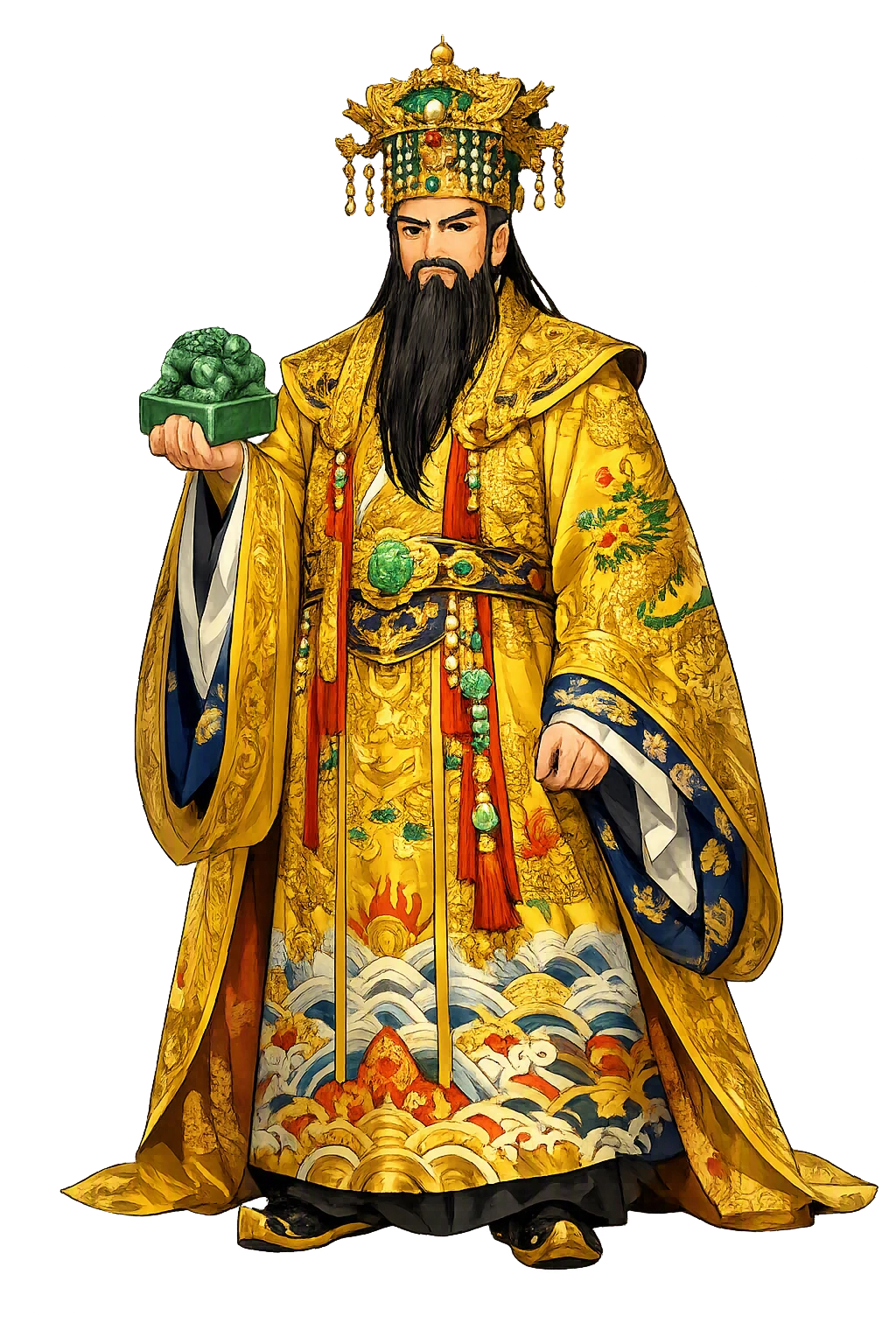
- The jade seal — The stamp that authenticates Heaven's decrees; jade itself — unchanging, luminous, and hard — is the substance of his name
- The beaded imperial crown (mianguan) — The twelve-strand curtain crown of the highest rank, marking him as sovereign of the celestial court
- The dragon throne — The axis of bureaucratic Heaven: from it issue the commissions of thunder, rain, and the registers of death
- The peach of immortality — The Queen Mother of the West's peaches, served at the banquet of the gods (Journey to the West, ch. 5)
- The memorial and the register — Petition and ledger: the machinery by which prayer ascends and fate descends
Archaeology & Evidence
The material record for Yùhuáng survives in a small number of securely identified remains, catalogued below; the corpus is thin but unambiguous, and each site is tied to the name by ancient testimony.
Yùhuáng is attested in the textual and iconographic record of the Chinese tradition.
Realm & Domain
Yùhuáng belongs to the Chinese tradition, where it is associated with jade emperor, heaven, sovereignty.
Jade Emperor
The central domain of Yùhuáng in the chinese tradition.
Jade Emperor
The name signifies "Jade Emperor".
Unicode Restoration
The restoration Yùhuáng recovers what plain ASCII yuhuang flattens.
Original Attestation
Attested in the sources as 玉皇. Yùhuáng's domain is the celestial court itself: law, destiny, and the moral ledger that determines fortune and rebirth.
The Throne of Heaven
Supreme administrator of the celestial bureaucracy — thunder, rain, plague, and the registers of life and death all report to his court.
Jade Sovereign
玉 yù, 'jade' — the incorruptible stone; 皇 huáng, 'sovereign': Heaven's ruler in the substance of Heaven.
Across Cultures
Yùhuáng appears within the Chinese tradition and has influenced later retellings, artistic depictions, and scholarly study. The Unicode restoration preserves the name's distinctive orthography for contemporary use.
Within the Chinese tradition, closely related names in the corpus include Bāguà, Cáishén, Cháng'é, Fúxī, Guāndì, and Guānyīn.
Cultural Legacy
Yùhuáng continues to appear in scholarship, art, and popular reception as a significant figure of the Chinese tradition. Restoring the name in Unicode returns the original marks that ASCII removes. The Jade Emperor is honored throughout the Chinese-speaking world during New Year rituals and in temple cults that blend Daoist, Buddhist, and folk elements.
The Scholarly Record
The account of Yùhuáng given in this edition rests on the witnesses and reference works listed below. Lexica and etymological dictionaries secure the form and meaning of the name; the literary and religious texts supply the narrative evidence.
- Unihan Database.
- Hanyu Da Zidian. Sources include Daoist scriptures, the Fengshen Yanyi, and ethnographic studies of Chinese popular religion.
A Meditation
Yùhuáng embodies jade emperor, heaven, sovereignty in the Chinese imagination. The name's restoration is not merely cosmetic: it recovers the stress, length, and script that make the figure recognizable in the source tradition.
The Unicode Restoration
Yùhuáng preserves stress. The ASCII fallback yuhuang still resolves everywhere, but it is the restored form that carries the name's full information. Across the 7 characters of the name, the restoration adjusts 2: 2 marks of stress (ù, á). That is the whole thesis of this temple: the marks are the message.
Name Variations
The lexicon records 1 additional form of the name:
- Jade Emperor (ascii) — Common English name
The temple uses Yùhuáng as the primary form: it is the spelling that best balances philological accuracy with the practical limits of DNS.
Character by Character
The journey from yuhuang to Yùhuáng, one character at a time:
- y → Y — Same, capitalized
- u → ù — Grave tone mark
- h → h — Same
- u → u — Same
- a → á — Acute tone mark
- n → n — Same
- g → g — Same
The Domain Name
The restored name is live as a working domain: yùhuáng.com, which the DNS carries in punycode form as xn--yhung-zqa9n.com — an ASCII-compatible encoding that lets a non-ASCII name travel the global network without breaking older infrastructure. The visitor sees Yùhuáng; the machines see the encoding. That duality is the engineering compromise on which the entire restoration rests, and it is why a name written the way its own tradition wrote it in Chinese characters can now be typed into any browser on earth.
The Chinese Pantheon
Yùhuáng is one of 59 entries the PuniCodex lexicon catalogues under the Chinese pantheon. The Pantheon page gathers the tradition's major figures in one place, and the Lexicon lets you filter all 983 restorations by tradition or script — the fastest way to see where this name sits among its kin.
Frequently Asked Questions
What does Yùhuáng mean? The traditional gloss is "Jade Emperor."
Which tradition does Yùhuáng belong to? Yùhuáng is catalogued in the Chinese pantheon of the PuniCodex lexicon.
What does Yùhuáng preserve that ASCII cannot show? The form itself answers: Yùhuáng preserves stress — and the marks in the restored spelling are exactly that evidence.
Is Yùhuáng a working domain? Yes — yùhuáng.com resolves today and routes to this temple.
What is the punycode for yùhuáng.com? The DNS encoding is xn--yhung-zqa9n.com; browsers perform the translation automatically, so visitors only ever see the restored name.
Can I use Yùhuáng in a normal browser? Yes. The DNS resolves the punycode form automatically, and the type tool on this site converts yuhuang to Yùhuáng for copying and pasting.
Where does the scholarly information come from? The entry is built from lexica, inscriptional evidence, and reviewed scholarly sources listed in the Scholarly Edition. Every claim is traceable to a canonical source.
Typing Yùhuáng
You do not need a special keyboard to use this restoration. The PuniCodex Type Tool converts the ASCII form yuhuang into Yùhuáng as you type, and the browser extension offers the same conversion inside any text field. Copy the restored form, paste it into the address bar, and the DNS does the rest.
Sister Temples
Other temples in the Chinese pantheon include Wénshū, Yámen, and Zhīnǚ — each with its own restoration story, its own scholarly record, and its own place in the lexicon.
Why This Restoration Matters
The marks in Yùhuáng were never lost; they were only waiting for a carrier that could hold them. Now that the carrier exists, the burden flips: every use of yuhuang is a choice to leave evidence on the table. The PuniCodex temple keeps the restored form in circulation — as a domain, a dataset entry, and a scholarly argument — so that the choice to use it stays easy. Accent by accent, macron by macron, that is how the original names come back: not with a single grand gesture, but with a spelling that finally works everywhere.
Explore Further
This post is one doorway into the temple. The home page carries the full character breakdown and the ambient canvas; the lore page tells the myths in long form; the Scholarly Edition preserves the sources, pronunciation data, and revision history; and the patron wall supports the restoration directly. For the wider map, browse the Lexicon, explore the Pantheon, or return to the PuniCodex blog.
A Closer Look at the Marks
A restored name is a small map. In Yùhuáng, the journey from the ASCII fallback yuhuang to the Unicode form can be read letter by letter, and each letter tells a story. Of the 7 characters, 5 remain unchanged; they anchor the name to its modern shape. The remaining adjustments recover marks the source tradition used to distinguish this name from every other word built from the same letters.
The y stays as it is — Same, capitalized.
The u becomes ù — Grave tone mark.
The h stays as it is — Same.
The u stays as it is — Same.
The a becomes á — Acute tone mark.
The n stays as it is — Same.
The g stays as it is — Same.
Together these changes are not decoration. They are the minimum set of marks needed to keep the name legible in its own tradition. Remove them and you still have a string of letters; you no longer have the name as it was written.
Yùhuáng in Its Tradition
Yùhuáng does not stand alone. It belongs to the Chinese tradition, where it is counted among 59 names in the PuniCodex lexicon. Its sphere — Jade Emperor, Heaven, Sovereignty — places it beside other figures who govern similar aspects of experience. The restored spelling is therefore not only a philological decision; it is a way of keeping the name in the company of its kin. When the address bar shows Yùhuáng, it marks the boundary between a generic search term and a named entry in a living catalog of myth. That catalog is the point of the project. Every restored name is a vote for specificity: the web should know the difference between a figure and a keyword, between a tradition and a trend. Yùhuáng is one such vote.
Related Names
Sources
The full scholarly apparatus — every citation, revision, and review — lives in the Scholarly Edition. Key references for this post:
- Shujing (Classic of Documents).
- Sima Qian, Shiji (Records of the Grand Historian).
- Daoist Canon (Daozang), Jade Emperor scriptures.
- Taoist canon (Dàozàng).
- Chinese Buddhist canon (Dàzàngjīng / Taishō Tripiṭaka).
- Chinese folk religion (syncretic temple practice).
- Unihan Database.
- Hanyu Da Zidian.
- Lexicon authorities for this entry: Chinese folk religion, Taoist canon, Yang.