
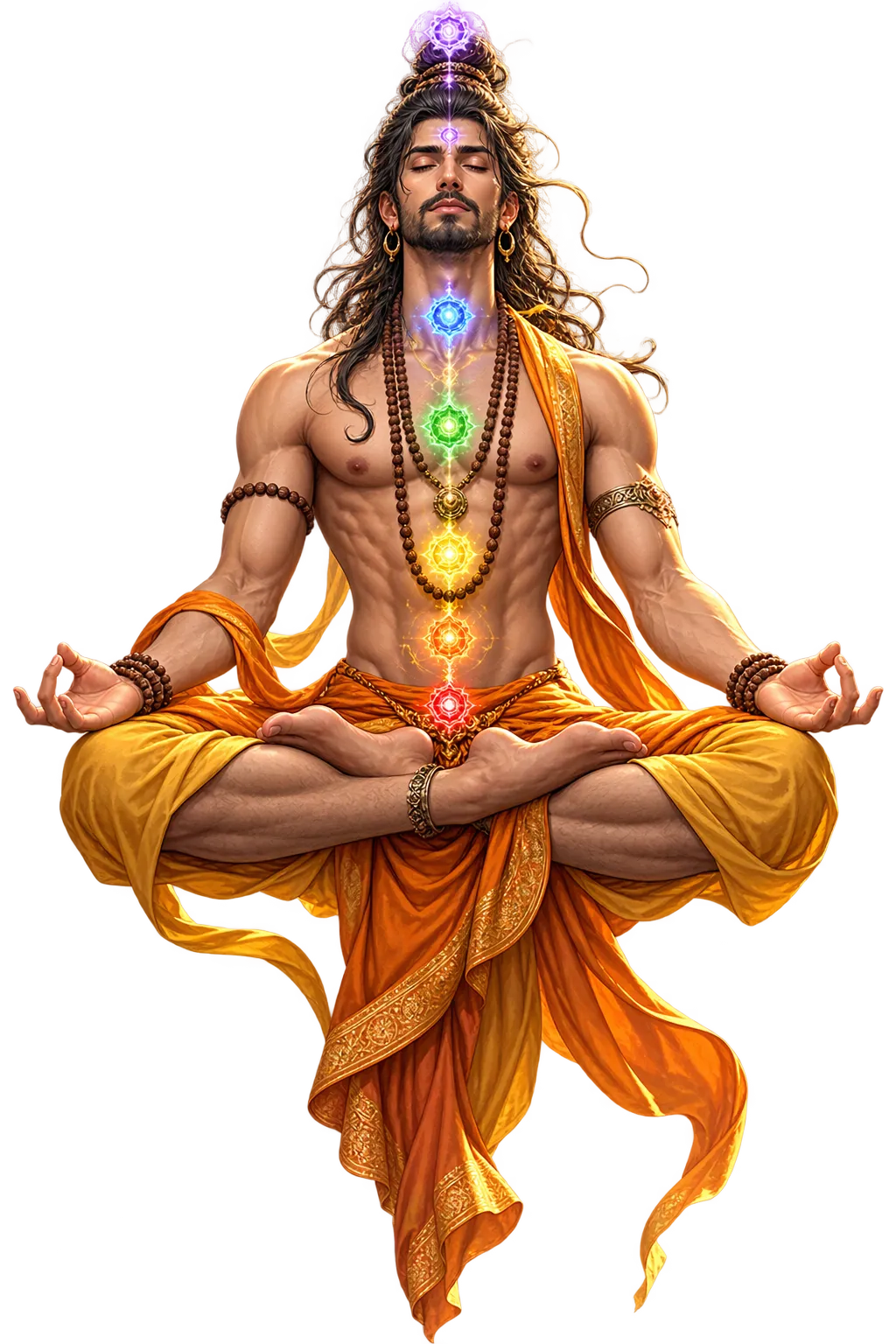
The hidden history behind Yoga
Behind the modern ASCII form yoga hides a much longer story. Yoga reaches back through manuscripts, inscriptions, and oral tradition long before it ever touched a keyboard, and every mark in the restored spelling is a receipt from that journey. In what follows we trace the name from its Devanagari attestations through its mythology, its cult, its symbols, and its afterlife in other cultures — and we show how the PuniCodex project turned that philological record into a Unicode domain that resolves today. The history was never lost. It was only waiting for the infrastructure to catch up.
At a Glance
- Restored name: Yoga
- ASCII form: yoga
- Meaning: "Union, yoking — spiritual and ascetic discipline by which the individual self is joined to the divine; also the name of one of the six orthodox schools of Hindu philosophy."
- Domain of influence: Union, Discipline
- Pantheon: Sanskrit
- Restoration: ASCII-equivalent form
- Original script: योग (Devanagari)
Overview
Yoga (yoga) — Union, the Yoking of Self to Divine · Union, yoking — spiritual and ascetic discipline by which the individual self is joined to the divine — belongs to the Sanskrit tradition, where it is catalogued under the domain "Union, Discipline". The name means "Union, yoking — spiritual and ascetic discipline by which the individual self is joined to the divine; also the name of one of the six orthodox schools of Hindu philosophy.".
Yoga is the discipline of union: the yoking — the same root as English ‘yoke’ — of mind, breath, and self to the still point beneath them. Born in the ascetic experiments of the late Vedic age, codified by Patañjali’s sūtras, it is both one of the six orthodox schools of Indian philosophy and, in the Bhagavadgītā’s teaching, the art of every act done without attachment to its fruit.
PuniCodex restores the name as Yoga and serves its temple at its temple. The restoration aSCII-equivalent form — a description computed from the displayed form itself. The plain ASCII form yoga survives as a modern convenience imposed by the early domain-name system; the restoration, not the fallback, is the form the project defends as philologically complete.
The Name
The name is attested in Devanagari as योग. Etymologically it means "Union, yoking — spiritual and ascetic discipline by which the individual self is joined to the divine; also the name of one of the six orthodox schools of Hindu philosophy.".
The ASCII form yoga survives only because the early domain-name system could not carry diacritics; it is a technological compromise, not an ancient spelling. The Unicode restoration Yoga recovers the full diacritic detail of the scholarly transliteration directly in the address bar. The restoration aSCII-equivalent form — a description computed from the displayed form itself.
The letter-by-letter transformation runs:
- y → Y — Same, capitalized
- o → o — Same
- g → g — Same
- a → a — Same
The Original Script
The name is preserved in Devanagari as योग.
The scholarly transliteration is Yoga.
The rendering proceeds step by step:
- Sanskrit Yoga is written in Devanagari as योग
- IAST transliteration maps each Devanagari vowel and consonant to a Latin equivalent
- Macrons mark long vowels (ā, ī, ū); dots beneath consonants mark retroflex articulation (ṭ, ḍ, ṇ, ṣ)
Pronunciation
The reconstructed pronunciation of the name is /ˈjoʊɡə/ — Sanskrit (IAST: Yoga).
Phoneme by phoneme:
- Yo- — From √yuj, “to yoke, join”; the o is long — the yoking of the self to the divine.
- -ga — The abstract noun: the yoking itself — the discipline by which union is achieved.
For the modern speaker, the closest approximation is: “YOH-guh”
Kindred and historical forms of the name:
- Latin — iugum, English “yoke” — the same Indo-European root
The word and English “yoke” are cousins: yoga is the yoke worn willingly. The root √yuj also yields English "yoke" — the cognate pair has named the same joining for five millennia.
Mythology
Yoga has no myths — it has sūtras, and the sūtras are their own literature of precision. Its ‘stories’ are the doctrine’s own history: the ascetics in the forests of the Upaniṣads, the Nātha-lineage’s wonder-working adepts, and the modern export that made a metaphysical discipline into the world’s most practised physical art.
The Chariot Simile (Kaṭha Upaniṣad)
The body the chariot, the senses the horses, the mind the reins, the intellect the driver, the rider the self: the Kaṭha Upaniṣad’s simile is the oldest complete map of the psychophysical discipline. Who holds the reins attains the end of the road — ‘the still place from which the wise do not return’.
The Yoga of Three Paths (Bhagavadgītā)
The Gītā democratizes the discipline: jñāna-yoga of knowledge for the philosopher, karma-yoga of selfless work for the householder, bhakti-yoga of devotion for the lover of god. ‘Yogasthaḥ kuru karmāṇi’ — established in yoga, act — is the verse on which Gandhi claimed to have fed his whole life.
The One Hundred Ninety-Five Sūtras (Patañjali)
Patañjali’s Yoga-sūtra — c. 195 aphorisms — systematized what had been experiment: the eight limbs, the afflictions, the meditative absorptions, the supernormal powers that are signs on the path and traps at its end. Commentators from Vyāsa to the present have kept it the living constitution of the discipline.
The Immortal Teachers (Nātha Lineage)
The medieval Nātha order gave yoga its adepts-legend: Matsyendra caught among the fishes, Gorakṣa the miracle-working founder, and later figures claimed to walk the centuries — the siddhas, perfected ones, whose bodies outlast death. Hatha-yoga’s physical canon comes from this line of embodied experimenters.
Symbols & Iconography
The iconography associated with Yoga concentrates in a small set of recurring attributes, each a compressed statement about the name:
- The Eight Limbs — Patañjali’s aṣṭāṅga: restraint, observance, posture, breath, withdrawal, focus, meditation, absorption.
- Union of Rivers — The yogin joins mind to breath to object as rivers join the sea — the Upaniṣadic image.
- Yoga in the Gītā — Skill in action: the yogin works without craving the fruit — karma-yoga as the path for the householder.
- The Cessation of the Waves — Patañjali’s definition: yogaś citta-vṛtti-nirodhaḥ — the stilling of thought’s waves, so the seer abides in itself.
Archaeology & Evidence
The material record for Yoga survives in a small number of securely identified remains, catalogued below; the corpus is thin but unambiguous, and each site is tied to the name by ancient testimony.
The discipline leaves postures, not temples: the Mohenjo-daro seal of a figure in yogic seat (its identity debated), the Mathura images of śramaṇa ascetics, and the modern globe’s studios. The oldest ‘monument’ is the human body arranged to be still.
Realm & Domain
Yoga is the discipline of union: the yoking — the same root as English ‘yoke’ — of mind, breath, and self to the still point beneath them. Born in the ascetic experiments of the late Vedic age, codified by Patañjali’s sūtras, it is both one of the six orthodox schools of Indian philosophy and, in the Bhagavadgītā’s teaching, the art of every act done without attachment to its fruit.
The Eight Limbs
Patañjali’s aṣṭāṅga: restraint, observance, posture, breath, withdrawal, focus, meditation, absorption.
Union of Rivers
The yogin joins mind to breath to object as rivers join the sea — the Upaniṣadic image.
Yoga in the Gītā
Skill in action: the yogin works without craving the fruit — karma-yoga as the path for the householder.
The Cessation of the Waves
Patañjali’s definition: yogaś citta-vṛtti-nirodhaḥ — the stilling of thought’s waves, so the seer abides in itself.
Across Cultures
Buddhism and Jainism adopted yoga wholesale — the Buddha’s dhyāna is Patañjali’s dhāraṇā by another name — while Sufi India found its own correspondences. The modern export reversed the flow: haṭha-yoga, stripped of metaphysics, returned to India from the West as physical culture before being re-spiritualized. The word is now claimed by three civilizations at once.
Within the Sanskrit tradition, closely related names in the corpus include Aditi, Agni, Ambikā, Aṃśa, Arjuna, and Bhakti.
Cultural Legacy
Some two hundred million people practise asana today — the largest following of any discipline in the lexicon. ‘Yoga’ entered English as a loan-word a century ago and now needs no italics. The discipline’s texts stand, with the Upaniṣads and the Gītā, among the world’s most translated and most printed books.
The Scholarly Record
The account of Yoga given in this edition rests on the witnesses and reference works listed below. Lexica and etymological dictionaries secure the form and meaning of the name; the literary and religious texts supply the narrative evidence.
- Kaṭha Upaniṣad 1.3 (the chariot simile).
- Bhagavadgītā 2.48 (yoga as skill in action).
- Patañjali, Yoga-sūtra 1.2 and 2.29.
- Hatha-yoga-pradīpikā (medieval physical canon).
A Meditation
Yoga: the yoke that joins — and the word itself is joined, across four millennia and two language families, to ‘yoke’. Restored plainly, it demonstrates what the discipline teaches: the simplest form can carry the heaviest joining. Two syllables, one root, half the planet practising.
The Unicode Restoration
Yoga aSCII-equivalent form. The ASCII fallback yoga still resolves everywhere, but it is the restored form that carries the name's full information. That is the whole thesis of this temple: the marks are the message.
Character by Character
The journey from yoga to Yoga, one character at a time:
- y → Y — Same, capitalized
- o → o — Same
- g → g — Same
- a → a — Same
The Sanskrit Pantheon
Yoga is one of 102 entries the PuniCodex lexicon catalogues under the Sanskrit pantheon. The Pantheon page gathers the tradition's major figures in one place, and the Lexicon lets you filter all 983 restorations by tradition or script — the fastest way to see where this name sits among its kin.
Frequently Asked Questions
What does Yoga mean? The traditional gloss is "Union, yoking — spiritual and ascetic discipline by which the individual self is joined to the divine; also the name of one of the six orthodox schools of Hindu philosophy.."
Which tradition does Yoga belong to? Yoga is catalogued in the Sanskrit pantheon of the PuniCodex lexicon.
What does Yoga preserve that ASCII cannot show? The form itself answers: Yoga aSCII-equivalent form — and the marks in the restored spelling are exactly that evidence.
Can I use Yoga in a normal browser? Yes. The DNS resolves the punycode form automatically, and the type tool on this site converts yoga to Yoga for copying and pasting.
Where does the scholarly information come from? The entry is built from lexica, inscriptional evidence, and reviewed scholarly sources listed in the Scholarly Edition. Every claim is traceable to a canonical source.
Typing Yoga
You do not need a special keyboard to use this restoration. The PuniCodex Type Tool converts the ASCII form yoga into Yoga as you type, and the browser extension offers the same conversion inside any text field. Copy the restored form, paste it into the address bar, and the DNS does the rest.
Sister Temples
Other temples in the Sanskrit pantheon include Nārada, Oṃ, and Prajāpati — each with its own restoration story, its own scholarly record, and its own place in the lexicon.
Why This Restoration Matters
The story of Yoga did not end in antiquity; it changed medium. Names that survive for millennia do so because each generation finds a new carrier for them — clay, papyrus, print, and now DNS. The PuniCodex restoration simply makes the carrier honest: the spelling that resolves is the spelling the evidence supports. If this post showed anything, it is that yoga and Yoga are not the same name with different styling. They are a summary and the text it summarizes. The web can now serve the text.
Explore Further
This post is one doorway into the temple. The home page carries the full character breakdown and the ambient canvas; the lore page tells the myths in long form; the Scholarly Edition preserves the sources, pronunciation data, and revision history; and the patron wall supports the restoration directly. For the wider map, browse the Lexicon, explore the Pantheon, or return to the PuniCodex blog.
A Closer Look at the Marks
A restored name is a small map. In the case of Yoga, the map does not lead through diacritics or special letters, because the source tradition wrote the name in Devanagari rather than in the Latin alphabet. The ASCII form yoga and the restored form share the same letters; the restoration is a decision about which conventional spelling should serve as the public reference.
That decision is not cosmetic. The original script attestation carries semantic and phonetic information that no romanization can fully reproduce. By fixing one conventional spelling as the canonical domain form, the project prevents the drift that happens when a name is romanized differently in every article, map, and database. The breakdown still lists each character — y, o, g, a — so visitors can see exactly what is being carried forward and what is not. What looks like "no change" is, in fact, a deliberate choice to keep the name stable, searchable, and addressable.
Yoga in Its Tradition
Yoga does not stand alone. It belongs to the Sanskrit tradition, where it is counted among 102 names in the PuniCodex lexicon. Its sphere — Union, Discipline — places it beside other figures who govern similar aspects of experience. The restored spelling is therefore not only a philological decision; it is a way of keeping the name in the company of its kin. When the address bar shows Yoga, it marks the boundary between a generic search term and a named entry in a living catalog of myth. That catalog is the point of the project. Every restored name is a vote for specificity: the web should know the difference between a figure and a keyword, between a tradition and a trend. Yoga is one such vote.
What You Will Find in the Temple
The temple page for Yoga is more than a landing page. The home tab presents the character breakdown, the pronunciation guide, and the live domain status in a single view. The lore tab gathers the myths and narratives that give the name its depth. The Scholarly Edition tab publishes the sources, variant forms, and review history that justify the restoration. Industry patterns show where the name appears in modern commerce and culture, while the gallery and creatives tabs collect visual and sponsor material. The patron wall lets visitors support the restoration directly. Each tab is generated from the same canonical sources, so the domain, the blog, the scholars page, and the search index all agree. The result is a single source of truth about a name, delivered through several doors.
The Restoration on the Live Web
A domain name is a kind of publication. When Yoga resolves, it proves that the restored spelling is not a theoretical exercise; it is a working address on the public internet. Search engines can index it, language models can encounter it, and anyone who copies it from a manuscript can paste it into a browser. That practical reality changes the status of the restoration. Before Unicode domains, a scholar could write the name correctly in an article while the public web flattened it to yoga. Now the public web can carry the correct form end to end. The punycode translation happens silently, so the infrastructure remains compatible while the visible name keeps its marks. That compromise — human-readable restoration, machine-readable encoding — is the foundation of every PuniCodex temple.
Restoration Notes
Restoring a name is not a single decision; it is a sequence of smaller decisions, each backed by a different kind of evidence. For Yoga, the chain begins with the attested form in Devanagari, continues through the standard scholarly romanizations, and ends with the DNS-compatible Unicode spelling used by this temple. The meaning "Union, yoking — spiritual and ascetic discipline by which the individual self is joined to the divine; also the name of one of the six orthodox schools of Hindu philosophy." anchors the name in its semantic field; without that anchor, the marks would float free of the figure they name. The restored form Yoga and the ASCII form yoga share the same Latin letters; the restoration here is a conventional capitalization rather than a recovery of lost diacritics or special characters. Those adjustments are not arbitrary styling. They follow the restoration logic the displayed form wears openly: Yoga aSCII-equivalent form. The rule is mechanical, not editorial, which means the same standard applies to every entry in the lexicon. A visitor who disagrees with the classification can at least see exactly which evidence produced it, because every step is recorded in the Scholarly Edition. That transparency is the difference between a restoration project and a branding exercise. The name is being put back, not invented.
Related Names
Sources
The full scholarly apparatus — every citation, revision, and review — lives in the Scholarly Edition. Key references for this post:
- Kaṭha Upaniṣad 1.3 (the chariot simile).
- Bhagavadgītā 2.48 (yoga as skill in action).
- Patañjali, Yoga-sūtra 1.2 and 2.29.
- Monier-Williams Sanskrit-English Dictionary.
- Lexicon authorities for this entry: MW, Yoga Sutras.