The Living Myth
Union, Discipline · Union, the Yoking of Self to Divine · Union, yoking — spiritual and ascetic discipline by which the individual self is joined to the divine
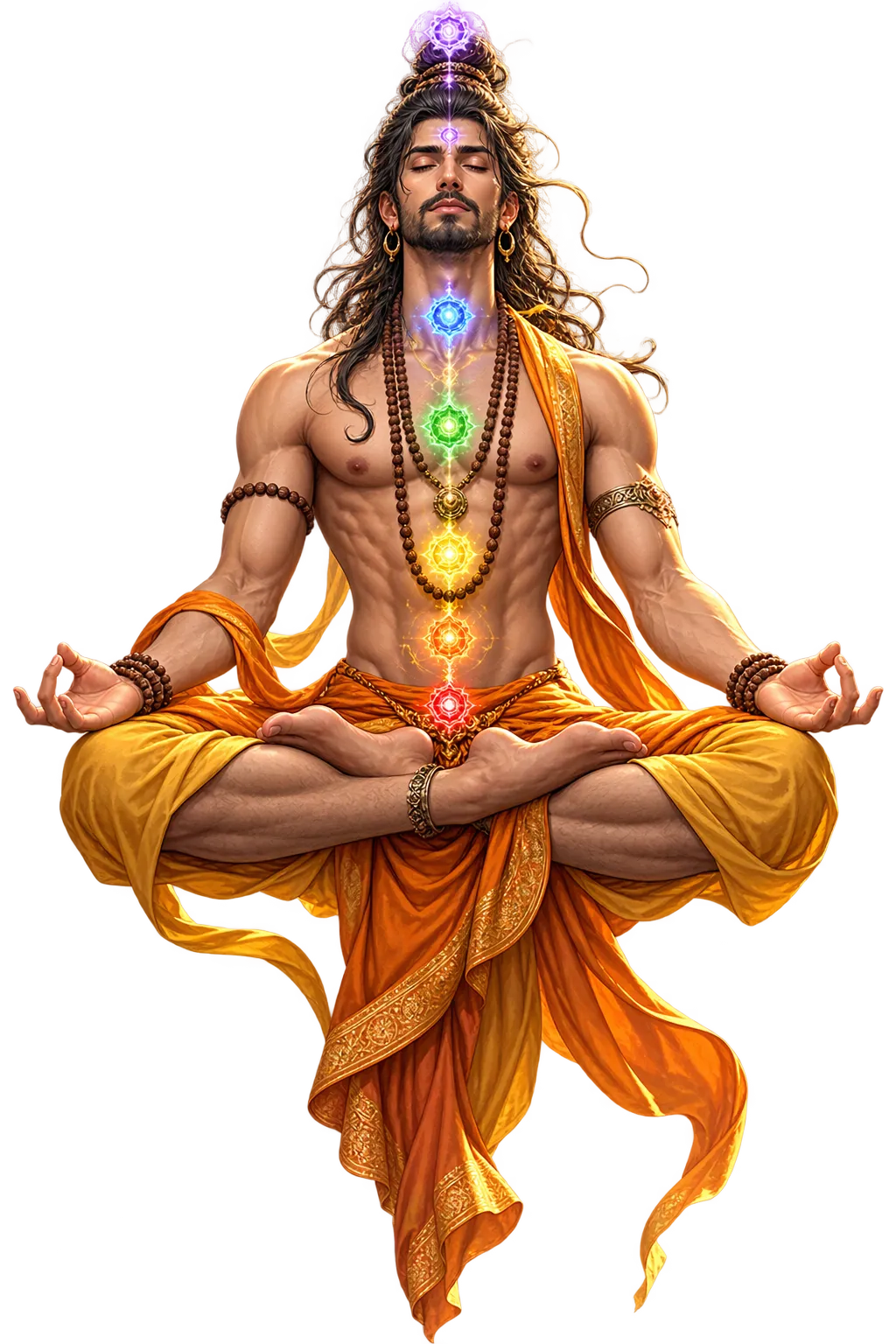
Stories of Yoga
Yoga has no myths — it has sūtras, and the sūtras are their own literature of precision. Its ‘stories’ are the doctrine’s own history: the ascetics in the forests of the Upaniṣads, the Nātha-lineage’s wonder-working adepts, and the modern export that made a metaphysical discipline into the world’s most practised physical art.
The body the chariot, the senses the horses, the mind the reins, the intellect the driver, the rider the self: the Kaṭha Upaniṣad’s simile is the oldest complete map of the psychophysical discipline. Who holds the reins attains the end of the road — ‘the still place from which the wise do not return’.
The Gītā democratizes the discipline: jñāna-yoga of knowledge for the philosopher, karma-yoga of selfless work for the householder, bhakti-yoga of devotion for the lover of god. ‘Yogasthaḥ kuru karmāṇi’ — established in yoga, act — is the verse on which Gandhi claimed to have fed his whole life.
Patañjali’s Yoga-sūtra — c. 195 aphorisms — systematized what had been experiment: the eight limbs, the afflictions, the meditative absorptions, the supernormal powers that are signs on the path and traps at its end. Commentators from Vyāsa to the present have kept it the living constitution of the discipline.
The medieval Nātha order gave yoga its adepts-legend: Matsyendra caught among the fishes, Gorakṣa the miracle-working founder, and later figures claimed to walk the centuries — the siddhas, perfected ones, whose bodies outlast death. Hatha-yoga’s physical canon comes from this line of embodied experimenters.
The Discipline That Joins
Yoga is the discipline of union: the yoking — the same root as English ‘yoke’ — of mind, breath, and self to the still point beneath them. Born in the ascetic experiments of the late Vedic age, codified by Patañjali’s sūtras, it is both one of the six orthodox schools of Indian philosophy and, in the Bhagavadgītā’s teaching, the art of every act done without attachment to its fruit.
Patañjali’s aṣṭāṅga: restraint, observance, posture, breath, withdrawal, focus, meditation, absorption.
The yogin joins mind to breath to object as rivers join the sea — the Upaniṣadic image.
Skill in action: the yogin works without craving the fruit — karma-yoga as the path for the householder.
Patañjali’s definition: yogaś citta-vṛtti-nirodhaḥ — the stilling of thought’s waves, so the seer abides in itself.
From the original script to the living URL
योग
The name in its original Sanskrit form. Yoga (योग) is attested in the source tradition — “Union, yoking — spiritual and ascetic discipline by which the individual self is joined to the divine; also the name of one of the six orthodox schools of Hindu philosophy.”. Its original diacritics and script distinctions carry the full phonetic and orthographic weight of the source tradition.
yoga
The plain yoga form is identical to the Unicode restoration. Because this name is already written in Latin letters, no diacritics, stress, or script information were lost — only capitalization differs.
Yoga
The Unicode restoration does not need to recover lost marks for Yoga. Its value is canonical spelling and consistent cataloguing, not the reconstruction of erased orthography. The domain is readable as-is to both DNS and humanity.
Yoga.com
This restoration is written entirely in ASCII letters — no Punycode encoding stands between Yoga and the DNS. The domain reads identically to machines and to human eyes.
The attested spelling family of Yoga
Yoga
Restores योग. The full Unicode restoration. yoga.com is not in the PuniCodex collection — it is watched for release; if it drops, this temple upgrades to an owned flagship. Attested by MW, Yoga Sutras.
How Yoga was spoken
How Yoga travels from ancient script to the modern URL
The lore you have read is the living myth. Extended Lore opens the scholarly vault beneath it: the cult and its material remains, a history of the image, the name after antiquity, a meditation on what the name still means, and the full scholarly apparatus — etymology, orthography, sources.
Enter Extended Lore