
The Cult
No priesthood — the practitioner is the officiant. The daily āsana and prāṇāyāma are the liturgy; the guru is the tradition’s single human institution. International Day of Yoga (June 21) is its largest annual congregation.
Extended Lore
Etymology · Orthography · Cult · Iconography · Reception · Sources
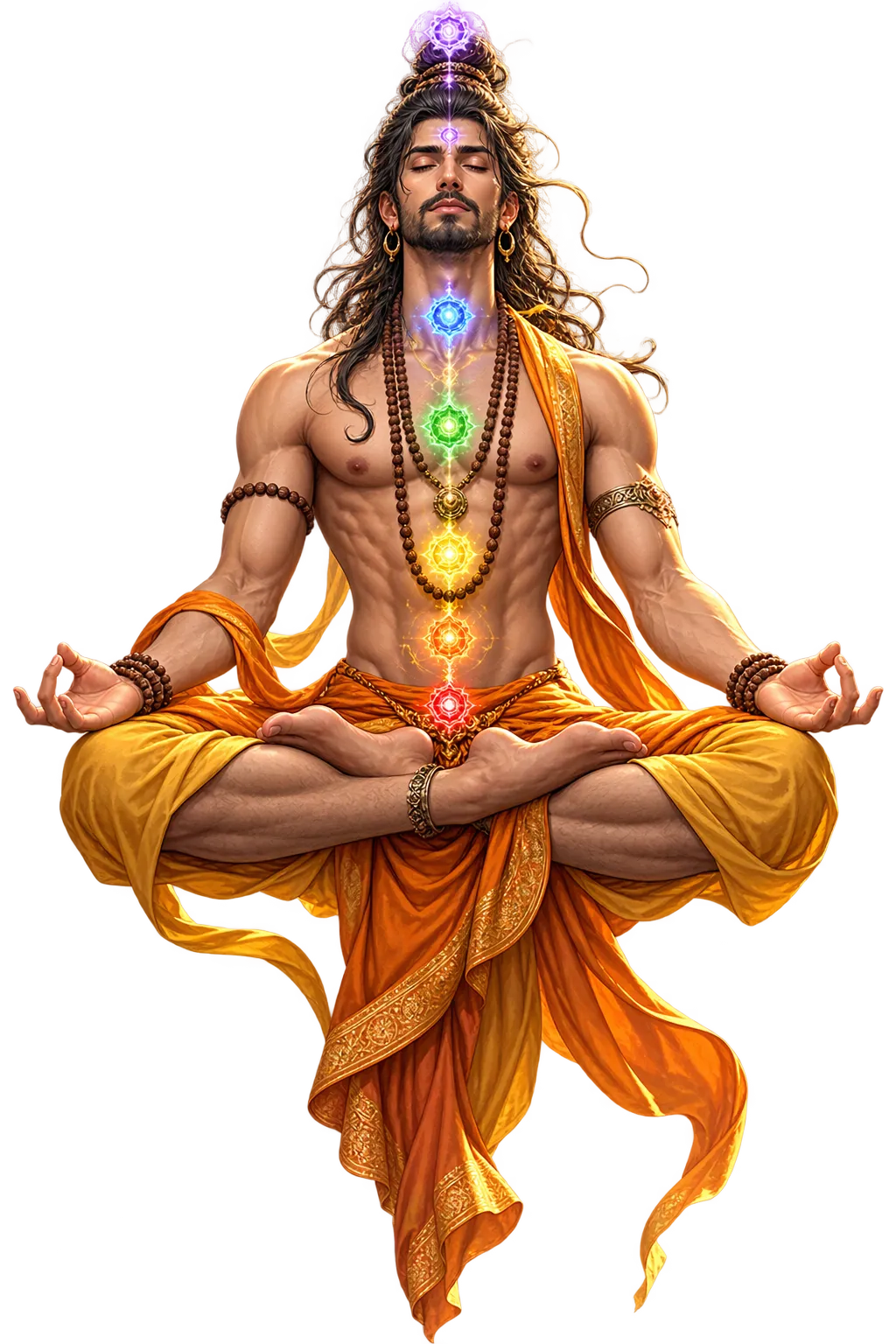
Essential information about Yoga, Union, Discipline
From original script to Unicode restoration
The name Yoga reaches the modern world through scholarly transliteration of the sanskrit tradition. Because the conventional spelling uses only Latin letters, its Unicode and ASCII forms coincide — the tradition it carries is in the name itself, not in diacritics.
Character-by-character philological analysis
| Character | Unicode | Name | Block | Phonetic Role |
|---|---|---|---|---|
| Y | U+0059 | Latin Capital Letter Y | Basic Latin | Same, capitalized |
| o | U+006F | Latin Small Letter O | Basic Latin | Same |
| g | U+0067 | Latin Small Letter G | Basic Latin | Same |
| a | U+0061 | Latin Small Letter A | Basic Latin | Same |
This restoration reflects fidelity to the attested tradition, not recovered diacritics: every character of Yoga already survives in ASCII. What the restoration preserves is the canonical spelling itself — the form scholarship standardised.
How the sacred was kept — rites, sanctuaries, remains
No priesthood — the practitioner is the officiant. The daily āsana and prāṇāyāma are the liturgy; the guru is the tradition’s single human institution. International Day of Yoga (June 21) is its largest annual congregation.
The discipline leaves postures, not temples: the Mohenjo-daro seal of a figure in yogic seat (its identity debated), the Mathura images of śramaṇa ascetics, and the modern globe’s studios. The oldest ‘monument’ is the human body arranged to be still.
How Yoga was imaged across the ages
The seated ascetic — Śiva as Yogīśvara, lord of yogis, on the Elephanta reliefs — is the discipline’s master-image: stillness arranged. The cakra-diagrams of the subtle body and the haṭha-yoga’s diagrams of the inner sun and moon are its anatomy.
The name after its own age — transmission, translation, survival
The modern world received yoga twice: first as esoteric philosophy through theosophy, then as physical culture through the global āsana movement. Scholars debate what was lost and what survived; the practice itself — two hundred million daily acts of stillness — is the largest living answer the lexicon contains.
Buddhism and Jainism adopted yoga wholesale — the Buddha’s dhyāna is Patañjali’s dhāraṇā by another name — while Sufi India found its own correspondences. The modern export reversed the flow: haṭha-yoga, stripped of metaphysics, returned to India from the West as physical culture before being re-spiritualized. The word is now claimed by three civilizations at once.
Some two hundred million people practise asana today — the largest following of any discipline in the lexicon. ‘Yoga’ entered English as a loan-word a century ago and now needs no italics. The discipline’s texts stand, with the Upaniṣads and the Gītā, among the world’s most translated and most printed books.
What Yoga means — beyond the dictionary
Yoga: the yoke that joins — and the word itself is joined, across four millennia and two language families, to ‘yoke’. Restored plainly, it demonstrates what the discipline teaches: the simplest form can carry the heaviest joining. Two syllables, one root, half the planet practising.
Common questions about Yoga, Union, Discipline, and Unicode restoration
In reconstructed pronunciation, Yoga is /ˈjoʊɡə/ — approximately “YOH-guh”.
Yoga means Union, yoking — spiritual and ascetic discipline by which the individual self is joined to the divine; also the name of one of the six orthodox schools of Hindu philosophy. in the sanskrit tradition.
Yoga is associated with The Eight Limbs (Patañjali’s aṣṭāṅga: restraint, observance, posture, breath, withdrawal, focus, meditation, absorption.), Union of Rivers (The yogin joins mind to breath to object as rivers join the sea — the Upaniṣadic image.), Yoga in the Gītā (Skill in action: the yogin works without craving the fruit — karma-yoga as the path for the householder.), The Cessation of the Waves (Patañjali’s definition: yogaś citta-vṛtti-nirodhaḥ — the stilling of thought’s waves, so the seer abides in itself.).
Yoga is written entirely in ASCII letters, so its restoration is about canonical fidelity rather than recovered diacritics: the temple fixes the name in its scholarly standard spelling, attested in the source tradition, instead of leaving it to drift.
“The Chariot Simile” — the Kaṭha Upaniṣad story that anchors the mythology of Yoga, told in full on the lore page.
The philological foundations of this restoration
Every claim on this page is grounded in established scholarship. The orthographic restorations follow disciplinary convention. The etymological chain follows the best available reference works. This is not invention — it is resurrection through scholarship.
You have traced the name from its earliest attestation to its Unicode restoration. Now return to the myth. The story is where the name lives.
Back to Lore