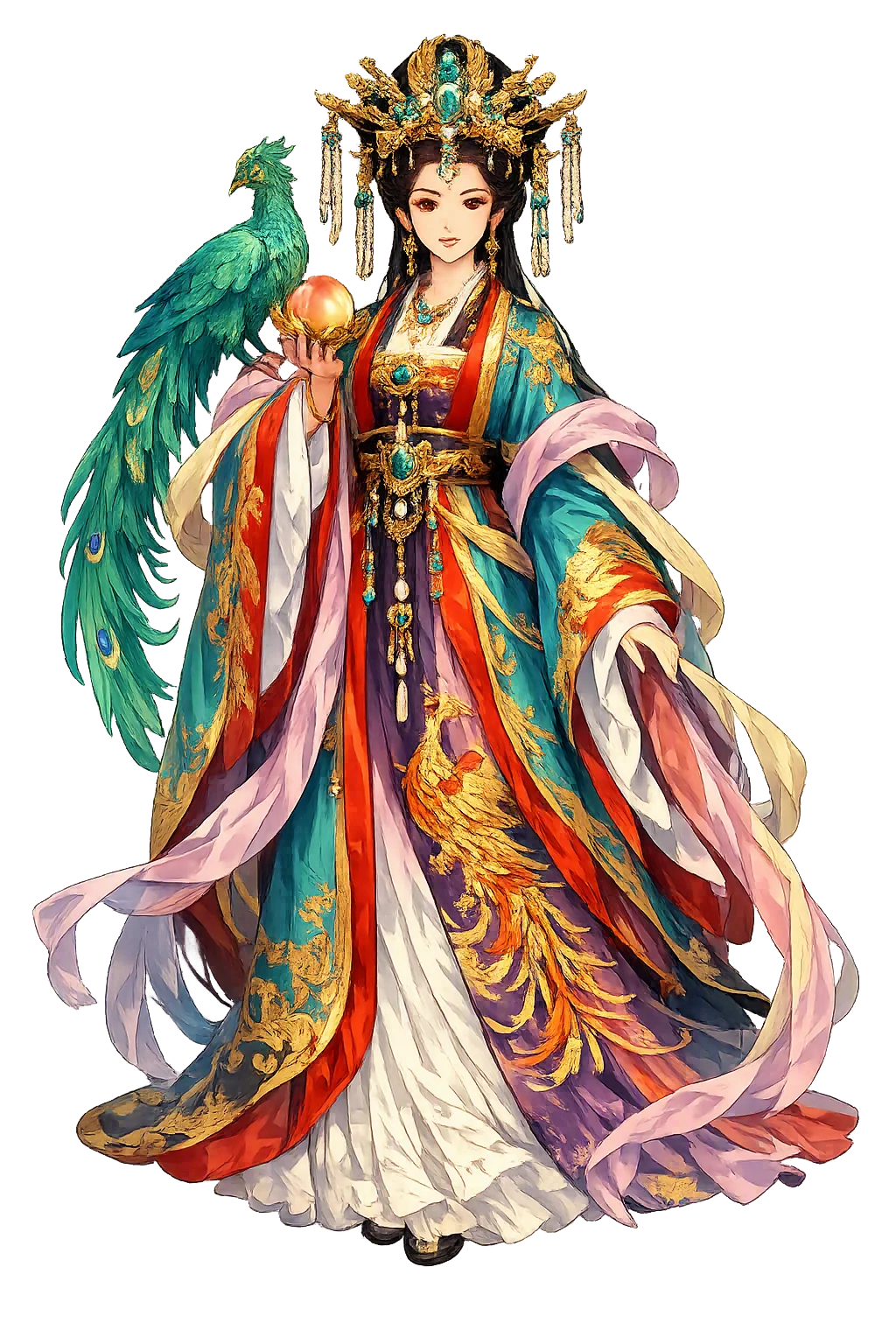
Stories of Xīwángmǔ
Xīwángmǔ's myths trace an arc no other Chinese deity matches: from wilderness terror to the most gracious sovereign of the Taoist heavens. Each age kept something of the last, so that the serene hostess of the Peach Banquet still carries the teeth and tail of the mountain power she once was.
Her oldest portrait is the strangest. In the Classic of Mountains and Seas, compiled from Warring States to Han materials, the Queen Mother "has the form of a human, the tail of a leopard, the teeth of a tiger, and is good at whistling; her tangled hair is bound with a sheng headdress" (ch. 2, Xishan jing). A later stratum adds her office — she "presides over the calamities of heaven and the five punishments" (ch. 16, Dahuang xi jing), seated on Mount Kūnlún with three azure birds to fetch her food. She is not yet a queen in any courtly sense. She is the numinous danger of the far west itself: the lands where the sun goes down, source of plague and of everything the settled world cannot control. Later ages would dress her in silk and seat her among goddesses — but the earliest text keeps her wild, and the wildness never entirely left the throne.
It is from Xīwángmǔ that immortality flows. The Huainanzi records that Hòuyì, the archer who shot down the nine excess suns, "begged the elixir of undying from the Queen Mother of the West" — and that his wife Héng'é stole it and fled to the moon, where she became the moon's goddess (her name later softened to Cháng'é under a Han emperor's name-taboo). Versions disagree about the theft — greed, fear, or rescue of the elixir from unworthy hands — but they agree on the source: no one in the Chinese cosmos rises beyond death except through the Queen Mother's treasury. The same storehouse reappears in every later system: her peaches ripen once in three thousand years; her banquet seats the assembled immortals; her garden is raided in every retelling of the Monkey King. Sovereignty over the boundary between life and death was her first office and remained her last — whether she wore a leopard's tail or a phoenix crown.
The Queen Mother was never only a goddess of mirrors and palace ladies. In 3 BCE — recorded in the Book of Han (ch. 11, Annals of Emperor Ai) — her cult ignited across the empire: crowds in more than twenty commanderies passed her tally-tokens (chóu) from hand to hand, sang and danced in the streets, wore her tokens, and converged on the capitals "thousands strung together", awaiting the fulfilment of her promise. The movement alarmed the court enough to be entered in the dynastic history — one of the earliest documented popular religious movements in China, three centuries before the organized Daoist church. The tallies were small pieces of wood, and their passing was the whole theology: a pledge, from the goddess of the west, that the world as it was could not last. The chroniclers record the phenomenon and not the promise. The crowds, clearly, knew what they were waiting for.
Once in three thousand years the Peaches of Immortality ripen in the Queen Mother's orchard, and once in three thousand years she hosts the pántáohuì, the Peach Banquet, for the assembled immortals, gods, and buddhas of the three religions. In Journey to the West (ch. 5) the task of guarding the orchard is given, with fatal optimism, to Sūn Wùkōng — who samples the fruit systematically, dining on the 3,000-year, 6,000-year, and 9,000-year trees alike, and then crashes the feast itself in a disguise borrowed from a serving goddess. It is one of literature's great heists, and its comedy rests on real theology: the peaches are the most tightly held treasure in heaven, ripening on a schedule longer than recorded history, and the Queen Mother is their unanswerable custodian. The Monkey King's appetite did what no god could. It made her orchard — and her three-thousand-year patience — the most famous garden in Chinese fiction.
Before she was a Taoist sovereign she was a royal hostess. The Mu Tianzi Zhuan (Account of King Mu) — a Warring States text unearthed in 281 CE from a Wei royal tomb — sends King Mu of Zhou to her Jasper Pool (Yáochí) at the western edge of the world. There she receives the traveling king as an equal: she sings to him in the text's archaic verse — "white clouds in the sky, the road long, mountains between us; may you not die, and come again" — and he answers in kind before turning his eight-horse team east. The scene is her earliest humane portrait, and it fixed two things: the title by which Taiwanese temples still know her, Golden Mother of the Jasper Pool, and her oldest character — not empress, not bureaucrat, but the hostess at the end of the road, inviting the greatest traveler of the age to live long enough to come back. Every later banquet descends from that first cup of wine at the edge of the world.
The Peaches of Immortality, Mount Kūnlún, and the Taming of a Wilderness Goddess
Xīwángmǔ, the Queen Mother of the West, has the strangest biography of any great Chinese goddess: in the oldest text she is a tiger-toothed power of plague on Mount Kūnlún; by the Han she is enthroned in the western paradise; by the Tang she hosts the Peach Banquet and guards the elixir. The wilderness was never banished from her — it was enthroned.
Her paradise stands on Mount Kūnlún at the western edge of the world, the axis where heaven leans down to meet the wild earth.
The pántáo ripen once every three thousand years; to taste one is to step outside death's jurisdiction — which is why the Monkey King could not resist them.
Her archaic form keeps its claws: the Shān Hǎi Jīng gives her a tiger's teeth and a leopard's tail, the regalia of a mistress of plague and calamity.
In mature Taoist theology she rules yin, the west, and all goddesses, balanced against Dōngwánggōng's yang and east — the two poles of a complete cosmos.
From the original script to the living URL
西王母
The name in its original Taoist form. Xīwángmǔ (西王母) is attested in the source tradition — “Western queen mother”. Its macron-length vowels and acute stress marks carry the full phonetic and orthographic weight of the source tradition.
xiwangmu
Reduced to plain xiwangmu, the name loses everything that made it specific: macron-length vowels and acute stress marks. What remains is an ASCII string that machines can parse but that no longer speaks with its original voice.
Xīwángmǔ
The Unicode restoration recovers what ASCII flattened. Xīwángmǔ restores macron-length vowels and acute stress marks, returning the name to its original written dignity. The domain encodes to Punycode, but the browser displays the truth.
Xīwángmǔ.com → xn--xwngm-yqa03cy7b.com
The non-ASCII characters in Xīwángmǔ are encoded while the ASCII remains visible. To the DNS, it is Punycode. To humanity, it is Xīwángmǔ.
Owned, ideal, and ASCII forms of Xīwángmǔ
Xīwángmǔ
Restores 西王母. The live temple domain — xīwángmǔ.com.
xiwangmu
Flattens 西王母. The plain ASCII fallback — what DNS and legacy systems see.
How Xīwángmǔ was spoken
How Xīwángmǔ is preserved in writing
A bespoke provenance study for Xīwángmǔ is being prepared by the PUNICODEX scholarly team.
Contribute scholarly provenance →The lore you have read is the living myth. Extended Lore opens the scholarly vault beneath it: the cult and its material remains, a history of the image, the name after antiquity, a meditation on what the name still means, and the full scholarly apparatus — etymology, orthography, sources.
Enter Extended Lore