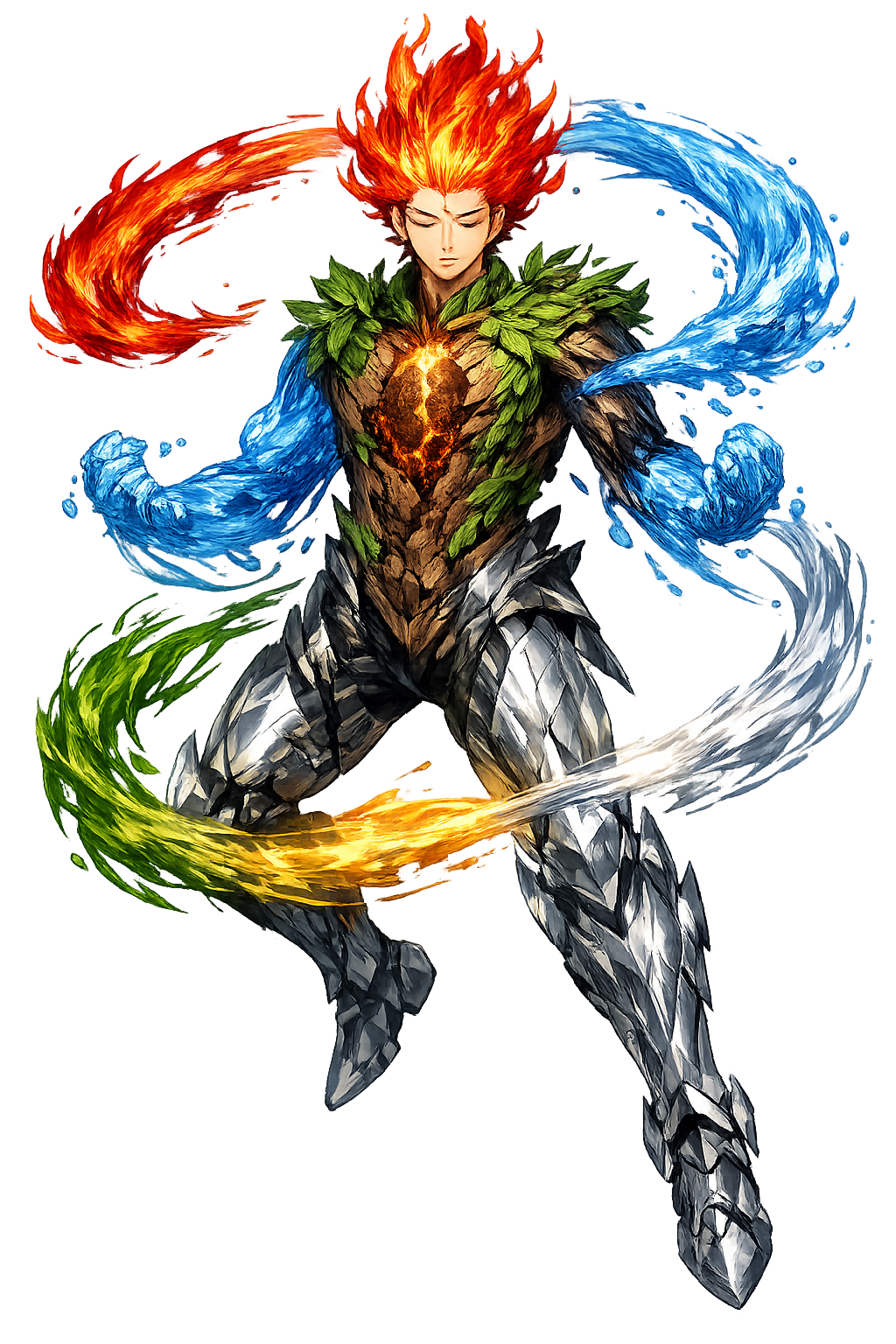
Stories of Wǔxíng
Wǔxíng has no divine biography — it is a cosmology, not a theogony — but its intellectual history is dramatic. It began as a description of natural processes in the Shangshu, became a theory of dynastic legitimacy under Zou Yan, and ended as the diagnostic grammar of Traditional Chinese Medicine, where it still orders diagnosis today.
The Hongfan ('Great Plan') chapter of the Shangshu presents the five materials as the first of the Nine Categories revealed to Yu the Great — the cosmic charter through which Heaven's order was transmitted to the founder of the Xia. Water, fire, wood, metal, and earth are listed with their natures: water soaks and descends, fire blazes and ascends, wood bends and straightens, metal yields and can be changed, earth receives sowing and yields harvests (Shangshu, Hongfan). This is the earliest systematic statement of Wǔxíng cosmology, and its setting matters as much as its content: the phases are handed down in the same breath as the laws of government, because in early Chinese thought there was no separating how nature behaves from how rule must behave. The myth's core meaning is that transformation is lawful — and law, understood deeply enough, is a description of transformation.
The philosopher Zou Yan (c. 305–240 BCE) of Qi turned the five phases into an engine of history. Sima Qian, who appends his biography to those of Mencius and Xunzi in the Shiji (ch. 74), records the doctrine: each dynasty rules by the virtue of one phase, and Heaven signals the coming transfer with omens — the Yellow Emperor possessed the virtue of earth, the Xia of wood, the Shang of metal, the Zhou of fire — so that each new house commands the phase that conquers its predecessor's. Conquest, not election, is the mechanism of legitimacy: the Qin claimed water (and the color black) to douse Zhou fire, and two centuries of Han debate argued whether the Han ruled by earth or by fire. Xunzi's school dismissed Zou Yan's talk of heaven as grandiose, but the emperors kept the theory for a simple reason — it made revolution look like meteorology. The myth means that cosmic legitimacy is a technology: whoever reads the phases correctly can crown a conquest as a season.
The Huainanzi, compiled at the court of Liu An around 139 BCE, integrates Wǔxíng with astronomy, music, and politics into a single encyclopedic vision. Its early chapters map the phases onto the heavens and the calendar: wood commands the east and the spring equinox, fire the south and the summer solstice, metal the west and the autumn, water the north and the winter — while earth holds the center and the season between. Each direction carries its emblems (the Green Dragon, the Red Bird, the White Tiger, the Dark Warrior), its pitch-pipe, its winds, its prohibitions, and the work of the month (Huainanzi, ch. 3–5). The text shows the system at its most ambitious: one grid in which the emperor's conduct, the farmer's calendar, and the music master's pitch pipes are different cells of the same pattern. The myth's meaning is the encyclopedia itself — correlative thinking as an attempt to live inside a cosmos where microcosm and macrocosm rhyme.
The Huangdi Neijing ('Inner Classic of the Yellow Emperor') turns Wǔxíng into medicine. The liver belongs to wood, the heart to fire, the spleen to earth, the lungs to metal, and the kidneys to water — and with the organs come their whole retinue of correspondences: the eyes and sinews of wood, the tongue and vessels of fire, the mouth and flesh of earth, the nose and skin of metal, the ears and bones of water (Huangdi Neijing, Suwen). Health is the smooth circulation of these phases through their generating and controlling cycles; disease is their obstruction, rebellion, or excess — wood overacting on earth, fire failing to warm water. Diagnosis reads the five colors on the face, the five notes of the voice, and the five flavors of the patient's craving; treatment works through the same grammar, nourishing a mother phase to strengthen its child. The myth means that the body is not a machine with parts but a landscape with seasons — and the physician's art is the art of reading weather.
Wood, Fire, Earth, Metal, Water
Wǔxíng is often mistranslated as 'five elements,' but xíng means movement, conduct, or phase. Wood, fire, earth, metal, and water are not static substances but dynamic processes: wood grows, fire flames, earth ripens, metal contracts, water descends. Together they form a grammar of transformation that Chinese thinkers applied to seasons, organs, emotions, dynasties, and military strategy.
The system works through two main cycles: the generating cycle (wood feeds fire, fire makes earth, earth bears metal, metal carries water, water nourishes wood) and the controlling cycle (wood parts earth, earth absorbs water, water quenches fire, fire melts metal, metal chops wood).
Each phase gives birth to the next in a circle of mutual nourishment and support.
Each phase checks another, preventing any one process from running to destructive excess.
Every phase maps to a direction, season, color, organ, emotion, taste, and musical note.
The phases organize the year: wood/spring, fire/summer, earth/late summer, metal/autumn, water/winter.
From the original script to the living URL
五行
The name in its original Chinese form. Wǔxíng (五行) is attested in the source tradition — “Five phases”. Its acute stress marks carry the full phonetic and orthographic weight of the source tradition.
wuxing
Reduced to plain wuxing, the name loses everything that made it specific: acute stress marks. What remains is an ASCII string that machines can parse but that no longer speaks with its original voice.
Wǔxíng
The Unicode restoration recovers what ASCII flattened. Wǔxíng restores acute stress marks, returning the name to its original written dignity. The domain encodes to Punycode, but the browser displays the truth.
Wǔxíng.com → xn--wxng-wpa89k.com
The non-ASCII characters in Wǔxíng are encoded while the ASCII remains visible. To the DNS, it is Punycode. To humanity, it is Wǔxíng.
Owned, ideal, and ASCII forms of Wǔxíng
Wǔxíng
Restores 五行. The live temple domain — wǔxíng.com.
wuxing
Flattens 五行. The plain ASCII fallback — what DNS and legacy systems see.
How Wǔxíng was spoken
How Wǔxíng travels from ancient script to the modern URL
Chinese 五行 Wǔxíng; from 五 wǔ “five" + 行 xíng “phase, movement"; the five phases of qi transformation.
Five Elements, Change
The Unicode restoration Wǔxíng preserves the Mandarin tone mark; the ASCII form loses tone.
The lore you have read is the living myth. Extended Lore opens the scholarly vault beneath it: the cult and its material remains, a history of the image, the name after antiquity, a meditation on what the name still means, and the full scholarly apparatus — etymology, orthography, sources.
Enter Extended Lore