PuniCodex

Extended Lore

五行 Wǔxíng

Etymology · Orthography · Cult · Iconography · Reception · Sources

Tier 1 Wǔxíng.com
Wǔxíng — Five Elements, Change
01

Quick Facts

Essential information about Wǔxíng, Five Elements, Change

Original Script五行
Unicode RestorationWǔxíng
Reconstructed Pronunciation/u˨˩˦ ɕiŋ˧˥/
PantheonChinese
DomainFive Elements, Change
MeaningFive phases
ClassificationTier 1
Primary DomainWǔxíng.com
Sacred SymbolsWood, Fire, Earth, Metal, Water
02

Etymology & Word Family

From original script to Unicode restoration

Original Script 五行 Wǔxíng — "Five phases"
Unicode Restoration Wǔxíng Restored stress, length, and script
Modern ASCII wuxing Plain-ASCII fallback

The name Wǔxíng carries the orthographic signature of the chinese tradition: 五行. Unicode restoration recovers what ASCII flattens.

03

Unicode Character Breakdown

Character-by-character philological analysis

CharacterUnicodeNameBlockPhonetic Role
WU+0057Latin Capital Letter WBasic LatinSame, capitalized
ǔU+01D4Latin Small Letter U with CaronLatin Extended-BSpecial character
xU+0078Latin Small Letter XBasic LatinSame
íU+00EDLatin Small Letter I with AcuteLatin-1 SupplementStress on i
nU+006ELatin Small Letter NBasic LatinSame
gU+0067Latin Small Letter GBasic LatinSame

The Tier 1 classification reflects how much of the original phonology this restoration preserves — stress and vowel length for Greek names, distinctive letters and diacritics for every other tradition.

04

Cult & Worship

How the sacred was kept — rites, sanctuaries, remains

The Cult

The Five Phases never had a temple or a priest, but they ran China's ritual machinery for two thousand years. Han cosmologists aimed the state cult by them: five suburban altars for the five directions, the Five Sacred Peaks fed with offerings, and the regalia recolored as dynasties changed their ruling phase — the Qin chose water and black, the Han earth and then fire. Court hemerologists scheduled every act of consequence by the generating and controlling cycles, and the Han shu's treatises grade Heaven's portents by phase, as if the sky itself kept the books. In the household the same patterning organized medicine, diet, and mourning. This was cult without gods: sanctuaries, calendars, and sacrifices in abundance, but addressed to transformation itself rather than to any figure with a name and a face.

In the Earth

The textual foundation of Wǔxíng appears in the Shangshu's Hongfan chapter, transmitted through Warring States and Han manuscript traditions. The Mawangdui tomb library (sealed 168 BCE, excavated 1973) preserves early medical manuscripts that apply the five phases to diagnosis and treatment, while the Huangdi Neijing became the canonical medical synthesis. Han dynasty lacquerware, bronze mirrors, and tomb murals display the color-direction correspondences of the five phases. Unlike a deity, Wǔxíng has no temple, but its logic is inscribed across the material culture of state ritual, medicine, and calendrical science.

05

Iconography

How Wǔxíng was imaged across the ages

The Image

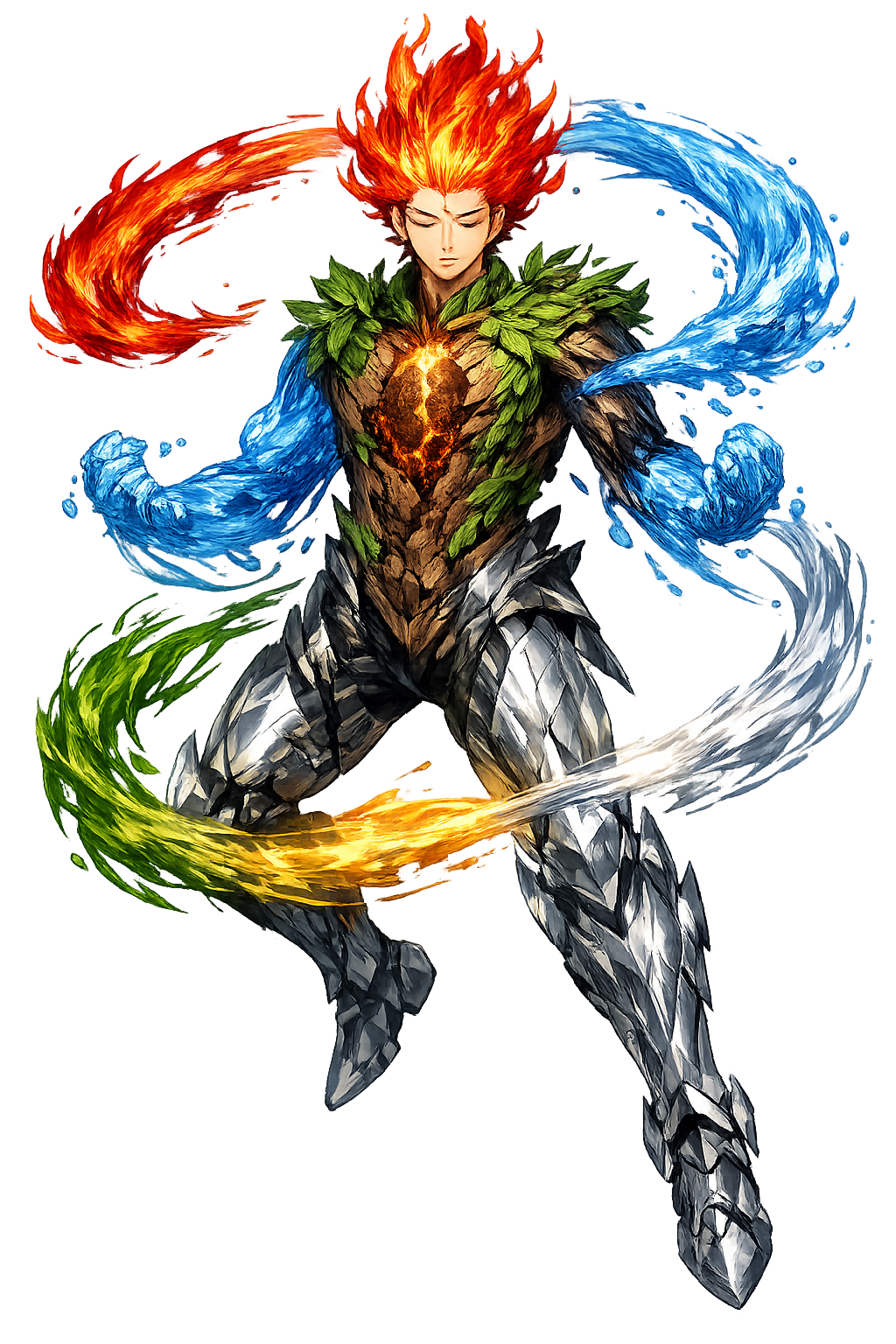
The Five Phases were imaged as a grammar of color, direction, and beast. The nested lacquer coffins of Lady Dai at Mawangdui, sealed in 168 BCE, paint their panels with cloud-borne guardian creatures; Han bronze 'TLV mirrors' weld the scheme to the sky itself, their T-L-V lattices pinning the azure dragon of the east, vermilion bird of the south, white tiger of the west, and entwined dark warriors of the north, with inscriptions on some examples naming the phases and their five colors. Han lacquerware and tomb murals repeat the palette — green, red, yellow, white, black — until the colors alone were legible as cosmology. From the Song, encyclopedias and medical charts drew the two cycles as circles of arrows, generation feeding one way, control crossing through. No single masterpiece contains the system; it is dispersed across ten thousand objects, which is its iconographic signature.

06

Reception & Transformation

The name after its own age — transmission, translation, survival

Afterlives

The system's paperwork is its biography. The Shangshu's Hongfan chapter already lists water, fire, wood, metal, and earth as the first of Heaven's nine gifts to Yu the Great; the Lüshi Chunqiu organized a year of monthly ordinances by them; and Zou Yan's school, as Sima Qian records, made the phases the pistons of dynastic history. The Huainanzi folded phases, directions, and tones into a single cosmology, and Dong Zhongshu read their imbalance as Heaven's memoranda to the throne. Ban Gu's Han shu gave the theory a state archive — its treatise on the five phases reads two centuries of comets and eclipses as portents — while the Huangdi Neijing turned the same five into the diagnostic grammar of the body. Song philosophers, Zhou Dunyi's diagram not least, absorbed the phases into Tàijí metaphysics, and Qing evidential scholars grew skeptical of the numerology. The modern West first met the system as 'elements,' a mistranslation a century of scholarship has labored to correct; Graham's studies of correlative thinking and Unschuld's history of Chinese medicine now anchor the scholarly view.

Identifications Across Traditions

Wǔxíng was sometimes compared by Western observers to the Greek four elements, but the comparison is misleading. The Greek elements are building blocks of substance; the Chinese phases are patterns of change. A closer Indian analogue is the pañca mahābhūta, though the correspondences differ. Wǔxíng entered Japan as gogyō and Korea as ohaeng, shaping East Asian medicine, astrology, and martial arts. In modern times, Wǔxíng has been invoked — and sometimes distorted — in management theory, martial-arts branding, and popular spirituality, often reduced to a color-coded personality test. The medical tradition, however, continues to use the five phases as a sophisticated heuristic for pattern differentiation.

Modern Legacy

Wǔxíng is the hidden scaffolding of much that looks merely 'Chinese' on the surface. The five flavors, five colors, five notes, five grains, and five directions all derive from it. Traditional Chinese Medicine diagnoses in its terms; feng shui designs spaces by it; Xingyiquan organizes its five basic fists around it; Chinese astrology assigns each year an element. The system even colored imperial ritual: the Yellow Emperor claimed earth, the Qin chose black water to overcome Zhou red fire. Today Wǔxíng survives in video-game elemental mechanics, wellness branding, and martial-arts school names — sometimes faithfully, often trivially. Its deepest legacy is a habit of mind: the tendency to see nature not as a collection of things but as a field of interactive processes.

07

The Meditation

What Wǔxíng means — beyond the dictionary

Wǔxíng teaches that nothing is only what it is. Wood is also the process of becoming fire; fire is also the ash that becomes earth; earth is also the ore that becomes metal; metal is also the condensation that becomes water; water is also the nourishment that becomes wood. Identity, in this system, is a verb.

This has practical consequences. To treat a symptom in Chinese medicine is not to kill a germ but to rebalance a process. To choose an auspicious date is not to appease a god but to align with seasonal momentum. To practice Xingyiquan is to embody the five phases until they move through the body the way they move through the year. Wǔxíng is less a belief than a method: look for the pattern of change, and work with it rather than against it.

08

Frequently Asked Questions

Common questions about Wǔxíng, Five Elements, Change, and Unicode restoration

01How do you pronounce Wǔxíng?

In reconstructed pronunciation, Wǔxíng is /u˨˩˦ ɕiŋ˧˥/ — approximately WOO-SHING — 'wu' dips low and rises (or stays low in fast speech), and 'xing' rises like 'sheen' with a rising tone.

02What does Wǔxíng mean?

Wǔxíng means Five phases in the chinese tradition.

03What are the symbols of Wǔxíng?

Wǔxíng is associated with Wood (Growth, spring, the east, the liver, the color green/blue, the wind), Fire (Flaming, summer, the south, the heart, the color red, heat), Earth (Ripening, late summer, the center, the spleen, the color yellow, dampness), Metal (Contracting, autumn, the west, the lungs, the color white, dryness), Water (Descending, winter, the north, the kidneys, the color black/dark, cold).

04Why restore Wǔxíng in Unicode?

Plain ASCII wuxing strips the stress, length, and script that make the name specific. Unicode restoration returns the name to its original written dignity.

05What is the most important myth about Wǔxíng?

“The Great Plan” — the Shangshu, Hongfan story that anchors the mythology of Wǔxíng, told in full on the lore page.

09

Scholarly Sources

The philological foundations of this restoration

Every claim on this page is grounded in established scholarship. The orthographic restorations follow disciplinary convention. The etymological chain follows the best available reference works. This is not invention — it is resurrection through scholarship.

◈

Lexicography & Philology

  • I Ching
  • Chinese classics
◎

Primary Texts

  • Primary sources in the chinese tradition for Wǔxíng.
◉

Archaeology & Art History

  • Material evidence — iconography, inscriptions, and temple archaeology — for Wǔxíng and related cults.
✦

Religious Studies

  • Shangshu, Hongfan (The Great Plan)
  • Huangdi Neijing, Suwen
  • Huainanzi, ch. 3–5
  • Sima Qian, Shiji ch. 74 (Zou Yan and the five virtues)
  • Graham, A. C., Yin-Yang and the Nature of Correlative Thinking
  • Unschuld, Paul U., Medicine in China: A History of Ideas
Return

The Surface Awaits

You have traced the name from its earliest attestation to its Unicode restoration. Now return to the myth. The story is where the name lives.

Back to Lore
Wǔxíng mascot