
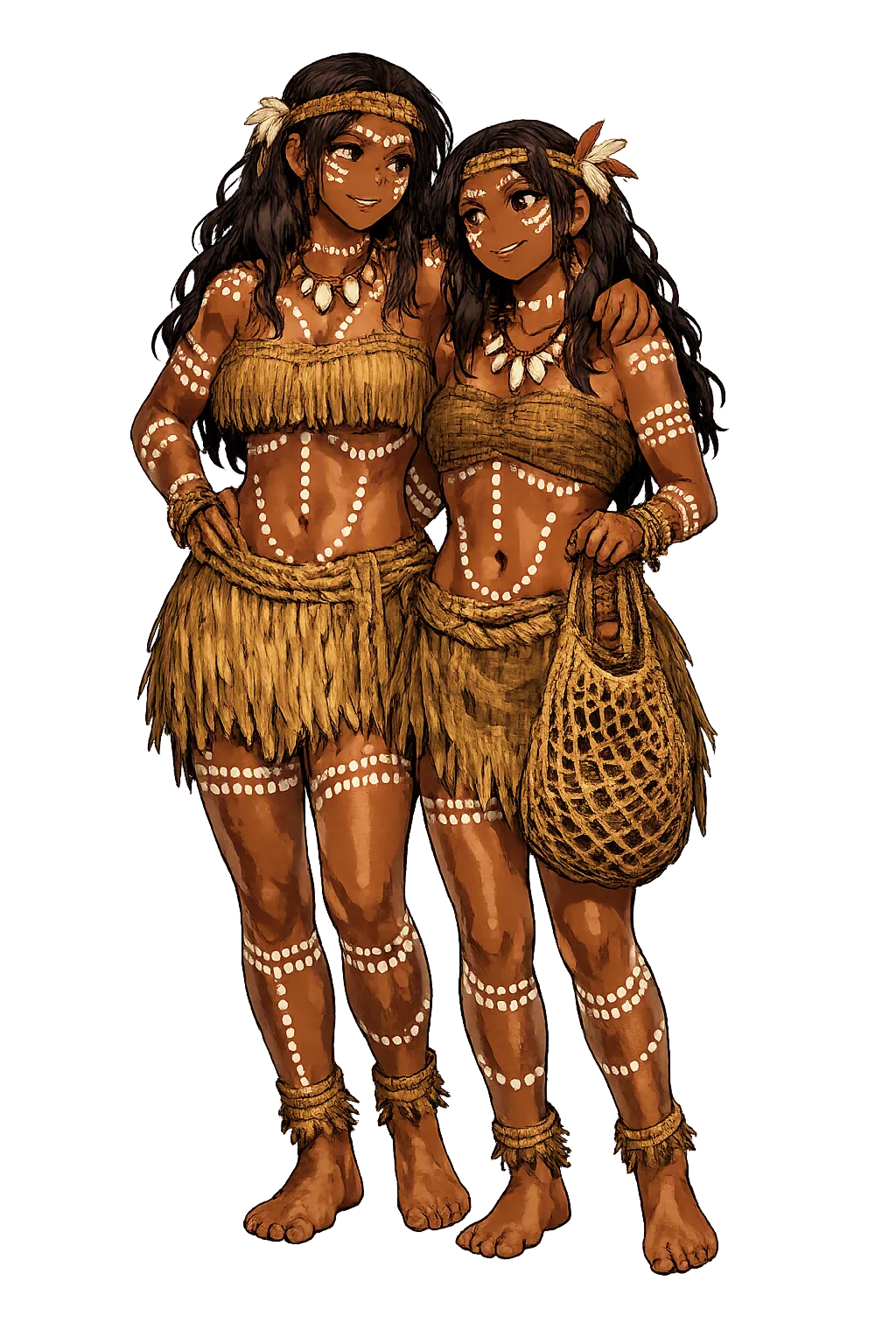
The provenance file on Wawalag
The provenance file for Wawalag. Nothing here is unsourced; that is what the file is for.
Provenance
1. The attestation. —, from the tradition's own record. On record: Berndt, Ronald M. and Catherine H. Berndt, The Speaking Land: Myth and Story in Aboriginal Australia, Penguin, 1989, Warner, W. Lloyd, A Black Civilization: A Social Study of an Australian Tribe, Harper & Brothers, 1937 (revised 1958), Elkin, A. P., Aboriginal Men of High Degree, Angus & Robertson, 1945 (reprinted 1977), Australian Institute of Aboriginal and Torres Strait Islander Studies (AIATSIS), subject guides and catalogue entries on Yolŋu religion and the Wawalag/Wauwalak sisters.
2. The narrative record. The Journey and the Birth — In the Arnhem Land song cycle, the two Wawalag sisters travel from the interior toward the coast, their mother with them and the younger sister heavy with child. Every camp is a future sacred site: they name the waterholes, gather yams and shellfish, dig for honey — and each ordinary act, performed at that place by those women, becomes the charter for a clan's ownership and a ceremony's script. Yurlunggur Swallows the Sisters — The blood reaches the waterhole, and Yurlunggur — the great Rainbow Serpent, in Warner's rendering of the python's name — rises. Attraction and anger are one movement: the serpent swallows the sisters, the child, and their mother.
3. The physical record. The Wawalag cycle is anchored in the physical landscape of Arnhem Land: waterholes, rock shelters, and seasonal wetlands named in the travelling songs. Rock art panels depicting ancestral figures, serpents, and journey tracks are known from the region, though identifying a specific 'Wawalag' image requires community permission and cultural knowledge. Archaeological evidence for human occupation of Arnhem Land extends back at least 65,000 years, providing the deep time frame within which the Wawalag narrative has been transmitted.
4. The current holding. The temple at /wawalag/, classified Tier 2. One decisive feature survives — a single, honest mark — which places the restoration in Tier-2: exact, and exactly labeled.
5. The documented resonances. Travel, Tourism & Place Branding, Education, Research & Knowledge, Faith & Spiritual Organizations — seats argued and weighted in the pattern atlas, read through the myths in this temple's Resonance File.
6. The continuing record. The Wawalag sisters remain central to Arnhem Land ceremony, art, and land tenure. Their song cycles are performed in initiation and public ritual; their images appear in bark paintings, sculptures, and contemporary Aboriginal art produced under community-controlled protocols.
At a Glance
- Restored name: Wawalag
- ASCII form: wawalag
- Meaning: "The two sisters"
- Domain of influence: Two Sisters, Creators
- Pantheon: Aboriginal
- Classification: Tier 2
- Original script: —
- Series: The Restoration Files, No. 527 of 548
The File Continues
Read the founding dispatch for the name's full story, the Resonance File for the archetype at work — or the whole archive in one sitting.
Continue the series — previous file: Wandjina (read it here) · next file: Whiro (read it here).
The Restoration Files are written from the same canonical record as the temples themselves: the lexicon, the lore catalog, the pattern atlas, and the cited scholarly sources. If a file ever disagrees with its temple, the temple is right — tell us, and the file will be corrected.