The Living Myth
Two Sisters, Creators · Yolŋu sisters who gave birth to the law
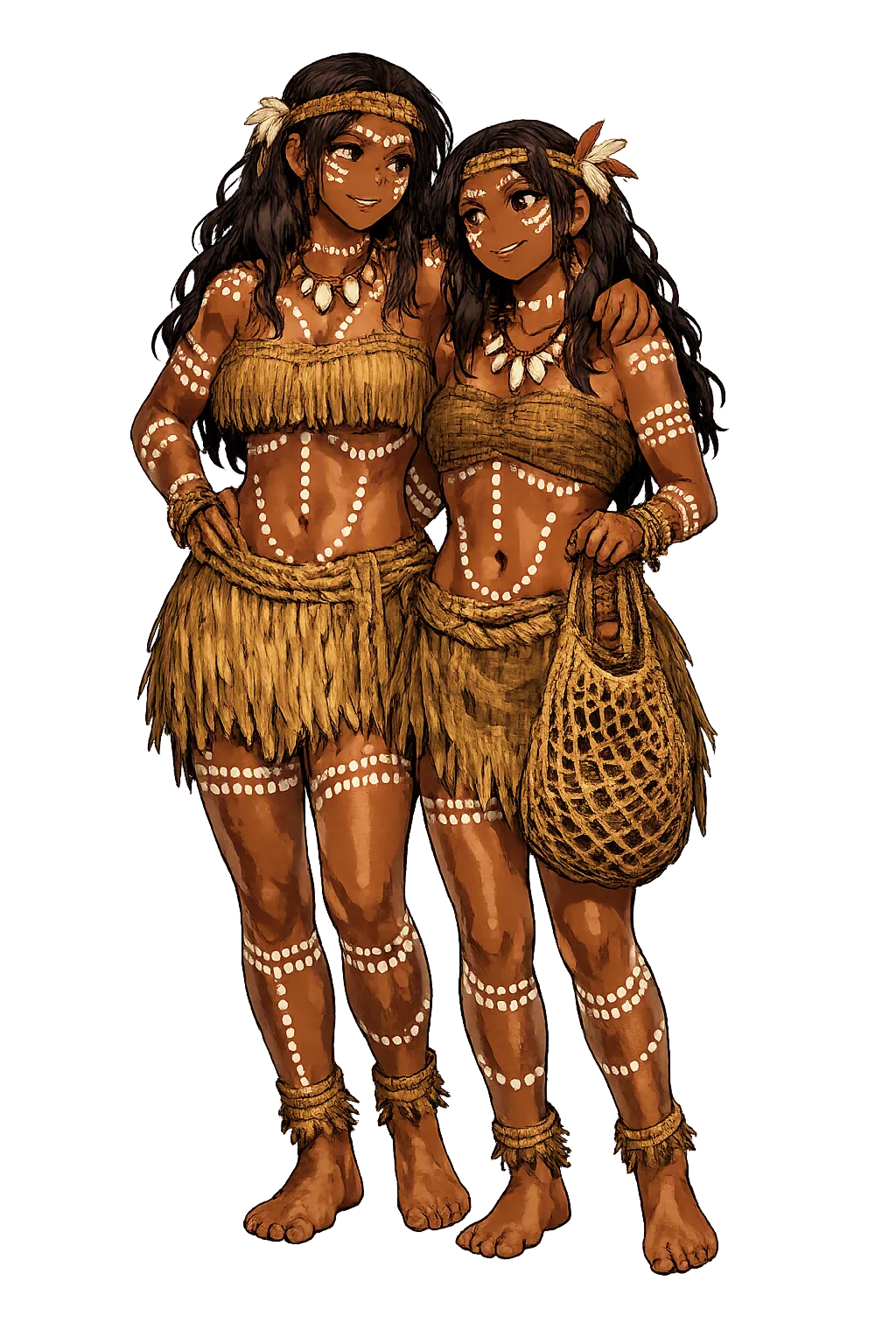
Stories of Wawalag
The Wawalag sisters travel across Arnhem Land with their mother and a newborn child, and everything they do — every camp, every name spoken, every birth — becomes law, geography, and weather. The cycle is not a single fixed text but a song performed in ceremony, whose episodes encode land tenure, marriage class, and the coming of the wet season; the spellings Wawalag, Wauwalak, and Wawilak record different transcribers and different estates.
In the Arnhem Land song cycle, the two Wawalag sisters travel from the interior toward the coast, their mother with them and the younger sister heavy with child. Every camp is a future sacred site: they name the waterholes, gather yams and shellfish, dig for honey — and each ordinary act, performed at that place by those women, becomes the charter for a clan's ownership and a ceremony's script. The younger sister gives birth at a camp near the great python's waterhole, and the blood of childbirth, flowing with the storm-rain into the pool, is the event the whole country has been waiting for. W. Lloyd Warner recorded this cycle among the Yolŋu in the 1920s (A Black Civilization, 1937) under the spelling Wulareg; Ronald and Catherine Berndt later recorded Wawilak and Wauwalak versions (The Speaking Land, 1989). The journey's meaning is tenure: to walk the sisters' track and name their camps is to read the land's title deeds aloud, and to know which clan is responsible for which waterhole.
The blood reaches the waterhole, and Yurlunggur — the great Rainbow Serpent, in Warner's rendering of the python's name — rises. Attraction and anger are one movement: the serpent swallows the sisters, the child, and their mother. Inside the serpent, however, the story does not end; the sisters keep singing, and their songs within the belly become part of the sacred repertoire that men will later receive in initiation. The episode is not framed as punishment for impurity — the blood is powerful, not dirty; it is ancestral substance answering ancestral substance, and the serpent acts because the law of the land demands a response to the power in women's bodies. The myth carries a theology without sin: violation and response, swallowing and singing, are parts of one exchange between people and country. What swallows you also carries you, and what carries you transforms the world outside.
Yurlunggur cannot keep what he has swallowed: he releases the sisters, and from that act of being taken in and given back comes the architecture of society — the moieties (in Warner's Murngin terminology, Dua and Yiritja), the marriage classes, and the rights and duties of each clan to its named places. The sisters' bodies mark the geography: this waterhole where he rose, that camp where she bore the child. The myth thereby solves, in narrative, the problem every human society must solve: how to divide the land without war. The division is a bodily memory — the country itself, taken in and given back, is the deed of title, and every ceremony that re-tells the swallowing re-issues it. Berndt and Berndt emphasized that versions differ by estate and that the deepest layers belong to initiated custodians; what is public is exactly this: the clans came out of the serpent, together.
The python's rising is the monsoon. The storm that breaks when the blood enters the waterhole is the wet season itself, and the flood that follows fills the swamps, breeds the geese and the fish, and greens the woodlands — the annual renewal on which everything in Arnhem Land life depends. To sing the Wawalag cycle, then, is meteorology as liturgy: the performers do not merely remember the first flood but summon the next one, timing the ceremony to the build-up of the season. Warner recorded how the song cycles move with the year's ecological rhythm, and the Berndts noted that the same narrative anchors rain-making rites. The myth's final meaning is ecological: the country is not scenery behind the story; it is the story's body. When the sisters bleed and the serpent rises, the rains come — because the law has been spoken, and the land always answers.
Creators, Law-Givers, and the Monsoon
Wawalag are the two ancestral sisters of north-eastern Arnhem Land. In Yolŋu and related traditions they are at once travellers, mothers, law-givers, and the agents through whom the Rainbow Serpent reshapes the country. Their journey establishes clan territories, marriage classes, and the rituals that still renew the monsoon. They are not domesticated heroines: they carry sacred power in their bodies, and the land responds to that power with flood, fire, and transformation.
Two women travelling with a child, their camp sites and actions founding the ritual geography of Arnhem Land.
Yurlunggur rises from the waterhole when the sisters' blood enters the water, swallowing and later releasing them to create the clans.
Their myth encodes the coming of the wet season: flood, renewal, and the waterholes that hold life through the dry.
The sisters' story underpins initiation, kinship rules, and the obligations between clans and country.
From the original script to the living URL
Wawalag
The name survives in scholarly transliteration. Wawalag is the standard Aboriginal romanisation, documented in academic sources — “The two sisters”. Because the spelling uses only Latin letters, the form is the same in both ASCII and Unicode.
No indigenous writing system is securely attested for individual aboriginal names. The form shown is a modern scholarly transliteration.
wawalag
The plain wawalag form is identical to the Unicode restoration. Because this name is already written in Latin letters, no diacritics, stress, or script information were lost — only capitalization differs.
Wawalag
The Unicode restoration does not need to recover lost marks for Wawalag. Its value is canonical spelling and consistent cataloguing, not the reconstruction of erased orthography. The domain is readable as-is to both DNS and humanity.
Wawalag.com
This restoration is written entirely in ASCII letters — no Punycode encoding stands between Wawalag and the DNS. The domain reads identically to machines and to human eyes.
Owned, ideal, and ASCII forms of Wawalag
Wawalag
The full Unicode restoration. wawalag.com is not in the PuniCodex collection — it is watched for release; if it drops, this temple upgrades to an owned flagship.
How Wawalag was spoken
How Wawalag is preserved in writing
No indigenous writing system is securely attested for individual aboriginal names. The form shown is a modern scholarly transliteration.
Contribute scholarly provenance →The lore you have read is the living myth. Extended Lore opens the scholarly vault beneath it: the cult and its material remains, a history of the image, the name after antiquity, a meditation on what the name still means, and the full scholarly apparatus — etymology, orthography, sources.
Enter Extended Lore