
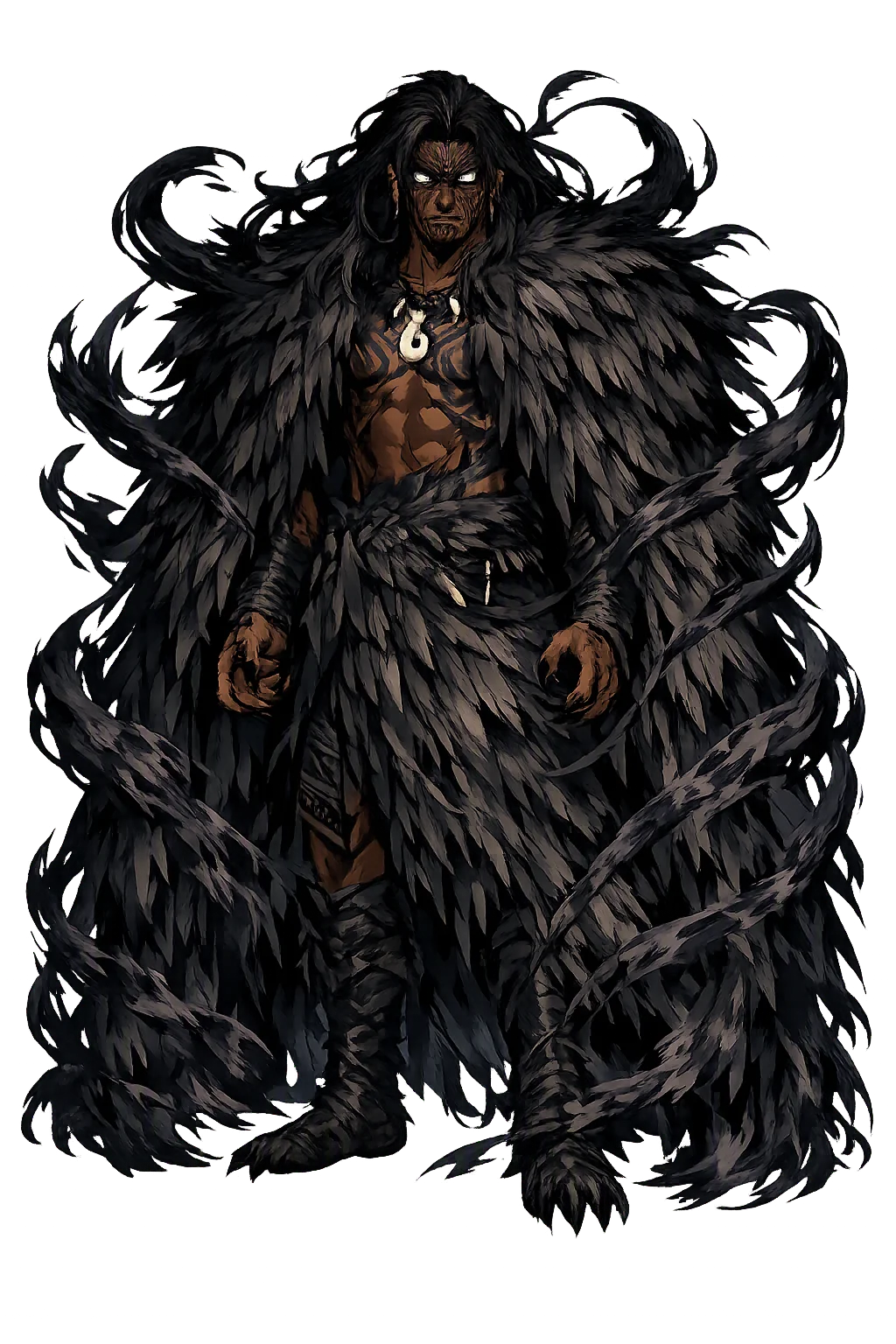
How Whiro was rebuilt, mark by mark
Bench notes, Whiro: what we found, what we rejected, and what we finally set down. Kept in the open, because a restoration you cannot audit is just a spelling with confidence.
What We Found
The attestation runs through the tradition's own sources: —. Meaning: "The lizard of death".
The figure behind the name: Whiro's mythology is an antagonist's dossier — he exists in the Māori corpus chiefly as the power Tāne and the tohunga must overcome.
What the Name Carried In
The War Over the Baskets of Knowledge. In the great myth preserved by George Grey (Polynesian Mythology, 1855; Nga Mahi a nga Tupuna), Tāne ascends through the layered heavens to obtain the three baskets of knowledge (ngā kete o te wānanga) for humankind. Whiro — Whiro-te-tipua — marshals the powers of darkness against the ascent, and the myth is explicitly a war: each heaven is contested, and Tāne prevails only with the aid of the winds and ancestor-gods above.
Whiro and the Descent to Pō. Māori eschatology sends the dead (ngā mate) to the underworld of Rarohenga, in the keeping of the goddess Hine-nui-te-pō. Within that realm the sources assign Whiro a dreadful office: Best (Tūhoe, 1925) records that Whiro consumes the dead — the final extinction that awaits those who pass fully into his night — while other authorities make the underworld a guarded, not devoured, existence.
A spelling that has to carry stories like these is not a label. It is equipment.
Where It Stood Before Us
As with most Māori atua, there is no material representation of Whiro: Māori religion was aniconic, and no carving, amulet, or structure is identified with him — the dread of his likeness would itself have been a contradiction. The relevant archaeology is contextual: the carved meeting houses whose pou (posts) embody ancestors of light, set against the prohibitions and ritual zones around burial caves and urupā, where his jurisdiction was strongest. Traditional Māori rock art and tattoo (tā moko) employ curvilinear forms sometimes read as reptilian, but attributing them to Whiro exceeds the evidence. The 'sites' of Whiro are instead the documented places of night practice — the sickbed, the burial ground, the lizard-haunted gully — mapped for us by Best's ethnography rather than by excavation. The bench inherits all of it — the web temple is the newest site, not the first.
What We Rejected
Any form invented for availability. The rule on the bench: if the evidence does not carry it, the domain does not get it — whatever the registrar has in stock.
What We Set Down
Whiro — One decisive feature survives — a single, honest mark — which places the restoration in Tier-2: exact, and exactly labeled.
For the voice: 'FEE-roh' — the wh is an f-sound in most modern Māori, and the r is trilled.
The temple stands at /whiro/ — the notes above are public in its Scholarly Edition, sources and all.
At a Glance
- Restored name: Whiro
- ASCII form: whiro
- Meaning: "The lizard of death"
- Domain of influence: Darkness, Evil
- Pantheon: Polynesian
- Classification: Tier 2
- Original script: —
- Series: The Restoration Files, No. 528 of 548
The File Continues
The temple's founding dispatch tells the name's story; its Resonance File reads the myths into the industries; the blog index holds the whole archive.
Continue the series — previous file: Wawalag (read it here) · next file: Wújí (read it here).
The Restoration Files are written from the same canonical record as the temples themselves: the lexicon, the lore catalog, the pattern atlas, and the cited scholarly sources. If a file ever disagrees with its temple, the temple is right — tell us, and the file will be corrected.