
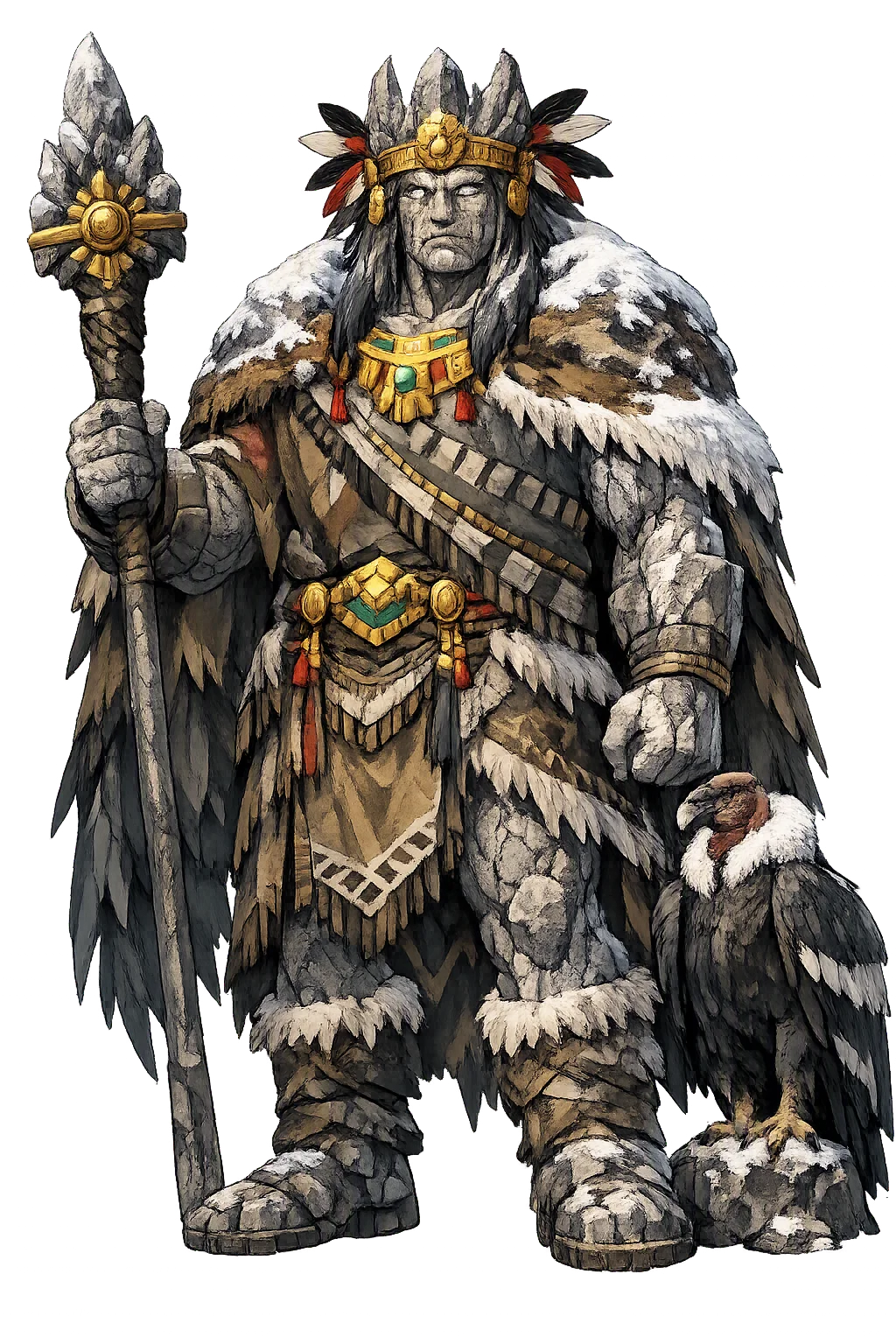
The appointments Wamani made — and who is keeping them
The mistake is reading myths as entertainment. Wamani's cycle reads more like a charter — each story assigning a duty the modern world still pays for.
At a Glance
- Temple: Wamani
- Pantheon: Incan
- Domain of influence: Sacred Mountain
- Pattern seats: 4
- Sectors touched: Energy & Natural World · Home & Lifestyle
- Strongest seat: Agriculture, Food & Harvest
- Series: The Resonance Files, No. 525 of 548
The Cycle, Read Forward
Agriculture, Food & Harvest — through The Mountain that Gives Birth
Every Andean community once knew which mountain it came from. The colonial chronicles — Cobo's Historia del Nuevo Mundo (Book 13), Sarmiento de Gamboa's Historia Indica, and the now-lost Cusco paintings they copied — record a landscape dense with paqarina, 'emergence places,' from which founding ancestors rose to establish the ayllu.
The atlas states the seat in one line: Primary seat: Wamani embodies sacred mountain — the core of agriculture food. The story above is the long version of the same sentence. The trade thinks it is optimizing a process. It is re-enacting a charter.
Environmental & Climate Services — through Water for Offerings
The wamani's side of the covenant is water: from the snowfields the apu sends the springs that fill the terraces, and the people's side is the offering — coca leaves and maize beer poured on stone platforms, llamas driven to high pasture, prayers spoken to the peak by name. Cobo watched the rites; modern ethnography (Flores Ochoa) records their grammar: an offering is not a purchase but a greeting, the same exchange of coca and goodwill with which one honors an elder.
The atlas states the seat in one line: Resonant seat: Wamani shares symbolic territory with environment climate. The story above is the long version of the same sentence. That is the cycle working: story becomes duty, duty becomes trade.
Forestry, Conservation & Outdoor Industries — through The Star Snow of Sinakara
Each June, tens of thousands of pilgrims climb from the Quechua-speaking nations to the glacier of Qoyllur Rit'i — 'Star Snow' — in the Cordillera Vilcanota, below the peak of Sinakara, and dance for five nights at the edge of the ice. The rite is old enough to have watched the Pleiades: Quechua farmers once timed sowing and harvest to tianquiztli's disappearance and return (Urton, At the Crossroads of the Earth and the Sky), and the shrine stands exactly where sky-calendar and snow-melt meet.
The atlas states the seat in one line: Resonant seat: Wamani shares symbolic territory with forestry conservation. The story above is the long version of the same sentence. Industries do not invent their archetypes; they inherit them and call them best practice.
Home, Hearth & Real Estate — through Children of the Summit
When the Inca state faced crisis — an eclipse, an epidemic, an emperor's death — its answer was the capacocha: a procession to the high peaks bearing what was most precious. The chosen children were dressed as miniature lords, feasted in Cusco, given coca and maize beer, and walked with gold and silver figurines to shrines at five and six thousand metres, where they were left in the cold that would not let them decay.
The atlas states the seat in one line: Resonant seat: Wamani shares symbolic territory with real estate home. The story above is the long version of the same sentence. The trade thinks it is optimizing a process. It is re-enacting a charter.
The Theme That Runs the Cycle
Wamani has no epic cycle: Andean mountain religion lives in ritual, pilgrimage, and origin story rather than narrative text. What survives — from the colonial chronicles, the temple origin legends, and a living cult at Qoyllur Rit'i — reads as one long covenant between people and peak; the four 'myths' below are its chapters.
The Method, Stated Plainly
Skeptical? Good — the system is built for you. Every seat in this file carries its why-line and its weight, the full derivation is public at the methodology page, and the challenge process is part of the design. Falsifiable is not a posture here; it is the mechanism.
For the Ones Who Work There
If you work in agriculture, food & harvest, environmental & climate services, or any trade this temple holds a seat in, this is the honest version of what a placement means: your industry beside the story it has been re-telling all along — on the temple floor itself, before an audience that came specifically to read it. The patron tier and the advertising terms describe the mechanics; the resonance above describes the fit.
The File Continues
One of 548 Resonance Files — the series where the pantheon goes to work. Read the founding dispatch for the name, the Restoration File for the spelling, or the whole archive end to end.
Continue the series — previous: Wꜣḏyt (read it) · next: Wandjina (read it).
The Resonance Files are argued from the same canonical record as the pattern atlas itself: the lexicon, the lore catalog, and the cited sources. Every seat can be challenged at the methodology page — and the challenge is the point.