PuniCodex

Extended Lore

Vǫr — The Deeper Record

Etymology · Orthography · Cult · Iconography · Reception · Sources

Preserves distinctive marks Vǫr.com
Vǫr — Wisdom, Oaths, Knowledge
01

At a Glance

Vǫr — every fact links to its home

PantheonNorse
DomainWisdom, Oaths, Knowledge
Original Scriptᚢᚢᛦ →
Primary Sources4 cited →
02

Etymology & Word Family

From original script to Unicode restoration — the full etymology page →

Original Script ᚢᚢᛦ Vǫr — "The careful one, oath-goddess"
Unicode Restoration Vǫr Restored stress, length, and script
Modern ASCII vor Plain-ASCII fallback

Old Norse Vǫr, goddess associated with wisdom and oaths; her name is related to vörðr "pledge, vow".

03

Unicode Character Breakdown

Character-by-character philological analysis

CharacterUnicodeNameBlockPhonetic Role
VU+0056Latin Capital Letter VBasic LatinSame, capitalized
ǫU+01EBLatin Small Letter O with OgonekLatin Extended-BO with ogonek: nasalized vowel
rU+0072Latin Small Letter RBasic LatinSame

The restoration of Vǫr preserves what it can of the original phonology — stress and vowel length for Greek names, distinctive letters and diacritics for every other tradition.

04

Cult & Worship

How the sacred was kept — rites, sanctuaries, remains

The Cult

No temple, festival, or votive to Vǫr is attested anywhere — for all the record shows, no one ever sacrificed to her. Everything known comes from a three-line entry in Snorri's catalogue (Gylfaginning 35) and her name in the þulur, the skalds' metrical name-lists. Her 'cult' is thus a position in a list: tenth among the Ásynjur, described as wise and questioning, set immediately beside Vár, the oath-goddess — which is why the handbooks assign her the office of witness to oaths and hidden things. The name itself is the ordinary adjective vǫrr, 'aware, acquainted with,' so the figure may be no more than a personified word. Modern Ásatrú and Heathen groups do invoke her for truth-telling and discernment today, but that is a revival movement building on Snorri's single sentence, not a continuation of any ancient rite.

In the Earth

Vǫr is a purely textual figure: no runestone, image, or place-name is securely hers. Her witnesses are manuscripts — above all the Codex Regius of the Prose Edda (GKS 2367 4to, c. 1300) and its sister codices carrying Gylfaginning 35, and the þulur lists transmitted with the grammatical and skaldic apparatus. For a goddess of attention there is a fitting irony in the evidence: everything we know of her survives because medieval readers kept noticing and copying a three-line entry — the watchful goddess is attested, in the end, only by the watchfulness of scribes.

05

Iconography

How Vǫr was imaged across the ages

The Image

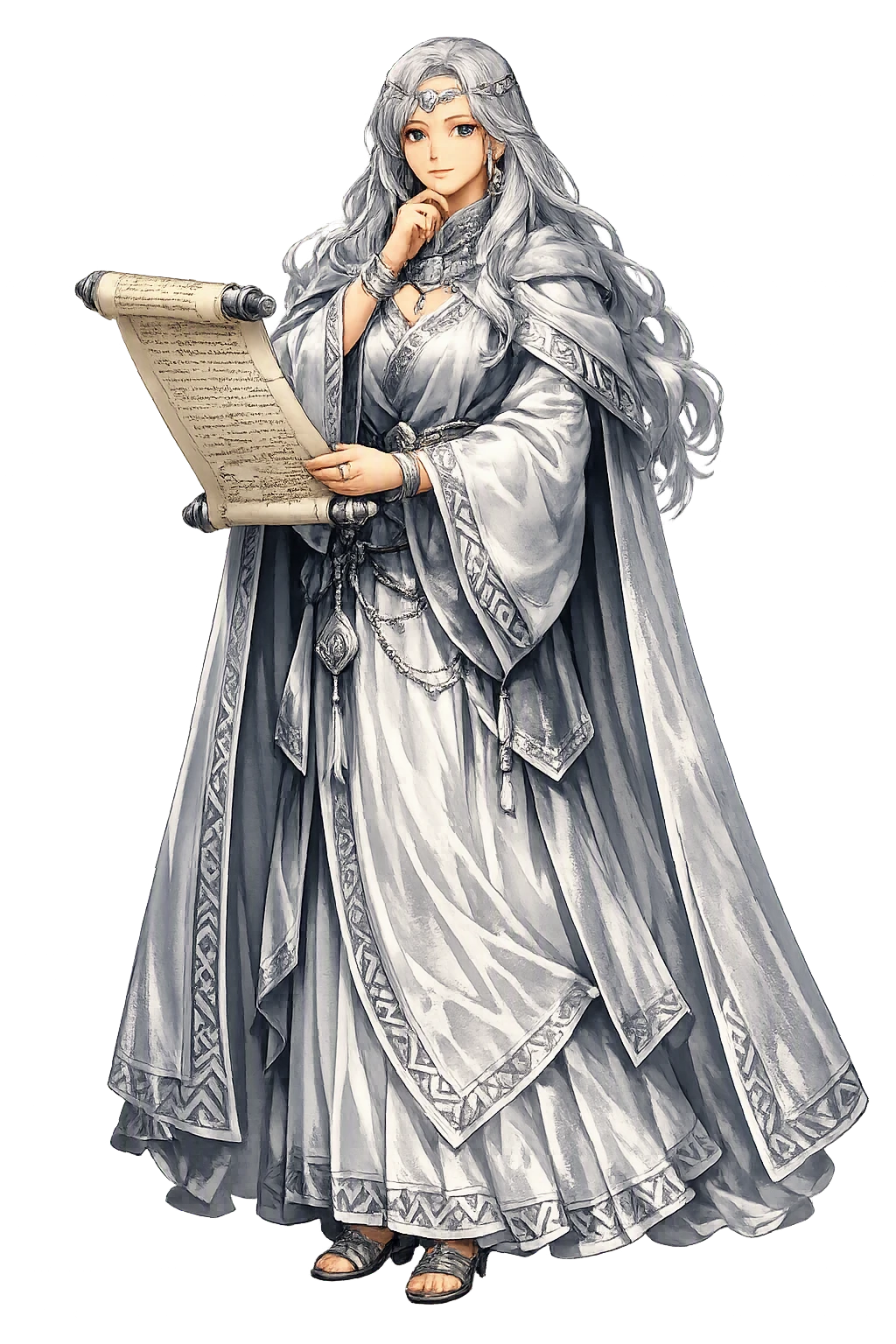
No image of Vǫr survives — not one. No runestone, pendant, picture stone, or manuscript illumination names her, and archaeology is silent. The medieval sources give her no attribute at all: Snorri's words are her whole portrait, and the seeing eye, mirror, and scales that modern illustrators sometimes lend her are reasonable extrapolations from that one sentence, not fragments of a lost tradition. Even the poets knew her only as a name to weave into woman-kennings. If she was ever pictured, the picture has vanished without a trace — a fitting anonymity for the goddess whose power is to notice, not to be noticed.

06

Reception & Transformation

The name after its own age — transmission, translation, survival

Afterlives

Vǫr's afterlife is the afterlife of a manuscript sentence. She rides through the Middle Ages inside the Prose Edda — Gylfaginning preserved complete in the Codex Regius of about 1300 and its sister codices — and steps into print with Peder Hansen Resen's 1665 Copenhagen edition, the first time the Edda left Iceland's scriptorium. Eighteenth-century antiquarians gathered the codices into the Arnamagnæan collection; the Romantic age gave her readers, as Jacob Grimm's Deutsche Mythologie (1835) taught Europe to take the minor ásynjur seriously, and nineteenth-century editors — the 1848 Copenhagen text associated with Jón Sigurðsson, Finnur Jónsson's of 1900 — fixed the very words scholars quote. Twentieth-century kennings scholarship, Meissner's Die Kenningar der Skalden (1921), catalogued her name among the poets' goddess-heiti; English readers met her in Brodeur's 1916 translation and Faulkes's 1987 Edda. Iceland has since revived Vǫr as a woman's name — the truest immortality a three-line goddess can claim.

Identifications Across Traditions

No interpretatio romana ever found Vǫr a Latin name: the classical authors who mapped the northern gods left her unmentioned, and the medieval Icelanders who knew her wrote no equation. Functionally, though, she has ready company. The Greek Themis and the Roman Fides both watch over sworn agreements; the Egyptian Maat personifies truth itself; within the Edda her closest kin are Vár, who hears oaths, and Sága and Frigg, whose knowledge rivals even Óðinn's. The comparison is of office, not of origin — the name vǫrr is transparently native, the common adjective for watchfulness, and the North grew its attention-goddess out of its own vocabulary. In modern Heathen practice the same functionalism operates in reverse: where oaths are sworn at vé and frith is kept, Vǫr is invoked not as a borrowed virtue but as the native one — the goddess who was simply there when the tradition needed a name for not being deceived.

Modern Legacy

Vǫr is rarely a central figure in modern retellings, but her name and attribute persist wherever Norse goddess-lore is studied. She appears in the handbooks precisely as the Edda presents her: the example that proves the catalogue contains a deity of pure attentiveness, an abstract virtue given a seat among the Ásynjur rather than a cult. In modern Heathen and Ásatrú practice she is invoked for matters of truth-telling, oath-keeping, and discernment — the offices Snorri assigned her — and in fiction and games she drifts between the healer's retinue and the wise woman's, always in a watching role. Her real legacy is lexical and conceptual: the Old Norse word vǫrr, 'watchful, aware,' survived into Icelandic prose, and the goddess remains the personified reminder that knowledge begins with attention — that the cheapest and most neglected instrument of wisdom is simply refusing to look away.

08

The Original Script Note

What the written record preserves — and what it does not

Original Script

Vǫr is one of the minor ásynjur of Gylfaginning: 'wise and inquiring', Snorri says, 'so that nothing can be concealed from her' — a goddess of the knowing glance. Her name is the ordinary adjective vǫr, 'careful, aware, watchful', deified. The manuscript catalogue is her only record: no runic inscription, no place-name, no cult-trace. A normalized Younger Futhark rendering would be ᚢᚢᚱ — the úr rune ᚢ doing double duty for the initial v and the vowel ǫ, as Viking-Age orthography regularly requires. The restored form carries the ǫ, the short rounded vowel that plain ASCII flattens to o. The registrable form is vǫr.com (punycode xn--vr-f5a.com), held in the PuniCodex collection.

09

The Meditation

What Vǫr means — beyond the dictionary

Vǫr is the goddess who pays attention. In a world of masks and boasts, she is the one who notices the small contradiction, the slipped word, the glance that does not match the smile. Her wisdom is not the wisdom of the runes or the mead of poetry; it is the older and less glamorous wisdom of simply seeing what is there — and Snorri, in a characteristically practical aside, makes her the source of the very word for it.

To invoke Vǫr is to invoke honesty, first of all with oneself. She cannot be deceived because she does not deceive herself; her inquiry is tireless because it is innocent of vanity. The Edda offers her no story because attention has no plot — it is the condition of plots, the thing that lets everything else be seen. In an age engineered for distraction, she is the goddess most needed and most neglected: the one who asks, who watches, and who knows.

10

Frequently Asked Questions

Deep-dives into the cult, attestation, reception, and sources of Vǫr

01How do we know how Vǫr was worshipped?

Vǫr is a purely textual figure: no runestone, image, or place-name is securely hers. The full cult record →

02Where do the earliest attestations of Vǫr come from?

The record rests on Snorri Sturluson, Prose Edda: Gylfaginning 35 (Vǫr tenth among the Ásynjur, 'wise and the questioning one'; the vǫrr etymology; Vár beside her), Prose Edda, þulur (Vǫr in the goddess and valkyrie name-lists), Poetic Edda: Hávamál 138–139 (the paid-for wisdom of Óðinn, by contrast), among 6 cited works. The full source apparatus →

03How did later traditions reinterpret Vǫr?

Vǫr's afterlife is the afterlife of a manuscript sentence. Reception & transformation →

04What do the surviving images of Vǫr actually show?

No image of Vǫr survives — not one. The iconography →

05What does the written record of Vǫr actually preserve?

Vǫr is one of the minor ásynjur of Gylfaginning: 'wise and inquiring', Snorri says, 'so that nothing can be concealed from her' — a goddess of the knowing glance. The Original Script note →

11

Scholarly Sources

The philological foundations of this restoration

Every claim on this page is grounded in established scholarship. The orthographic restorations follow disciplinary convention. The etymological chain follows the best available reference works. This is not invention — it is resurrection through scholarship.

◈

Lexicography & Philology

  • Cleasby-Vigfusson
◎

Primary Texts

  • Prose Edda
  • Snorri Sturluson, Prose Edda: Gylfaginning 35 (Vǫr tenth among the Ásynjur, 'wise and the questioning one'; the vǫrr etymology; Vár beside her)
  • Prose Edda, þulur (Vǫr in the goddess and valkyrie name-lists)
  • Poetic Edda: Hávamál 138–139 (the paid-for wisdom of Óðinn, by contrast)
◉

Archaeology & Art History

  • Foote, P., & Wilson, D. M. The Viking Achievement; Graham-Campbell, J. Viking Art.
✦

Religious Studies

  • Cleasby–Vigfusson, An Icelandic-English Dictionary, s.v. Vǫr, vǫrr
  • Zoëga, A Concise Dictionary of Old Icelandic, s.v. Vǫr
  • Simek, Dictionary of Northern Mythology, s.v. Vǫr; Lindow, Norse Mythology: A Guide, s.v. Vǫr
Return

The Surface Awaits

You have traced the name from its earliest attestation to its Unicode restoration. Now return to the myth. The story is where the name lives.

Back to Lore
Vǫr mascot