
Pronouncing Venus: a guide for the curious
Saying Venus aloud is harder than reading it on a screen, and more rewarding. The restored spelling is a compressed pronunciation guide: every accent and macron is an instruction. This post unpacks those instructions — the reconstructed sound, the phoneme-by-phoneme record, the kindred forms in neighboring languages — and then zooms out to the full record around the name: its Original Script writing, its mythology, its cult, and its modern life as a Unicode domain. Whether you arrive as a linguist, a reader of myth, or a domainer, you will leave able to say the name the way the evidence suggests it was said — and able to type it the way it was written.
At a Glance
- Restored name: Venus
- ASCII form: venus
- Meaning: "The Roman goddess of love and beauty, mother of Aenēās; namesake of the planet Venus (epigraphic VENVS; all vowels short, so the standard form carries no diacritics)"
- Domain of influence: Love, Beauty, Desire
- Pantheon: Roman
- Restoration: ASCII-equivalent form
Overview
Venus (venus) — Love, Beauty, the Morning and Evening Star · The Roman goddess of love and beauty, mother of Aenēās — belongs to the Roman tradition, where it is catalogued under the domain "Love, Beauty, Desire". The name means "The Roman goddess of love and beauty, mother of Aenēās; namesake of the planet Venus (epigraphic VENVS; all vowels short, so the standard form carries no diacritics)".
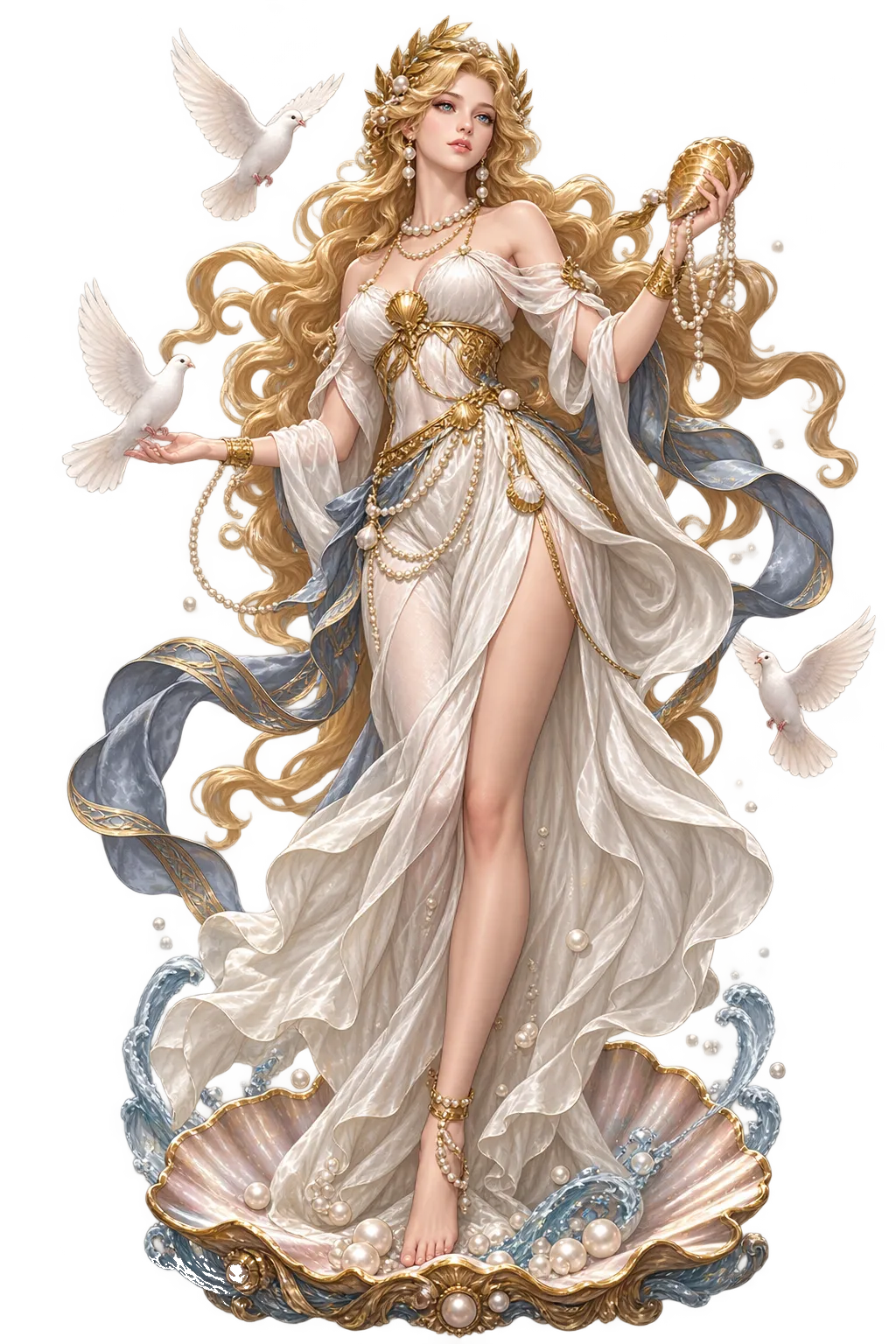
Venus is the Roman goddess of love and beauty — early and completely identified with Greek Aphrodite, but with a Roman political career the Greek original never had: mother of Aeneas, ancestress of the Romans, divine patron of the Julian line, and the planet’s namesake. From Lucretius’ opening hymn to the courtesan-cults of the seaports, she is Rome’s most versatile goddess — and the only one in this lexicon whose name needs no restoration at all.
PuniCodex restores the name as Venus and serves its temple at its temple. The restoration aSCII-equivalent form — a description computed from the displayed form itself. The plain ASCII form venus survives as a modern convenience imposed by the early domain-name system; the restoration, not the fallback, is the form the project defends as philologically complete.
The Name
The name is attested in the Latin record — inscriptions and literature are the native sources for Roman gods; the vowel quantities shown are editorial (L&S convention). Etymologically the name means "The Roman goddess of love and beauty, mother of Aenēās; namesake of the planet Venus (epigraphic VENVS; all vowels short, so the standard form carries no diacritics)".
The ASCII form venus survives only because the early domain-name system could not carry diacritics; it is a technological compromise, not an ancient spelling. The Unicode restoration Venus recovers the full diacritic detail of the scholarly transliteration directly in the address bar. The restoration aSCII-equivalent form — a description computed from the displayed form itself.
The letter-by-letter transformation runs:
- v → V — Same, capitalized
- e → e — Same
- n → n — Same
- u → u — Same
- s → s — Same
The Original Script
The original script for this roman name has not yet been added to PUNICODEX. The form shown is a scholarly transliteration.
The form Venus is therefore a scholarly transliteration rather than an attested ancient spelling; it encodes the reconstructed sound of the name for modern use, and no mark in it is decorative.
Pronunciation
The reconstructed pronunciation of the name is /ˈwiːnʊs/ — Latin (epigraphic: VENVS).
Phoneme by phoneme:
- Ve- — Classical Latin w-sound for V; short e as in “set”.
- -nus — Short u; the form is a noun of the fourth declension — Venus, Veneris.
- ** — The standard form carries no diacritics: all vowels short, no marks warranted.
For the modern speaker, the closest approximation is: “WAY-noos” — classical; “VEE-nus” in the church pronunciation
Kindred and historical forms of the name:
- Greek — Aphrodite — the identification made early and never questioned
- Epithet — Venus Genetrix — “Venus the Mother”, Caesar’s divine ancestress
The Roman name may descend from *wenos, “desire” — venus, venom, and “win” share the family.
Mythology
Venus’ mythology is Aphrodite’s retold in a Roman accent — the foam-birth, the Judgement of Paris, the loves and the intrigues — plus a Roman coda the Greeks never wrote: the divine ancestress of Rome. Virgil’s Aeneid makes her the poem’s moving force, the goddess who shields her son through Troy’s fall to Italy’s shore; and the Julian gens made her their household god.
The Foam-Birth (Hesiod via Rome)
The Greek story: Cronus’ severed genitals fell into the sea, and from the foam (aphros) rose the goddess, first at Cyprus’ shore. Roman poets from Ennius onward retold it with Venus’ name — the sea-foam’s child Latinized without effort, the island of Cyprus keeping the cult’s oldest address.
The Judgement of Paris (Homeric Cycle)
At the wedding of Peleus and Thetis, the uninvited Strife threw the golden apple ‘to the fairest’ — and Hera, Athena, and Venus asked the shepherd Paris to judge. Venus’ bribe, Helen, won; the judgement’s price was Troy. The Roman telling keeps every detail — only the goddess’ name has changed, and the empire’s stake in the story.
The Mother of the Race (Aeneid)
Virgil gives Venus her Roman apotheosis: she saves Aeneas from Troy’s burning, guides him through the sea-wanderings to Italy, and by the divine machinery’s decree founds the line — ‘I am Caesar and his whole Julian race’ — that will rule the world. No Greek goddess had such a son; the epic made her Rome’s mother.
The Onrushing of Creation (Lucretius)
The De Rerum Natura opens with the great hymn: ‘Venus, mother of Aeneas and his race, delight of men and gods, under your onrushing the leaping clouds flee’. Lucretius made her the Epicurean nature-principle — the generative urge that moves atoms and seasons — philosophy’s most surprising use of a love-goddess.
Symbols & Iconography
The iconography associated with Venus concentrates in a small set of recurring attributes, each a compressed statement about the name:
- The Morning Star — The planet Venus — Lucifer at dawn, Vesper at dusk — is her celestial body, brightest in the sky.
- Mother of Aeneas — By the Trojan Anchises she bore Aeneas — and through him, the whole Roman race claimed her blood.
- Venus Genetrix — “Venus the Mother”: Caesar dedicated her a temple in the Forum of Caesar, claiming her line.
- The Foam-Born — The Greek myth made her sea-born of foam — the Roman poets kept the story and Latinized the name.
Epithets & Cult Titles
Greek gods and heroes accumulate epithets — cultic titles that specify place, function, or quality. For Venus, the tradition preserves epithets that stress love.
Epicleses connected with The Morning Star, Mother of Aeneas, Venus Genetrix sharpen the name for local worship and literary invocation. The restored form Venus carries the same vowel quantities that these epithets inherited in oral performance.
Oracle Sites & Sanctuaries
Sanctuaries and oracular centers anchored the cult of Venus in the Greek landscape. Major sites include locations where the domain of love was ritually honored.
Pilgrims, offerings, and festival calendars tied the name to specific topography. The restoration Venus gives the figure a stable address in the digital landscape analogous to those ancient centers.
Archaeology & Evidence
The material record for Venus survives in a small number of securely identified remains, catalogued below; the corpus is thin but unambiguous, and each site is tied to the name by ancient testimony.
The Forum of Caesar’s temple of Venus Genetrix, the House of the Vettii’s great fresco, the Venus de Milo and the Capitoline Venus — her monuments span the empire. The planet’s telescopic mapping keeps her name on the morning sky.
Realm & Domain
Venus is the Roman goddess of love and beauty — early and completely identified with Greek Aphrodite, but with a Roman political career the Greek original never had: mother of Aeneas, ancestress of the Romans, divine patron of the Julian line, and the planet’s namesake. From Lucretius’ opening hymn to the courtesan-cults of the seaports, she is Rome’s most versatile goddess — and the only one in this lexicon whose name needs no restoration at all.
The Morning Star
The planet Venus — Lucifer at dawn, Vesper at dusk — is her celestial body, brightest in the sky.
Mother of Aeneas
By the Trojan Anchises she bore Aeneas — and through him, the whole Roman race claimed her blood.
Venus Genetrix
“Venus the Mother”: Caesar dedicated her a temple in the Forum of Caesar, claiming her line.
The Foam-Born
The Greek myth made her sea-born of foam — the Roman poets kept the story and Latinized the name.
Across Cultures
Venus absorbed Aphrodite wholesale — the earliest and most complete of the Greco-Roman identifications — and then Isis of the ports, the Syrian goddess of the sailors, and every eastern Astarte the legions met. The planet’s name passed through her to every European language; and the Christian polemics against ‘venereal’ error gave her name its modern shadow.
Within the Roman tradition, closely related names in the corpus include Cerēs, Diāna, Iānus, Iūnō, Iūpiter, and Mārs.
Cultural Legacy
The planet Venus is hers in every tongue that names the sky; the calendar’s Friday (veneris dies) still pays her; and ‘venereal’ keeps her name in the medical vocabulary. The Renaissance adored her — Botticelli’s Birth is her most reproduced image — and the word ‘Venus’ became, in plain Latin letters, the one goddess-name that never needed restoring.
The Scholarly Record
The account of Venus given in this edition rests on the witnesses and reference works listed below. Lexica and etymological dictionaries secure the form and meaning of the name; the literary and religious texts supply the narrative evidence.
- Hesiod, Theogony 176–206 (the foam-birth).
- Homer, Iliad 24 (the Judgement’s aftermath).
- Virgil, Aeneid 1–8 (Venus and Aeneas).
- Lucretius, De Rerum Natura 1.1–49.
- Julius Caesar, Forum of Caesar dedication.
A Meditation
Venus: the only entry in the batch whose restoration is a tautology — the name has crossed every border unaltered for three thousand years. She stands in the lexicon as the control-group of the whole project: some names need diacritics to keep what ASCII loses; this one kept everything in plain letters from the start.
The Unicode Restoration
Venus aSCII-equivalent form. The ASCII fallback venus still resolves everywhere, but it is the restored form that carries the name's full information. That is the whole thesis of this temple: the marks are the message.
Character by Character
The journey from venus to Venus, one character at a time:
- v → V — Same, capitalized
- e → e — Same
- n → n — Same
- u → u — Same
- s → s — Same
The Roman Pantheon
Venus is one of 11 entries the PuniCodex lexicon catalogues under the Roman pantheon. The Pantheon page gathers the tradition's major figures in one place, and the Lexicon lets you filter all 983 restorations by tradition or script — the fastest way to see where this name sits among its kin.
Frequently Asked Questions
What does Venus mean? The traditional gloss is "The Roman goddess of love and beauty, mother of Aenēās; namesake of the planet Venus (epigraphic VENVS; all vowels short, so the standard form carries no diacritics)."
Which tradition does Venus belong to? Venus is catalogued in the Roman pantheon of the PuniCodex lexicon.
What does Venus preserve that ASCII cannot show? The form itself answers: Venus aSCII-equivalent form — and the marks in the restored spelling are exactly that evidence.
Can I use Venus in a normal browser? Yes. The DNS resolves the punycode form automatically, and the type tool on this site converts venus to Venus for copying and pasting.
Where does the scholarly information come from? The entry is built from lexica, inscriptional evidence, and reviewed scholarly sources listed in the Scholarly Edition. Every claim is traceable to a canonical source.
Typing Venus
You do not need a special keyboard to use this restoration. The PuniCodex Type Tool converts the ASCII form venus into Venus as you type, and the browser extension offers the same conversion inside any text field. Copy the restored form, paste it into the address bar, and the DNS does the rest.
Why This Restoration Matters
Pronunciation turns out to be the heart of the matter. The marks in Venus are instructions for the voice, and a web that strips them is a web that mispronounces the past at scale. The restoration hands the instructions back: say it as the evidence suggests, type it as the tradition wrote it, and let the punycode machinery do the quiet translation in between. That is all the PuniCodex project asks of the infrastructure — and everything it asks of you, the reader, is to use the whole name.
Explore Further
This post is one doorway into the temple. The home page carries the full character breakdown and the ambient canvas; the lore page tells the myths in long form; the Scholarly Edition preserves the sources, pronunciation data, and revision history; and the patron wall supports the restoration directly. For the wider map, browse the Lexicon, explore the Pantheon, or return to the PuniCodex blog.
A Closer Look at the Marks
A restored name is a small map. In the case of Venus, the map does not lead through diacritics or special letters, because the source tradition wrote the name in Original Script rather than in the Latin alphabet. The ASCII form venus and the restored form share the same letters; the restoration is a decision about which conventional spelling should serve as the public reference.
That decision is not cosmetic. The original script attestation carries semantic and phonetic information that no romanization can fully reproduce. By fixing one conventional spelling as the canonical domain form, the project prevents the drift that happens when a name is romanized differently in every article, map, and database. The breakdown still lists each character — v, e, n, u, s — so visitors can see exactly what is being carried forward and what is not. What looks like "no change" is, in fact, a deliberate choice to keep the name stable, searchable, and addressable.
Venus in Its Tradition
Venus does not stand alone. It belongs to the Roman tradition, where it is counted among 11 names in the PuniCodex lexicon. Its sphere — Love, Beauty, Desire — places it beside other figures who govern similar aspects of experience. The restored spelling is therefore not only a philological decision; it is a way of keeping the name in the company of its kin. When the address bar shows Venus, it marks the boundary between a generic search term and a named entry in a living catalog of myth. That catalog is the point of the project. Every restored name is a vote for specificity: the web should know the difference between a figure and a keyword, between a tradition and a trend. Venus is one such vote.
What You Will Find in the Temple
The temple page for Venus is more than a landing page. The home tab presents the character breakdown, the pronunciation guide, and the live domain status in a single view. The lore tab gathers the myths and narratives that give the name its depth. The Scholarly Edition tab publishes the sources, variant forms, and review history that justify the restoration. Industry patterns show where the name appears in modern commerce and culture, while the gallery and creatives tabs collect visual and sponsor material. The patron wall lets visitors support the restoration directly. Each tab is generated from the same canonical sources, so the domain, the blog, the scholars page, and the search index all agree. The result is a single source of truth about a name, delivered through several doors.
The Restoration on the Live Web
A domain name is a kind of publication. When Venus resolves, it proves that the restored spelling is not a theoretical exercise; it is a working address on the public internet. Search engines can index it, language models can encounter it, and anyone who copies it from a manuscript can paste it into a browser. That practical reality changes the status of the restoration. Before Unicode domains, a scholar could write the name correctly in an article while the public web flattened it to venus. Now the public web can carry the correct form end to end. The punycode translation happens silently, so the infrastructure remains compatible while the visible name keeps its marks. That compromise — human-readable restoration, machine-readable encoding — is the foundation of every PuniCodex temple.
Related Names
Sources
The full scholarly apparatus — every citation, revision, and review — lives in the Scholarly Edition. Key references for this post:
- Hesiod, Theogony 176–206 (the foam-birth).
- Homer, Iliad 24 (the Judgement’s aftermath).
- Virgil, Aeneid 1–8 (Venus and Aeneas).
- Lucretius, De Rerum Natura 1.1–49.
- Lexicon authorities for this entry: Ovid, Virgil, Lewis & Short.