
The Cult
The Veneralia of April 1, the rites of Venus Erycina on the Capitol, and the courtesans’ cults of the seaports — hers was a religion of the body politic. The Julian line’s household worship made her the state’s ancestress.
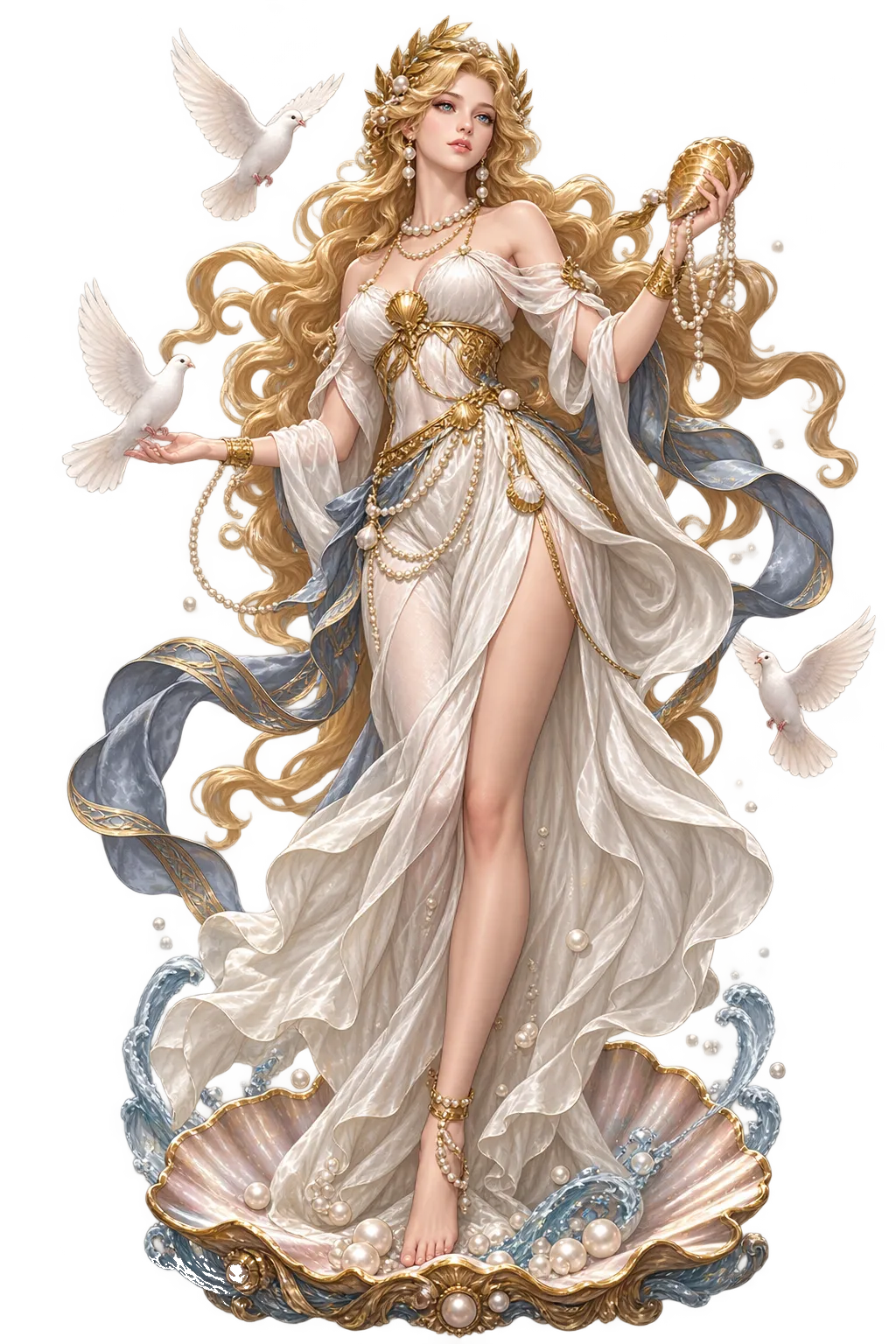
Essential information about Venus, Love, Beauty, Desire
From original script to Unicode restoration
The name Venus reaches the modern world through scholarly transliteration of the roman tradition. Because the conventional spelling uses only Latin letters, its Unicode and ASCII forms coincide — the tradition it carries is in the name itself, not in diacritics.
Character-by-character philological analysis
| Character | Unicode | Name | Block | Phonetic Role |
|---|---|---|---|---|
| V | U+0056 | Latin Capital Letter V | Basic Latin | Same, capitalized |
| e | U+0065 | Latin Small Letter E | Basic Latin | Same |
| n | U+006E | Latin Small Letter N | Basic Latin | Same |
| u | U+0075 | Latin Small Letter U | Basic Latin | Same |
| s | U+0073 | Latin Small Letter S | Basic Latin | Same |
This restoration reflects fidelity to the attested tradition, not recovered diacritics: every character of Venus already survives in ASCII. What the restoration preserves is the canonical spelling itself — the form scholarship standardised.
How the sacred was kept — rites, sanctuaries, remains
The Veneralia of April 1, the rites of Venus Erycina on the Capitol, and the courtesans’ cults of the seaports — hers was a religion of the body politic. The Julian line’s household worship made her the state’s ancestress.
The Forum of Caesar’s temple of Venus Genetrix, the House of the Vettii’s great fresco, the Venus de Milo and the Capitoline Venus — her monuments span the empire. The planet’s telescopic mapping keeps her name on the morning sky.
How Venus was imaged across the ages
The sea-born goddess wringing her hair, the doves and the swan at her feet, the apple of the judgement in her hand; or the modest Capitoline type. Her icon is the beauty that starts wars — the smile that launched the ships.
The name after its own age — transmission, translation, survival
Western art made her its favorite subject from Pompeii to the Salon; the word ‘Venus’ became the learned and then the common name for ideal beauty; and the planet’s brutal surface, mapped by her name, is astronomy’s favorite irony — the love-goddess’ world is the hottest hell in the sky.
Venus absorbed Aphrodite wholesale — the earliest and most complete of the Greco-Roman identifications — and then Isis of the ports, the Syrian goddess of the sailors, and every eastern Astarte the legions met. The planet’s name passed through her to every European language; and the Christian polemics against ‘venereal’ error gave her name its modern shadow.
The planet Venus is hers in every tongue that names the sky; the calendar’s Friday (veneris dies) still pays her; and ‘venereal’ keeps her name in the medical vocabulary. The Renaissance adored her — Botticelli’s Birth is her most reproduced image — and the word ‘Venus’ became, in plain Latin letters, the one goddess-name that never needed restoring.
What Venus means — beyond the dictionary
Venus: the only entry in the batch whose restoration is a tautology — the name has crossed every border unaltered for three thousand years. She stands in the lexicon as the control-group of the whole project: some names need diacritics to keep what ASCII loses; this one kept everything in plain letters from the start.
Common questions about Venus, Love, Beauty, Desire, and Unicode restoration
In reconstructed pronunciation, Venus is /ˈwiːnʊs/ — approximately “WAY-noos” — classical; “VEE-nus” in the church pronunciation.
Venus means The Roman goddess of love and beauty, mother of Aenēās; namesake of the planet Venus (epigraphic VENVS; all vowels short, so the standard form carries no diacritics) in the roman tradition.
Venus is associated with The Morning Star (The planet Venus — Lucifer at dawn, Vesper at dusk — is her celestial body, brightest in the sky.), Mother of Aeneas (By the Trojan Anchises she bore Aeneas — and through him, the whole Roman race claimed her blood.), Venus Genetrix (“Venus the Mother”: Caesar dedicated her a temple in the Forum of Caesar, claiming her line.), The Foam-Born (The Greek myth made her sea-born of foam — the Roman poets kept the story and Latinized the name.).
Venus is written entirely in ASCII letters, so its restoration is about canonical fidelity rather than recovered diacritics: the temple fixes the name in its scholarly standard spelling, attested in the source tradition, instead of leaving it to drift.
“The Foam-Birth” — the Hesiod via Rome story that anchors the mythology of Venus, told in full on the lore page.
The philological foundations of this restoration
Every claim on this page is grounded in established scholarship. The orthographic restorations follow disciplinary convention. The etymological chain follows the best available reference works. This is not invention — it is resurrection through scholarship.
You have traced the name from its earliest attestation to its Unicode restoration. Now return to the myth. The story is where the name lives.
Back to Lore