Stories of Valhǫll
Valhǫll is less a single myth than a single place at the center of many myths. It is the destination of the valkyries, the home of the einherjar, and the staging ground for Ragnarök. Every battle death is implicitly a journey toward its doors.
In Grímnismál, Óðinn in disguise describes Valhǫll from within: its benches are strewn with mail coats, its rafters hung with spears, its roof thatched with golden shields, its benches tipped with bright breastplates — 'there a warrior would go glad within', the refrain runs, 'a man who comes to Odin's hall'. And it is vast beyond any earthly hall: five hundred and forty doors stand on its walls, and through each door eight hundred einherjar will march abreast at Ragnarök. The poem makes war into architecture — a mead-hall scaled to hold every battlefield death in the world, built so that on the last morning the whole host can pour out at once. Valhǫll is a barracks disguised as a feast-hall, and the disguise is the point: the Norse afterlife keeps the shape of the lord's hall, only larger, brighter, and unending.
Snorri records the daily life of the einherjar in Gylfaginning: each day they don their armor, go out into the courtyard, and fight one another with joy, cutting each other down until the dinner hour. Then they ride home to Valhǫll and sit down to drink — and those who fell rise again whole and ride in with the rest. For food there is the boar Sæhrímnir, cooked every night by the cook Andhrímnir in the kettle Eldhrímnir and whole again by morning. For drink there is Heiðrún the she-goat, standing on the hall's roof and grazing on the leaves of the tree Læraðr, filling a vat each day with mead that the einherjar drink their fill of; and from the horns of the hart Eikþyrnir, which also stands on the roof, water falls into the spring Hvergelmir, whence all rivers rise. It is an eternal rehearsal for the last war — but a rehearsal that never feels like one, because the dying and the feasting are both part of the joy.
In Völuspá the valkyries ride through the air and over the sea, their byrnies dark with blood, as they choose among the slain; the poem sees them in Valhǫll itself, bearing ale to the einherjar, and names them: Skuld, Skögul, Gunnr, Hildr, and Göndul. Snorri, in Gylfaginning 24, adds the famous division of the spoil — Freyja has first choice of the battle-slain, and half the fallen go with her to her field Fólkvangr, while Óðinn has what remains. 'Thus it is said that Óðinn deals out men to Freyja,' Snorri notes, and the two destinations together cover every warrior's death. (An earlier draft of this entry misattributed the Fólkvangr division to Grímnismál 14; the verse is Snorri's.) The valkyries are thus not merely Óðinn's messengers but his quartermasters, levying the dead as a lord levies men — the cry of battle and the summons to Valhǫll are woven into the seeress's prophecy of the world's end.
Valhǫll's purpose is revealed only at its end. When the wolf Fenrir breaks his bonds and the sons of Muspell ride over the sky, Óðinn rides out of Valhǫll at the head of the einherjar — all the chosen dead of all ages marching through the five hundred and forty doors behind him — to meet the wolf on the field of Vígríðr, which is a hundred leagues square in every direction. The host that feasted so long finally fights; Óðinn falls to Fenrir, and the hall's doors stand open on an empty sky. The myth gives the einherjar's training its meaning and its limit: Valhǫll exists so that the world's gathered courage can meet the world's ending in one charge. It is the only paradise in any mythology built expressly to be emptied on the last day.
Óðinn's Warrior Paradise
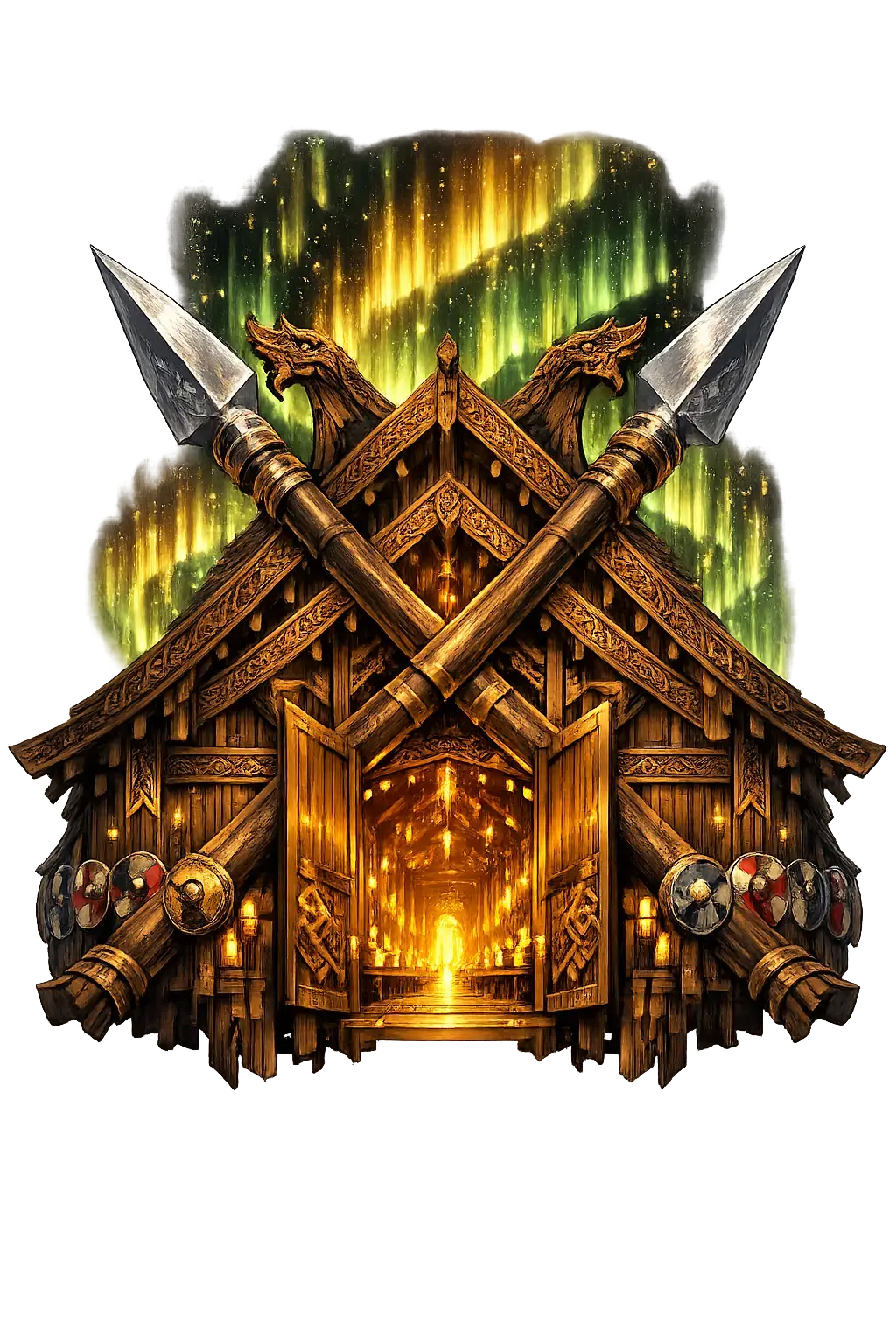
Valhǫll is the great hall of Óðinn, roofed with shields and crowded with the einherjar — warriors who died in battle and were chosen by the valkyries. It is not a quiet heaven but a warrior's training ground: by day the dead fight to the death, by night they rise whole and feast on the ever-renewing boar Sæhrímnir, while the she-goat Heiðrún pours mead from her udders.
The chosen slain who train for the final battle at Ragnarök.
Its rafters are hung with spears and its roof is thatched with golden shields.
The boar slaughtered and reborn each night to feed the hosts.
The choosers of the slain who serve mead and bear warriors to Óðinn's hall.
From the original script to the living URL
ᚢᛅᛚᚼᚢᛚ
The name in its original Norse form. Valhǫll (ᚢᛅᛚᚼᚢᛚ) is attested in the source tradition — “Hall of the slain warriors”. Its original diacritics and script distinctions carry the full phonetic and orthographic weight of the source tradition.
valholl
Reduced to plain valholl, the name loses everything that made it specific: original diacritics and script distinctions. What remains is an ASCII string that machines can parse but that no longer speaks with its original voice.
Valhǫll
The Unicode restoration recovers what ASCII flattened. Valhǫll restores original diacritics and script distinctions, returning the name to its original written dignity. The domain encodes to Punycode, but the browser displays the truth.
Valhǫll.com → xn--valhll-zcc.com
The non-ASCII characters in Valhǫll are encoded while the ASCII remains visible. To the DNS, it is Punycode. To humanity, it is Valhǫll.
Owned, ideal, and ASCII forms of Valhǫll
Valhǫll
Restores ᚢᛅᛚᚼᚢᛚ. The live temple domain — valhǫll.com.
valholl
Flattens ᚢᛅᛚᚼᚢᛚ. The plain ASCII fallback — what DNS and legacy systems see.
How Valhǫll was spoken
How Valhǫll travels from ancient script to the modern URL
Old Norse Valhǫll; from valr “slain warriors" + hǫll “hall"; Odin’s hall in Asgard.
Hall of the Slain
The Unicode restoration Valhǫll uses registrable Thorn and vowel accents; the runic form is not used because runic TLD support is impractical.
The lore you have read is the living myth. Extended Lore opens the scholarly vault beneath it: the cult and its material remains, a history of the image, the name after antiquity, a meditation on what the name still means, and the full scholarly apparatus — etymology, orthography, sources.
Enter Extended Lore