PuniCodex

Extended Lore

महावैरोचन Mahāvairocana

Etymology · Orthography · Cult · Iconography · Reception · Sources

Tier 1 Mahāvairocana.com
Mahāvairocana — Universal Illumination, Cosmic Buddha
01

Quick Facts

Essential information about Mahāvairocana, Universal Illumination, Cosmic Buddha

Original Scriptमहावैरोचन
Unicode RestorationMahāvairocana
Reconstructed Pronunciation/mɐ.ɦaː.ʋɛː.ˈroː.tɕɐ.nɐ/
PantheonBuddhist
DomainUniversal Illumination, Cosmic Buddha
Meaning‘the Great Illuminator’, the cosmic Buddha at the centre of the Avataṃsaka Sūtra and the Shingon school (mahā ‘great’ + vairocana ‘shining forth’, from vi-√ruc ‘to shine’), MW.
ClassificationTier 1
Primary DomainMahāvairocana.com
Sacred SymbolsThe sun disk, The wisdom-fist mudrā, The white lotus throne, The letter A, Indra's net
02

Etymology & Word Family

From original script to Unicode restoration

Original Script महावैरोचन Mahāvairocana — "‘the Great Illuminator’, the cosmic Buddha at the centre of the Avataṃsaka Sūtra and the Shingon school (mahā ‘great’ + vairocana ‘shining forth’, from vi-√ruc ‘to shine’), MW."
Unicode Restoration Mahāvairocana Restored stress, length, and script
Modern ASCII mahavairocana Plain-ASCII fallback

The name Mahāvairocana carries the orthographic signature of the buddhist tradition: महावैरोचन. Unicode restoration recovers what ASCII flattens.

03

Unicode Character Breakdown

Character-by-character philological analysis

CharacterUnicodeNameBlockPhonetic Role
MU+004DLatin Capital Letter MBasic LatinSame, capitalized
aU+0061Latin Small Letter ABasic LatinSame
hU+0068Latin Small Letter HBasic LatinSame
āU+0101Latin Small Letter A with MacronLatin Extended-AMacron: long /aː/
vU+0076Latin Small Letter VBasic LatinSame
aU+0061Latin Small Letter ABasic LatinSame
iU+0069Latin Small Letter IBasic LatinSame
rU+0072Latin Small Letter RBasic LatinSame
oU+006FLatin Small Letter OBasic LatinSame
cU+0063Latin Small Letter CBasic LatinSame
aU+0061Latin Small Letter ABasic LatinSame
nU+006ELatin Small Letter NBasic LatinSame
aU+0061Latin Small Letter ABasic LatinSame

The Tier 1 classification reflects how much of the original phonology this restoration preserves — stress and vowel length for Greek names, distinctive letters and diacritics for every other tradition.

04

Cult & Worship

How the sacred was kept — rites, sanctuaries, remains

The Cult

Mahāvairocana's cult is inseparable from imperial and esoteric Buddhism. In Japan, the Great Buddha of Tōdai-ji, dedicated in 752 CE by Emperor Shōmu, became the national protector and remains the supreme public rite of Vairocana devotion. Kūkai's Shingon school, founded on Kōya-san in 819 CE, placed the cosmic Buddha at the center of the abhiṣeka (initiation), maṇḍala rituals, and fire ceremonies (goma) transmitted through an unbroken patriarchal line. In East Asia, Hua-yen / Kegon and Chen-yen practices wove Vairocana into court liturgy. On Java, Borobudur's upper terraces map the bodhisattva path toward the central Buddha, its terraces still walked by pilgrims.

In the Earth

The monuments are enormous and intact. Tōdai-ji's Daibutsu (dedicated 752; head and hands recast) still anchors Nara; Kōya-san (vowed 816, consecrated 819) and Tō-ji (granted 823, its five-story pagoda the tallest wooden tower in Japan) preserve Kūkai's school entire — all UNESCO-listed. On Java, Borobudur's five-jina program culminates in the Vairocana series of its upper terraces, the Avataṃsaka cosmos walked as a mountain of stone, and its relief galleries unfold the Gaṇḍavyūha's pilgrimage of Sudhana panel by panel. Dunhuang's cave murals give the Flower Garland assemblies in pigment, the same cosmos painted on Silk Road walls. And on Wutai, the mountain the Avataṃsaka itself names, two of China's oldest timber halls still stand — the material survival of the sūtra's geography.

05

Iconography

How Mahāvairocana was imaged across the ages

The Image

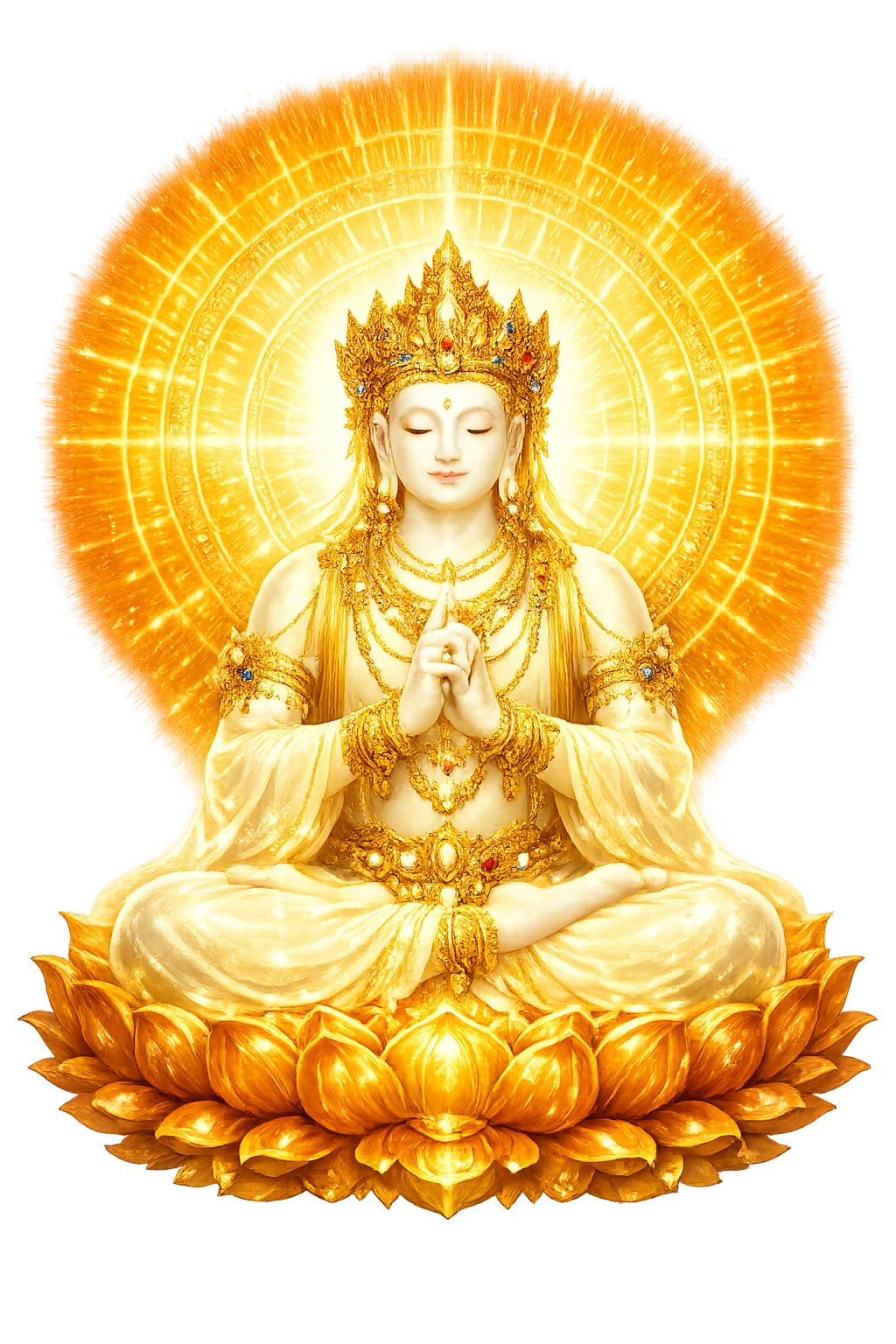
Vairocana is imaged as the cosmic axis of the maṇḍala: serene, white or golden, often seated on a lotus throne, hands forming the dharmacakra mudrā or the six-family mudrā of the Vajradhātu. In East Asian iconography he can appear crowned and jeweled as a celestial monarch. The Nara Daibutsu, some fifteen meters high in bronze, is the largest surviving ancient image; its head and hands were recast after earthquakes. Borobudur's latticed stupas reveal seated Vairocana figures on the summit, while Tibetan thangkas and Japanese mandalas translate his radiance into two-dimensional cosmograms.

06

Reception & Transformation

The name after its own age — transmission, translation, survival

Afterlives

Mahāvairocana moved from an abstract solar epithet in the Avataṃsaka Sūtra to the central deity of esoteric Buddhism through Śubhakarasiṃha and Yixing's translation of the Mahāvairocana Sūtra in 724–725 CE. Kūkai carried the text and its ritual technology to Japan in 806 CE, where it shaped aristocratic, and later warrior, religious culture. In China, the cosmic Buddha merged with Hua-yen metaphysics and imperial ideology. After the Meiji separation of Buddhism and Shinto, Tōdai-ji survived as a national monument and UNESCO World Heritage site. Modern scholarship traces Vairocana's origins to solar conceptions across India, Iran, and Central Asia, while his image remains an emblem of East Asian Buddhist grandeur in museums and pilgrimage.

Identifications Across Traditions

The name itself is an old loan from the sun: Monier-Williams lists Vairocana as a solar epithet and even as a Dānava king, the son of Prahlāda and father of Bali — Buddhism took the word for light and made it the light-source of the Dharma. In Japan the identification ran both ways: medieval honji-suijaku thought read Dainichi as the true face of Amaterasu, the sun goddess of Ise, fusing the two great suns of the archipelago's religions, and medieval Shinto-Buddhist combinatory cults installed Dainichi as the inner truth of shrine after shrine. In Tibet he is the center of the five tathāgatas, the white crown of the system; in China his Avataṃsaka became the Huayan school, whose Indra's-net teaching is still the standard Buddhist answer to the question of how everything relates — borrowed today, often unknowingly, by ecologists and systems theorists.

Modern Legacy

The Nara Daibutsu remains Japan's most visited Buddha, and Kōya-san's temple-cemetery complex — grown around Kūkai's mausoleum, where the master is held to sit in meditation still — is among the great sacred landscapes of Asia, its approach lit at dusk by ten thousand stone lanterns. The Avataṃsaka's jeweled net has become a standing metaphor far beyond Buddhism for interdependence itself, appearing in textbooks of ecology and complexity theory a millennium after Fazang's lion. Shingon's monks still chant the esoteric sūtras on Kōya-san as a daily act of maintaining the cosmos. And the name keeps its grammar: every Dainichi temple and every Rushana image is still conjugating vi-√ruc, the verb 'to shine forth,' in bronze and wood and gold.

07

The Meditation

What Mahāvairocana means — beyond the dictionary

Mahāvairocana asks the largest question a religion can ask: what if the universe is not indifferent matter but a sermon — and what if you are one of its sentences? The question sounds abstract until the Avataṃsaka's logic tightens: every atom contains every world, so the smallest act of attention is cosmically scaled; every jewel reflects every other, so no one is illuminated alone. The maṇḍala's answer is procedural rather than argumentative: enter, and see whether the center holds. Walk the Womb maṇḍala and you are walking through the Buddha's body; form the wisdom fist and your own six elements grip one another. The Great Sun does not demand belief so much as recognition — the light is already here, has always been here, and asks only the moon's office: to receive, and to return.

08

Frequently Asked Questions

Common questions about Mahāvairocana, Universal Illumination, Cosmic Buddha, and Unicode restoration

01How do you pronounce Mahāvairocana?

In reconstructed pronunciation, Mahāvairocana is /mɐ.ɦaː.ʋɛː.ˈroː.tɕɐ.nɐ/ — approximately mah-hah vai-ROH-chuh-nuh — mahā is 'great'; the c is the soft 'ch' of 'church.'.

02What does Mahāvairocana mean?

Mahāvairocana means ‘the Great Illuminator’, the cosmic Buddha at the centre of the Avataṃsaka Sūtra and the Shingon school (mahā ‘great’ + vairocana ‘shining forth’, from vi-√ruc ‘to shine’), MW. in the buddhist tradition.

03What are the symbols of Mahāvairocana?

Mahāvairocana is associated with The sun disk (Illumination without shadow: wisdom as a property of the universe, not an ornament of saints), The wisdom-fist mudrā (Fist within fist: the elements of body and mind gripping one another), The white lotus throne (The dharmakāya enthroned in its own purity at the center of both maṇḍalas), The letter A (The Siddham seed syllable A — the first sound of the alphabet, the unborn, the whole sūtra compressed into one letter), Indra's net (The Avataṃsaka's jeweled web: every jewel reflects every other — interdependence as the texture of reality).

04Why restore Mahāvairocana in Unicode?

Plain ASCII mahavairocana strips the stress, length, and script that make the name specific. Unicode restoration returns the name to its original written dignity.

05What is the most important myth about Mahāvairocana?

“The Buddha Whose Body Is the Cosmos” — the Avataṃsaka Sūtra story that anchors the mythology of Mahāvairocana, told in full on the lore page.

09

Scholarly Sources

The philological foundations of this restoration

Every claim on this page is grounded in established scholarship. The orthographic restorations follow disciplinary convention. The etymological chain follows the best available reference works. This is not invention — it is resurrection through scholarship.

◈

Lexicography & Philology

  • Avatamsaka Sutra
  • Buddhist texts
◎

Primary Texts

  • The Larger Sukhāvatī-vyūha Sūtra; the Smaller Sukhāvatī-vyūha Sūtra; the Amitāyurdhyāna Sūtra; the Lotus Sūtra.
◉

Archaeology & Art History

  • Material evidence — iconography, inscriptions, and temple archaeology — for Mahāvairocana and related cults.
✦

Religious Studies

  • Avataṃsaka Sūtra (Buddhabhadra's translation, 420 CE)
  • Mahāvairocana Sūtra (Śubhakarasiṃha and Yixing, 724–725)
  • Tattvasaṃgraha Tantra
  • Fazang, Jin shizi zhang (Treatise on the Golden Lion)
  • Kūkai, Shōji jissō gi
  • Shoku Nihongi
Return

The Surface Awaits

You have traced the name from its earliest attestation to its Unicode restoration. Now return to the myth. The story is where the name lives.

Back to Lore
Mahāvairocana mascot