The Living Myth
Universal Illumination, Cosmic Buddha · The Great Sun · Light of the Cosmos
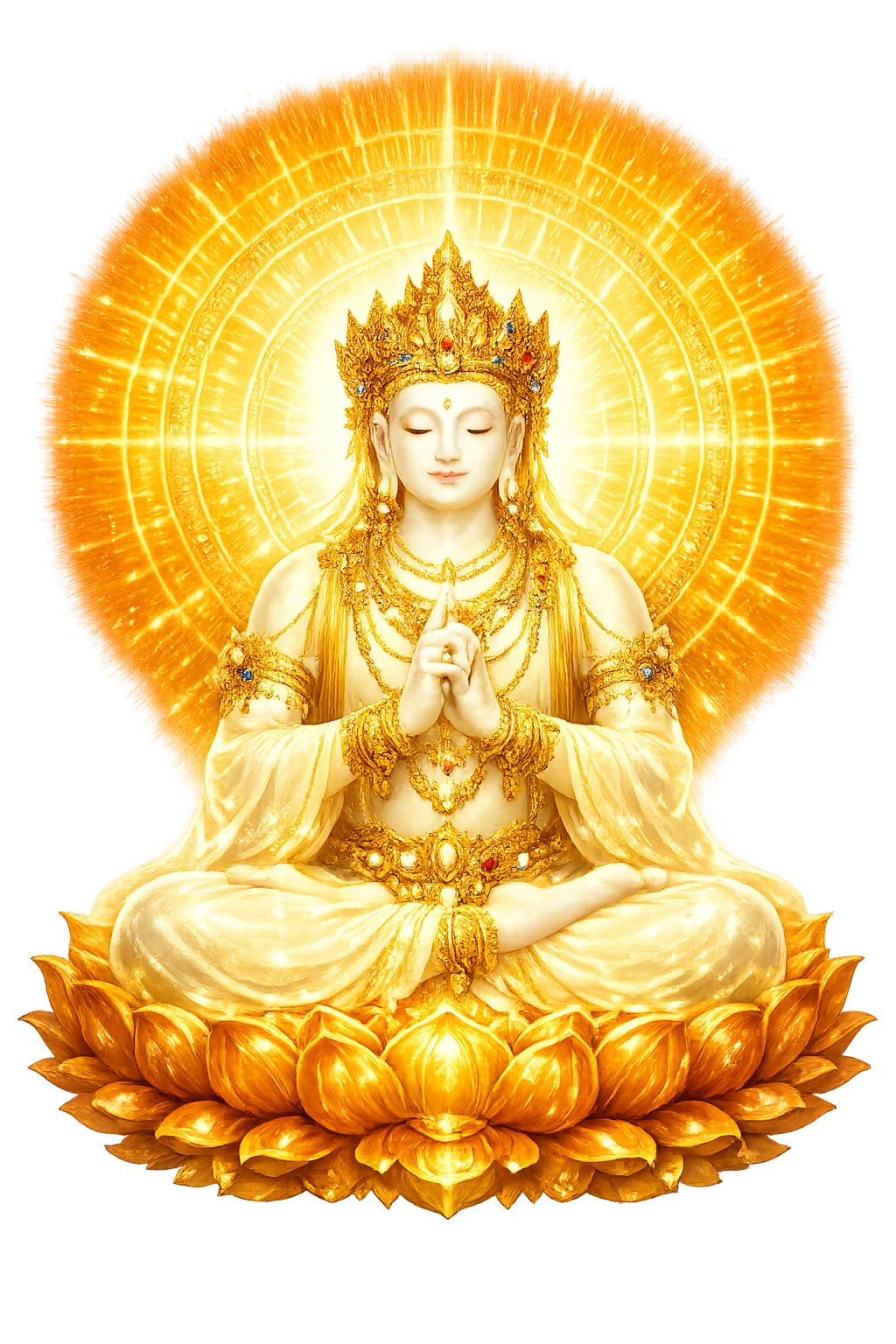
Stories of Mahāvairocana
Mahāvairocana's mythology is cosmology recited as liturgy: the universe telling itself the story of its own enlightenment. The Avataṃsaka gives him the cosmos, the esoteric sūtras give him the throne, Kūkai gives him Japan, and an emperor gives him the largest bronze Buddha of the age.
The Avataṃsaka Sūtra — the Flower Garland, first translated into Chinese by Buddhabhadra in 420 CE — opens on a scale no other scripture attempts: Vairocana enthroned not in a grove but in the dharmadhātu itself, the Dharma-realm, every pore of his body a world-system, every atom of every world containing all the others, the whole interpenetrating without confusion like the chambers of Indra's net, where a jewel at every crossing mirrors every other jewel, and each mirrored jewel mirrors the rest to infinity. The sūtra's visions are not allegories but descriptions: the cosmos is the Buddha's body, and the Buddha's body is the cosmos explaining itself. The Huayan masters drew the conclusion that became Chinese Buddhism's deepest contribution — li shih wu ai, the unobstructed interpenetration of principle and phenomena. It is the largest picture of interdependence ever painted: nothing exists alone, and the Great Sun is the name for the whole net seen at once.
The esoteric tradition's own charters, the Mahāvairocana Sūtra and its twin the Tattvasaṃgraha — translated into Chinese in 724–725 by the Indian master Śubhakarasiṃha with the commentary of the Chinese astronomer-monk Yixing — present the cosmic Buddha not as a person among persons but as the dharmakāya, the Dharma-body, whose sermon is reality's ongoing act of existing. The sūtra's root metaphor is the sun: as the sun illuminates all things without discriminating among them, the Buddha's wisdom shines on all beings without choosing favorites — and the moon's light, borrowed and returned, stands for the teaching as beings receive it. Kūkai gave the idea its boldest Japanese formula: hosshin seppō, the dharmakāya itself preaches. Mountains, rivers, the sound of rain — for Shingon these are not metaphors for the teaching but the teaching in progress, and the maṇḍala is the lesson read as a map. The myth dissolves the distance between scripture and weather.
In 804 the monk Kūkai sailed to Tang China; at Qinglong monastery in Chang'an the patriarch Huiguo, recognizing him on sight as his destined successor, transmitted to him the Womb and Diamond maṇḍalas — the two great maps of Mahāvairocana's body and wisdom — in the space of a few months, and in 806 Kūkai carried them home. In 816 he vowed a mountain monastery on Kōya-san, high in the cedar forests of Kii, consecrated 819; in 823 the court granted him Tō-ji in Kyoto as the esoteric school's capital seat; and there he built a school in which ritual, art, calligraphy, and philosophy are one act — to move through the maṇḍala in ceremony is to remember that one is made of the same light as its center. The tradition holds that Kūkai never died: he sits in eternal meditation in his tomb on Kōya-san, awaiting Maitreya. Shingon remains one of the largest living Vajrayāna communities outside Tibet — two maṇḍalas, still teaching.
In 743, with rebellion in the east and smallpox scything the cities, Emperor Shōmu issued his proclamation (recorded in the Shoku Nihongi) commanding a great bronze Vairocana — the Nara rendering of the cosmic Buddha, read in the Fujiwara-kyō and Nara court as the Avataṃsaka's central figure — so that the realm itself might be sheltered within the Buddha's body. The casting bankrupted and unified the provinces: the court taxed the road-corvée and conscripted the metal of the whole archipelago, and abbots wrote that heaven answered with good harvests. The Tōdai-ji Daibutsu, some fifteen meters of gilt bronze, was consecrated in 752 before ten thousand monks, the Indian monk Bodhisena daishing the eyes — kaigen, the ceremony of opening the eyes, held exactly as texts prescribed. It was the largest bronze casting of its age, bankrolled by a court that believed the Avataṃsaka's cosmos could shelter a state. The statue still sits in its hall, the Great Sun in metal.
The greatest teacher the Avataṃsaka ever found was a Sogdian-born prodigy in the Tang capital. Fazang, third patriarch of the Huayan school, was called to lecture on the sūtra before Empress Wu Zetian — and, the tradition recorded in his own Jin shizi zhang (Treatise on the Golden Lion), he chose his teaching-prop with imperial wit: a gilded lion from the palace itself. The lion's gold, he explained, is the principle, li; its form — eyes, ears, limbs, roar — is the phenomena, shi. Melt the gold and no lion remains, yet never for an instant was there gold that was not the lion: neither precedes the other, each pervades the other, and every hair of the mane contains the whole beast. The empress was enlightened on the spot, by court chronicle's account, and Huayan became the Tang's state philosophy of totality. The parable endures because it makes interdependence something you can hold: a lion of gold, a cosmos of light.
The Avataṃsaka Cosmos, the Two Maṇḍalas, and the Preaching of the Dharmakāya
Mahāvairocana is the cosmic Buddha: the Great Sun whose body is the universe itself, the center of the Avataṃsaka's jeweled cosmos and of the Shingon maṇḍalas — the Buddha who does not merely teach the Dharma but whose every mountain, river, and star is the teaching.
Dainichi: light as the universe's own substance — every being a spark of the one radiance.
The Avataṃsaka image: a jewel at every knot, each reflecting all — the cosmos as mutual mirroring.
Womb and Diamond: the Shingon pair in which his body and his wisdom are mapped, entered, and embodied.
Chiken-in: the Japanese seal of the six elements interpenetrating — body and mind gripped in one fist.
From the original script to the living URL
महावैरोचन
The name in its original Buddhist form. Mahāvairocana (महावैरोचन) is attested in the source tradition — “‘the Great Illuminator’, the cosmic Buddha at the centre of the Avataṃsaka Sūtra and the Shingon school (mahā ‘great’ + vairocana ‘shining forth’, from vi-√ruc ‘to shine’), MW.”. Its macron-length vowels carry the full phonetic and orthographic weight of the source tradition.
mahavairocana
Reduced to plain mahavairocana, the name loses everything that made it specific: macron-length vowels. What remains is an ASCII string that machines can parse but that no longer speaks with its original voice.
Mahāvairocana
The Unicode restoration recovers what ASCII flattened. Mahāvairocana restores macron-length vowels, returning the name to its original written dignity. The domain encodes to Punycode, but the browser displays the truth.
Mahāvairocana.com → xn--mahvairocana-9mb.com
The non-ASCII characters in Mahāvairocana are encoded while the ASCII remains visible. To the DNS, it is Punycode. To humanity, it is Mahāvairocana.
Owned, ideal, and ASCII forms of Mahāvairocana
Mahāvairocana
Restores महावैरोचन. The live temple domain — mahāvairocana.com.
mahavairocana
Flattens महावैरोचन. The plain ASCII fallback — what DNS and legacy systems see.
How Mahāvairocana was spoken
How Mahāvairocana travels from ancient script to the modern URL
The lore you have read is the living myth. Extended Lore opens the scholarly vault beneath it: the cult and its material remains, a history of the image, the name after antiquity, a meditation on what the name still means, and the full scholarly apparatus — etymology, orthography, sources.
Enter Extended Lore