
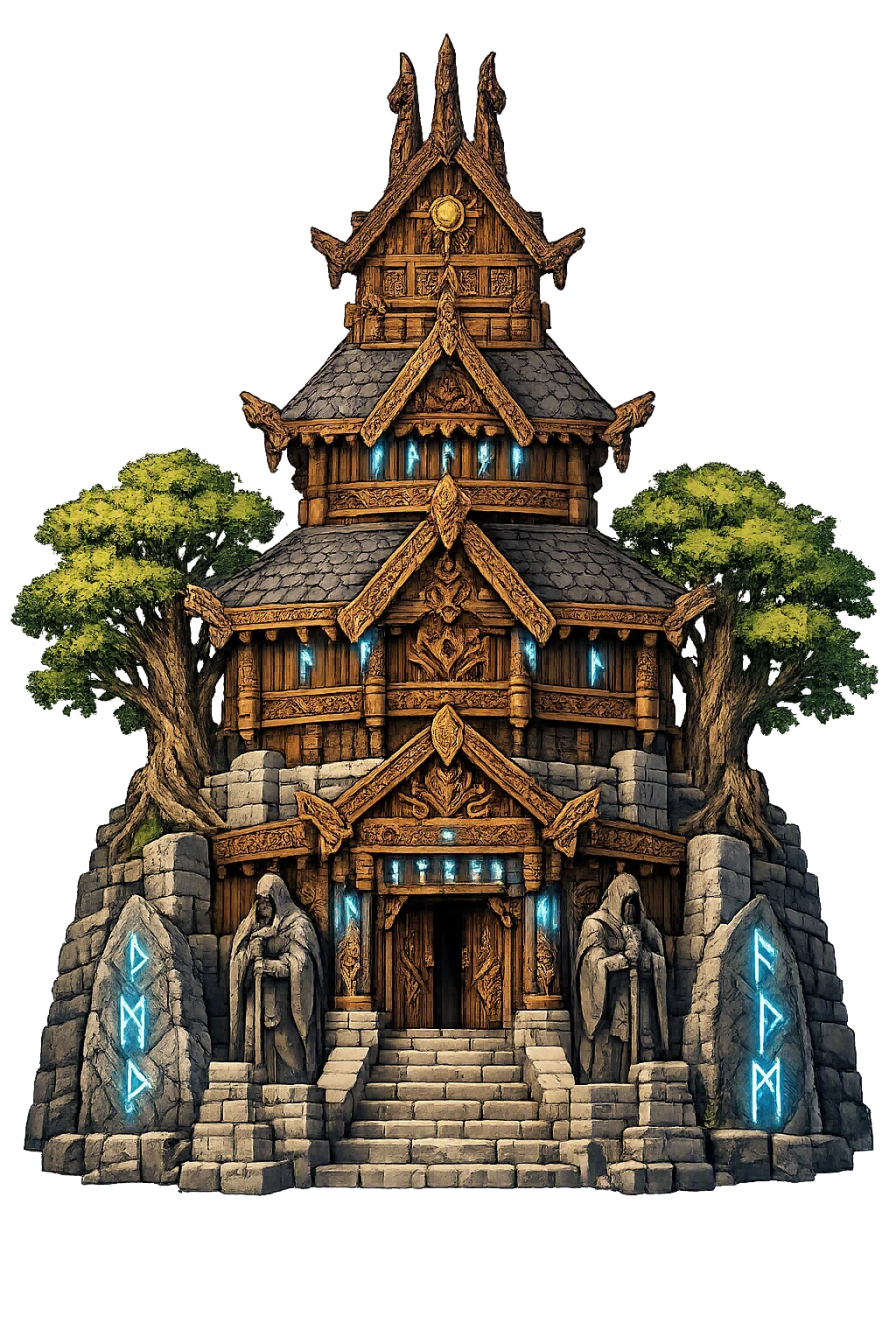
The provenance file on Uppsala
Provenance record 507 · Uppsala · one temple, fully accounted for.
Provenance
1. The attestation. ᚢᛒᛒᛋᛅᛚᛅ, from the tradition's own record. On record: Adam of Bremen, Gesta Hammaburgensis ecclesiae pontificum 4.26–27 with scholia 134–139 (the temple at Ubsola, the enthroned triad, the nine-year festival, the sacred grove, and the spring), trans. Francis J. Tschan, rev. Timothy Reuter (Columbia University Press, 2002), Snorri Sturluson, Heimskringla, Ynglingasaga 10 (Freyr builds the temple at Uppsalir, makes it his chief seat, endows the Uppsala wealth, and is buried in a mound there), trans. Lee M. Hollander, Snorri Sturluson, Prose Edda, Skáldskaparmál (the kenning 'Kraki's seed' — the gold Hrólfr sowed on the Fyrisvellir below Uppsala), trans. Anthony Faulkes, Hrólfs saga kraka (King Aðils at Uppsala, the flight of Hrólfr and the gold-sowing on the Fyrisvellir), trans. Jesse L. Byock.
2. The narrative record. The Golden Temple — Adam of Bremen, archbishop's scholar at Hamburg-Bremen, sets down about 1075 the most exact account of Norse cult that survives. Near Sigtuna, he writes, stands a famous temple called Ubsola, entirely decked with gold, and in it the people worship the statues of three gods: the most powerful, Thor, occupies the throne in the middle of the hall; on either side stand Wodan and Fricco. The Nine-Day Sacrifice — Adam's second chapter on the site records the great communal rite. Every nine years, he writes, all the provinces of Sweden hold a solemn assembly at Uppsala, from which no one may purchase exemption; every man sends offerings.
3. The physical record. Uppsala is the rare Norse holy place where the texts can be tested against the ground. The three royal mounds of Gamla Uppsala — the largest barrows in Sweden — were opened in 1846–47 under Bror Emil Hildebrand: beneath each lay a cremation of the sixth or seventh century, burned in its finery and sealed under birch bark, with weapons, game-boards, and sacrificed animals, the graves of the dynasty the poems call Ynglings or Scylfings. Beside them the medieval church — seat of Sweden's first archbishop from 1164 — stands on a great artificial plateau of levelled terraces, the one construction on the site that matches Adam's scale; Sune Lindqvist's excavation beneath the church floor in 1926 revealed the postholes of a very large wooden building, and the argument whether it was the pagan temple, a royal feasting hall, or both has run ever since — Olof Sundqvist's work on the Svea cult-and-kingship complex is the standard modern frame. The surrounding landscape is dense with the dynasty's furniture: boat-graves at Valsgärde a few miles north, the Vendel graves across the river, hundreds of smaller mounds on the Fyris plain. No runestone carves the place-name itself; the Younger Futhark rendering ᚢᛒᛒᛋᛅᛚᛅ (ubbsala) is a normalized reconstruction, though Uppland is the richest runestone province in Scandinavia.
4. The current holding. The temple at /uppsala/, classified Tier 2. The restoration keeps one feature the ASCII form drops. One is enough to matter, and the label says so plainly: Tier-2.
5. The documented resonances. Faith & Spiritual Organizations, Architecture & Spatial Design, Gaming, Fantasy & Entertainment IP — seats argued and weighted in the pattern atlas, read through the myths in this temple's Resonance File.
6. The primary sources. Poetic Edda, Prose Edda — the library this file answers to, open at the Sacred Texts collection.
7. The continuing record. Uppsala never stopped being the stage on which Sweden remembers itself. The old cult centre became the church's: Gamla Uppsala was the seat of Sweden's first archbishopric from 1164 until the see moved to Östra Aros — the modern city of Uppsala — in 1273, and the medieval church still stands on the artificial plateau where Adam's temple is sought.
At a Glance
- Restored name: Uppsala
- ASCII form: uppsala
- Meaning: "Upper halls"
- Domain of influence: Temple, Freyr, Sacred Grove
- Pantheon: Norse
- Classification: Tier 2
- Original script: ᚢᛒᛒᛋᛅᛚᛅ
- Series: The Restoration Files, No. 507 of 548
The File Continues
Read the founding dispatch for the name's full story, the Resonance File for the archetype at work — or the whole archive in one sitting.
Continue the series — previous file: Ullr (read it here) · next file: Urcaguary (read it here).
The Restoration Files are written from the same canonical record as the temples themselves: the lexicon, the lore catalog, the pattern atlas, and the cited scholarly sources. If a file ever disagrees with its temple, the temple is right — tell us, and the file will be corrected.