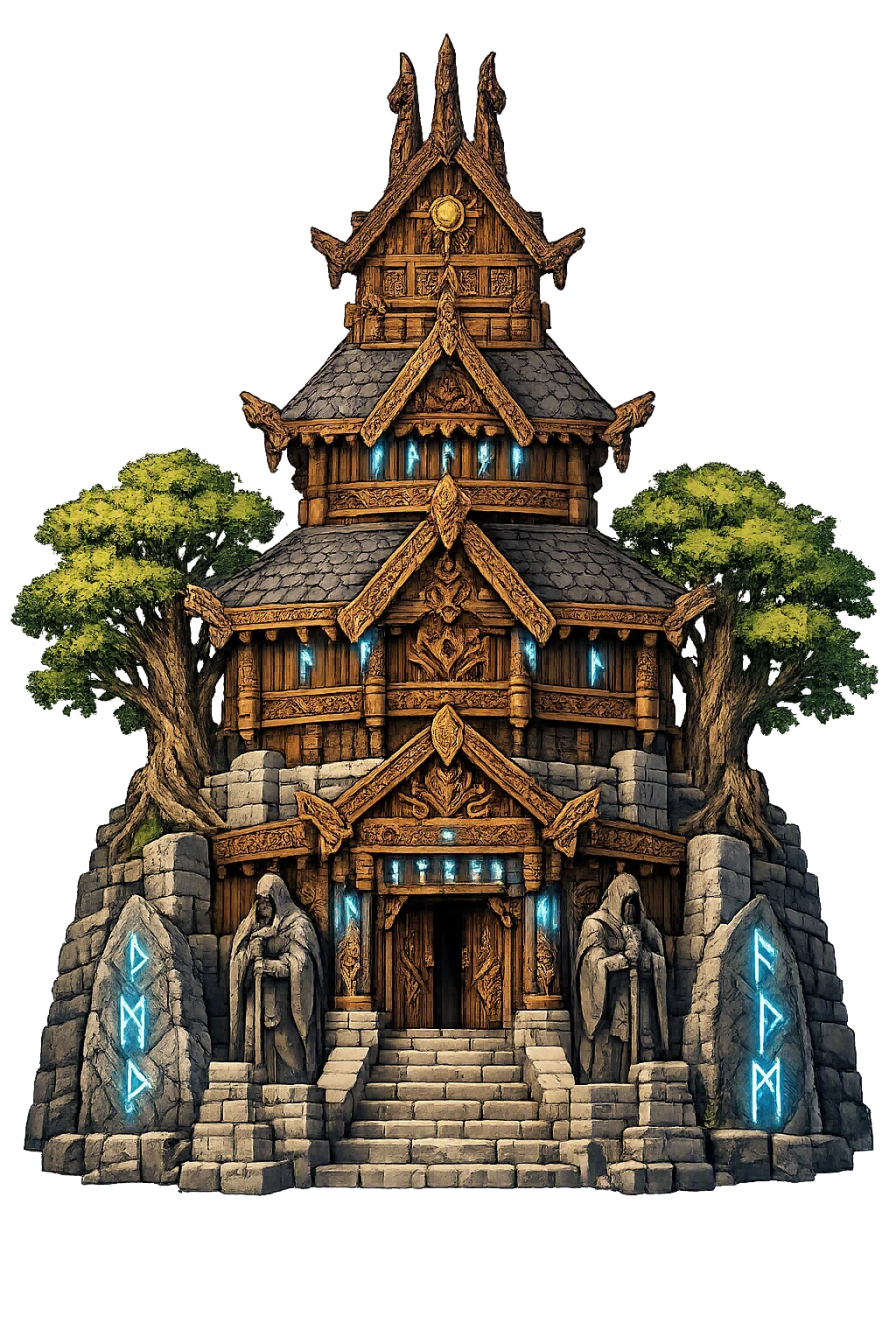
Stories of Uppsala
Uppsala's dossier is not a god's biography but a sanctuary's record — and it is the fullest any Norse holy place receives. Adam of Bremen describes the temple and its rites from the testimony of the Danish court a generation before the old religion died in Sweden; Snorri gives the site its founding god and its dynasty; the saga of Hrólfr kraki sets a famous treasure-flight on the plain below it. Between the four witnesses, the Upper Halls emerge as the one place where the whole northern religion can be watched at prayer.
Adam of Bremen, archbishop's scholar at Hamburg-Bremen, sets down about 1075 the most exact account of Norse cult that survives. Near Sigtuna, he writes, stands a famous temple called Ubsola, entirely decked with gold, and in it the people worship the statues of three gods: the most powerful, Thor, occupies the throne in the middle of the hall; on either side stand Wodan and Fricco. Thor, Adam explains, governs the air, thunder, lightning, winds, rains, fair weather and crops, and holds his sceptre like Jove; Wodan, 'that is, Frenzy', rules war and gives men strength against enemies, carved in the likeness of an armed man as Mars is shown; Fricco, bestower of peace and pleasure on mortals, is shaped with an immense phallus. Each god has his priests, and the people's vows follow need: in plague or famine they sacrifice to Thor, for war to Wodan, for weddings to Fricco. Adam worked from the reports of the Danish king Sven Estridsen, and the scholia fill in further colour — the temple ringed by a golden chain hanging from its gable, the feasting within.
What the account gives the record is irreplaceable: a working temple of the Æsir described in its last generation, by a churchman who wanted it abolished and could not help seeing it clearly.
Adam's second chapter on the site records the great communal rite. Every nine years, he writes, all the provinces of Sweden hold a solemn assembly at Uppsala, from which no one may purchase exemption; every man sends offerings. The sacrifice is of this kind: of every living creature that is male, nine head are offered, by whose blood it is the custom to placate the gods. The bodies are hung in a grove adjoining the temple, a grove so sacred to the heathens that each tree is believed divine because of the death and putrefaction of the victims. Dogs and horses hang there with the men, and one of the Christians told Adam he had seen seventy-two bodies hanging together. The incantations sung at the rite, Adam adds, are so disgraceful that it is better to say nothing of them.
A scholion adds the spring beside the temple in which a living man was drowned; if he was not found again, the people's wish would be granted. Every element — the nine-year cycle, the nine of each kind, the grove, the hanging — belongs to the deep grammar of Germanic sacrifice: Thietmar of Merseburg records a parallel nine-year rite at Lejre in Denmark, and Tacitus had described the sacred groves of the continental Germans a thousand years before. Uppsala is where that grammar has its fullest surviving page.
Snorri gives the site its founding god. When [[freyr|Freyr]] took the kingdom after his father [[njord|Njörðr]], he built a great temple at Uppsalir, made it his chief seat, and endowed it with all his revenues — lands, livestock, and money: the origin of the Uppsala auðr, the 'Uppsala wealth', the crown estate of the Swedish kings. In his days began the peace and good seasons the Swedes remembered as the best of times; Freyr was worshipped more than other gods because the people grew richer in his peace. His other name was Yngvi, and from him the Swedish royal house took its name — the Ynglings.
When Freyr died, the chapter continues, his men would not let the news out. They raised a great mound with a door and three holes and told the Swedes he lived on; for three years gold, silver, and copper were poured through as offerings while the peace held. When at last the truth came out, the Swedes would not burn him, believing he had brought the good seasons — so the god of the temple lies in a royal mound on his own ground, and the cult and the kingship are one estate. Every detail is euhemerized, and the archaeology keeps answering it: the three great barrows beside the church at Gamla Uppsala are real cremation graves of real sixth- and seventh-century kings.
Snorri, explaining in Skáldskaparmál why gold may be called 'Kraki's seed', tells of King Aðils at Uppsala and his guest turned rival, Hrólfr kraki of the Danes. When Hrólfr fled Uppsala with treasure taken from Aðils, the Swedish king rode in pursuit with his army; and Hrólfr, seeing the pursuit gain, sowed the stolen gold along the Fyrisvellir, the plain of the river Fyris, so that the Swedes, greedy for the shining harvest, stopped to gather it and let the Danes escape. Aðils himself is said to have stooped from his horse to pick up the ring Svíagriss, 'the pig of the Swedes' — and Hrólfr, watching him grovel for gold, declared he had now bent low the mightiest man in Sweden.
The saga tradition keeps Aðils at Uppsala for the rest of his strange life — the king who married his own daughter Yrsa, who sacrificed to a 'dis' and was thrown from his horse in the hall — and the same dynasty rides through Beowulf, where Eadgils son of Ohthere is king of the Scylfings, the 'shieldings' of Sweden. The identification of Beowulf's Swedish royal house with the kings of the Uppsala mounds is one of the oldest convictions of northern scholarship: the poems knew the Upper Halls as the house where kings, gold, and gods were one inheritance.
The Upper Halls of the Swedish Kings
Uppsalir — 'the Upper Halls' — is the one sanctuary of the Norse world the medieval record describes beam by beam and tree by tree. Adam of Bremen, writing about 1075 from the reports of the Danish court, gives us the golden temple where [[thor|Þórr]] sat enthroned between Wodan and Fricco; the sacred grove beside it, every tree made divine by the offerings hung in its branches; and the nine-day festival, renewed every ninth year, at which nine males of every living kind were given to the gods. Snorri's Ynglingasaga makes the place the seat of [[freyr|Freyr]] himself — the god who built the temple, endowed it with the Uppsala wealth, and lies in a mound beside it. Below the ridge the three royal mounds of Gamla Uppsala still stand, the largest barrows in Sweden, the graves of kings the poems call the Scylfings.
The temple at Uppsala that Adam of Bremen describes as entirely decked with gold, a golden chain hanging from its gable — the cult house of the Swedish commonwealth.
The grove adjoining the temple, every tree held sacred because of the death and decay of the victims — men, horses, and dogs hung among the branches.
Every ninth year, nine days of sacrifice at the turn of the cycle, one offering each day, nine of every male creature — a rite from which no Swede could absent himself without paying a price.
The three great barrows of Gamla Uppsala, cremation graves of sixth- and seventh-century kings; Ynglingasaga buries Freyr himself in such a mound on the same ground.
From the original script to the living URL
ᚢᛒᛒᛋᛅᛚᛅ
The name in its original Norse form. Uppsala (ᚢᛒᛒᛋᛅᛚᛅ) is attested in the source tradition — “Upper halls”. Its original diacritics and script distinctions carry the full phonetic and orthographic weight of the source tradition.
uppsala
The plain uppsala form is identical to the Unicode restoration. Because this name is already written in Latin letters, no diacritics, stress, or script information were lost — only capitalization differs.
Uppsala
The Unicode restoration does not need to recover lost marks for Uppsala. Its value is canonical spelling and consistent cataloguing, not the reconstruction of erased orthography. The domain is readable as-is to both DNS and humanity.
Uppsala.com
This restoration is written entirely in ASCII letters — no Punycode encoding stands between Uppsala and the DNS. The domain reads identically to machines and to human eyes.
Owned, ideal, and ASCII forms of Uppsala
Uppsala
Restores ᚢᛒᛒᛋᛅᛚᛅ. The full Unicode restoration. uppsala.com is not in the PuniCodex collection — it is watched for release; if it drops, this temple upgrades to an owned flagship.
How Uppsala was spoken
How Uppsala travels from ancient script to the modern URL
The lore you have read is the living myth. Extended Lore opens the scholarly vault beneath it: the cult and its material remains, a history of the image, the name after antiquity, a meditation on what the name still means, and the full scholarly apparatus — etymology, orthography, sources.
Enter Extended Lore