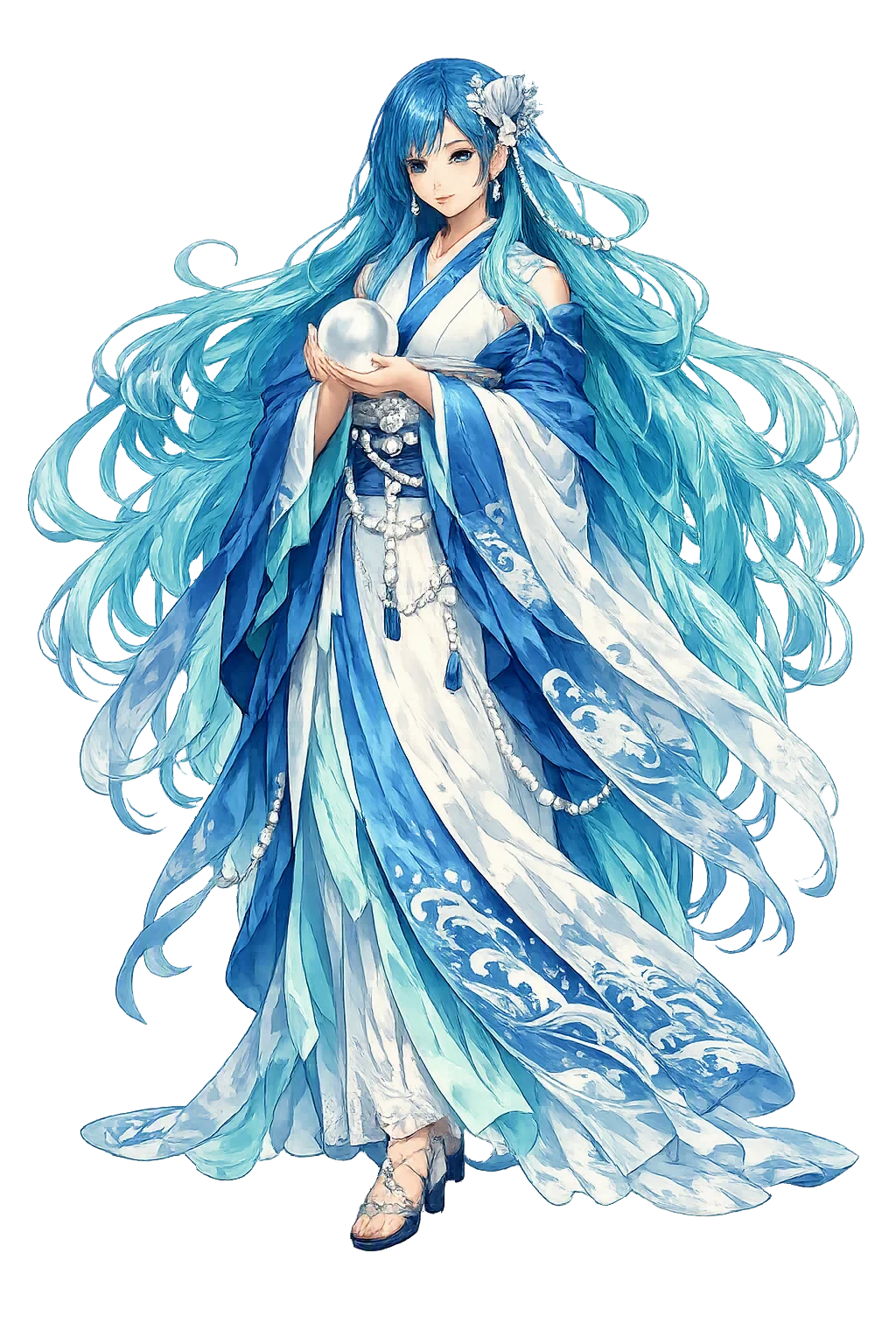
Stories of Toyotama
Toyotama's cycle, told in the Kojiki's Hoori narrative, is the story of a sea princess who marries into the land — and of the promise whose breaking closes the road between the realms forever. She is at once bride, mother, and exile: the ocean's gift to the imperial genealogy, and its loss.
Hoori — Hikohohodemi-no-mikoto, the hunter prince — came to the seashore weeping over a lost fishhook and a broken brotherhood. Guided by the old man of the sea, Shihotsuchi, he descended to the palace of Watatsumi, the dragon god of the depths. The palace walls were fish-scaled, its lanes alive with every creature of the sea, and the god received the prince with ceremony, presenting him to his daughter Toyotama-hime: 'I give you this maiden; dwell in our midst as long as heaven endures.' For three years Hoori lived in the sea palace, and there he recovered the hook, mastered his elder brother Hoderi, and won his bride (Kojiki, Hikohohodemi-no-mikoto; trans. Philippi). The marriage is the myth's hinge: the land's prince, powerless on land, is made whole by the sea's alliance — an oceanic bride as the seal between the hunting shore and the deep.
When Toyotama was with child, she told Hoori: 'In our country, when our kind give birth, we do so in our true form; do not look.' She built a parturition hut, sealed its entry, and withdrew. But longing overcame the prince: he stole to the hut and peered inside, and there he saw no woman but a great eight-fathom sea-dragon — a wani, sea-serpent or crocodile — coiling about the child. Ashamed to be seen in her true shape, Toyotama abandoned the newborn, left the hut, and returned to her father's palace; and the road between the sea and the land, she declared, was closed, because he had broken his promise (Kojiki). The sources preserve the detail without comment, and its force needs none: in the economy of this myth the gaze is the one theft the sea cannot forgive. What Hoori took by looking, the lineage paid for in a mother lost.
Toyotama did not leave the child wholly orphaned. From the sea palace she sent her younger sister, Tamayori-hime — 'the jewel-adorning princess' — to nurse the boy at the shore. The Kojiki names him Ugayafukiaezu, 'he of the unfinished roof': when the birth-hut was built, its thatching was left incomplete, and the name fixed the broken moment in the child himself. He grew at the edge of the sea he could never enter, married Tamayori — the aunt who had stood in his mother's place — and by her had four sons: Itsuse, Inahi, Mikenu, and the youngest, Kamuyamato-Iwarebiko. The pattern is an old one, attested across Japanese and continental tradition: what the mother could not stay to finish, the maternal kin complete, and the lost woman returns to the lineage through her sister. From that fourth son the chronicles will draw the first emperor.
The Kojiki closes the episode with an aetiology that turns a private shame into the human condition. Toyotama, departing, declares that she had meant to give birth easily — in the manner of her own kind, smoothly and without pain — but because Hoori had broken his promise, from that time forward women would suffer in childbirth. The sea princess thus bequeaths to every mother of the land the cost of a father's curiosity. The same chapter makes her the grandmother of empire: her youngest son's son took the name posterity knows as Emperor Jimmu, and Jimmu's eastern expedition, told later in the Kojiki, carries the sea's bloodline to Yamato and the throne at Kashihara. Read whole, the myth binds the two great facts of Japanese kingship into one sentence: the imperial line descends from the ocean, and it descends through a broken promise.
Sea, Transformation, and the Mother of Emperors
Toyotama is the daughter of the sea god Ryūjin and the wife of Hoori. Her name, 'Abundant Jewel,' evokes the treasures of the undersea palace. She is the mother of Ugayafukiaezu, making her an ancestor of Emperor Jimmu and a bridge between the ocean depths and the imperial line.
Daughter of Ryūjin and jewel of the undersea palace.
She married the descendant of Ninigi and bore his son.
Her son continued the line to Emperor Jimmu.
Her true form was the sea-dragon she hid from Hoori's eyes.
From the original script to the living URL
豊玉毘売命
The name in its original Japanese form. Toyotama (豊玉毘売命) is attested in the source tradition — “Abundant jewel”. Its script distinctions carry the full phonetic and orthographic weight of the source tradition.
toyotama
The plain toyotama form shares the canonical spelling. Because this name is already written in Latin letters, no recovered diacritics are required; capitalization follows the proper-noun convention.
Toyotama
The canonical spelling of Toyotama needs no recovered marks. Its value is consistent citation, transparent provenance, and a stable digital home for the scholarly record. The address is readable as-is to both DNS and humanity.
Toyotama.com
This restoration is written entirely in ASCII letters — no special domain encoding stands between Toyotama and the DNS. The domain reads identically to machines and to human eyes.
The attested spelling family of Toyotama
Toyotama
Original script 豊玉毘売命 — the attested writing of the name. The full canonical restoration. toyotama.com is not in the PuniCodex collection — it is watched for release; if it drops, this temple upgrades to an owned flagship. Attested by Kojiki, Nihon Shoki.
How Toyotama was spoken
How Toyotama is preserved in writing
A bespoke provenance study for Toyotama is being prepared by the PUNICODEX scholarly team.
Contribute scholarly provenance →The lore you have read is the living myth. Extended Lore opens the scholarly vault beneath it: the cult and its material remains, a history of the image, the name after antiquity, a meditation on what the name still means, and the full scholarly apparatus — etymology, orthography, sources.
Enter Extended Lore