PuniCodex

Extended Lore

豊玉毘売命 Toyotama

Etymology · Orthography · Cult · Iconography · Reception · Sources

Tier 2 Toyotama
Toyotama — Sea, Mother of Jimmu
01

Quick Facts

Essential information about Toyotama, Sea, Mother of Jimmu

Original Script豊玉毘売命
Unicode RestorationToyotama
Reconstructed Pronunciation/to.jo.ta.ma/
PantheonJapanese
DomainSea, Mother of Jimmu
MeaningAbundant jewel
ClassificationTier 2
Primary DomainToyotama
Sacred SymbolsJewel, Sea palace (Ryūgū), The wani (sea-dragon), Cormorant-feather thatch
02

Etymology & Word Family

From original script to Unicode restoration

Original Script 豊玉毘売命 Toyotama — "Abundant jewel"
Unicode Restoration Toyotama Canonical scholarly spelling — ASCII-identical
Modern ASCII toyotama Plain-ASCII fallback

The name Toyotama reaches the modern world through scholarly transliteration of the japanese tradition. Because the conventional spelling uses only Latin letters, its Unicode and ASCII forms coincide — the tradition it carries is in the name itself, not in diacritics.

03

Unicode Character Breakdown

Character-by-character philological analysis

CharacterUnicodeNameBlockPhonetic Role
TU+0054Latin Capital Letter TBasic LatinSame, capitalized
oU+006FLatin Small Letter OBasic LatinSame
yU+0079Latin Small Letter YBasic LatinSame
oU+006FLatin Small Letter OBasic LatinSame
tU+0074Latin Small Letter TBasic LatinSame
aU+0061Latin Small Letter ABasic LatinSame
mU+006DLatin Small Letter MBasic LatinSame
aU+0061Latin Small Letter ABasic LatinSame

The Tier 2 classification here reflects fidelity to the attested tradition, not recovered diacritics: every character of Toyotama already survives in ASCII. What the restoration preserves is the canonical spelling itself — the form scholarship standardised.

04

Cult & Worship

How the sacred was kept — rites, sanctuaries, remains

The Cult

Toyotama was never worshipped in her own right, and the record is honest about it: no shrine, festival, or priesthood is attested to her in any early source. Her 'cult' is entirely derivative — that of an imperial ancestress. State rites honouring the founder Jimmu, and the court's seasonal offerings to the imperial ancestors, logically pass through the mother of the line, yet no ceremony ever names her. On the Hyūga coast the tradition is commemorative rather than cultic: the island shrine of Aoshima marks the birth-hut legend, and Cape Kasasa looks out over the water she crossed. What survives is devotion to the story, not to the goddess — which, for a figure whose myth turns on a broken trust, may be the fitting tribute.

In the Earth

Toyotama has no excavated sanctuary and no inscription names her; her witnesses are books. The Kojiki was compiled in 712 and the Nihon Shoki in 720, and the Kojiki's oldest complete manuscript, the Shinpukuji-bon of 1371–72, still transmits the Hoori narrative. The myth's geography, however, is walked rather than read: the Miyazaki coast — Aoshima's tide-washed island shrine, the Cape Kasasa lookout, the Horikiri pass — preserves the story as local topography. Inland, at Kashihara in Nara prefecture, Kashihara Jingū marks the site of Jimmu's palace and throne, the terrestrial terminus of the sea-borne genealogy she began. Her material record, in short, is the map of Japan's founding geography.

05

Iconography

How Toyotama was imaged across the ages

The Image

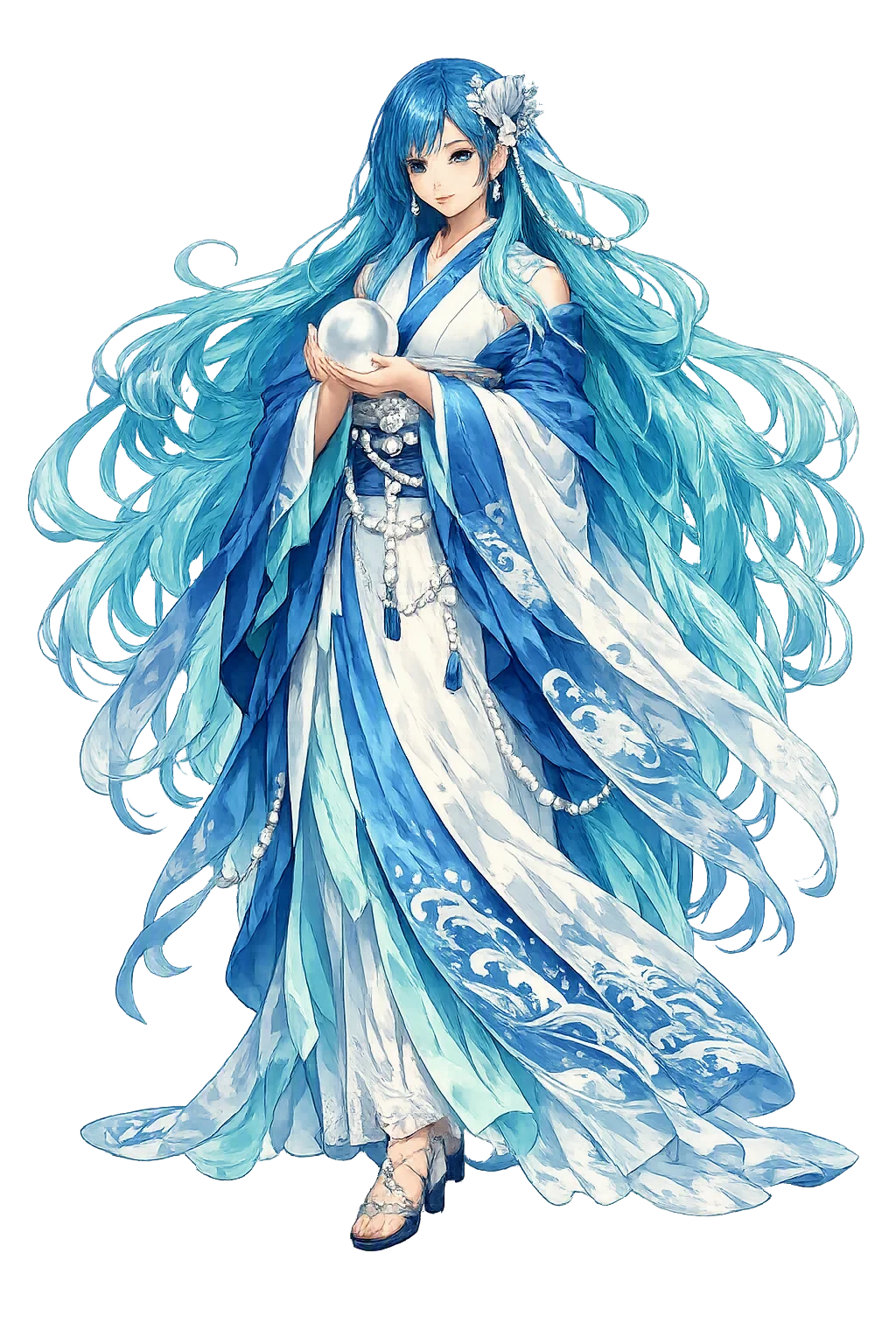
No ancient image of Toyotama survives, and the chronicles describe none: she exists in the imagination as voice and absence. The texts hand later artists a complete kit — the jewelled daughter of the sea palace, the wani sea-dragon true form, the unfinished cormorant-feather hut — and illustrators have worked from exactly those three props ever since. In painted versions of the Kojiki cycle and in modern prints she appears as a court lady whose hem trails water, or as a dragon coiled among the pillars of the deep. The image never varied because it never had a canonical image to vary from: every artist restages the same scene of hut and tide.

06

Reception & Transformation

The name after its own age — transmission, translation, survival

Afterlives

Toyotama's afterlife is the afterlife of the book that holds her. The Kojiki fixed her story in 712, and court scholars kept her in the official genealogy, where every ancient argument about the imperial line ran through her son. Edo nativism gave her close philological attention: Motoori Norinaga's Kojiki-den lingered over her name and her broken vow, and his school read the sea-marriage as sacred history worth defending. The Western reception begins with Aston's Nihongi (1896) and Philippi's Kojiki (1968), which made 'Toyotama-hime' a name comparative mythologists could finally cite; twentieth-century folklorists filed her tale beside the world's supernatural-bride stories, and historians of early Japan made her the pivot between ocean myth and dynastic politics. She travelled from court genealogy to philology to translation — a goddess whose fame rests on never being seen.

Identifications Across Traditions

Toyotama belongs to one of the oldest families of tales in East Asia: the supernatural bride whose true form must not be seen — the Japanese cousin of the Chinese dragon-palace romances and of the hagoromo 'feather-robe' cycle, in which a wife recovers her stolen robe and leaves her human family. Buddhist Japan read her father's palace through the nāga lens: the fish-scaled halls of the deep are the sea-serpents' treasure house, and Ryūjin's daughter moves between the two cosmologies without friction. In the medieval Shinto-Buddhist synthesis she is simply a kami of rank, fixed in the imperial genealogy she founded. Modern Japan keeps her as the archetype of the bride from the sea — beautiful, powerful, and gone — and the Ryūgū palace she left behind remains the nation's favourite undersea legend, retold in Noh, in the otogi-zōshi fairytales, and on screen.

Modern Legacy

Toyotama's legacy is dynastic before it is cultic: every emperor of Japan descends from her through Jimmu, so her name is woven into the state's founding genealogy. Her landscape is the Hyūga coast of Miyazaki — Aoshima, reached at low tide by its own sandbar, keeps the legend of the birth-hut, and Cape Kasasa and the Horikiri pass are pointed out as the myth's stations. The Ryūgū-palace motif she inhabits saturates Japanese art and story, from Noh and fairytales to modern film and anime, and 'Toyo-tama' was adopted by one of the twentieth century's great industrial houses — a modern reuse of the 'abundant jewel'. Her story endures because it is the founding genealogy's most human page: a marriage across worlds, a broken trust, a child raised between shore and sea.

07

The Meditation

What Toyotama means — beyond the dictionary

Toyotama is the mother who leaves — and the myth refuses to let us blame her cleanly. Her husband broke the only condition she set, and she went back to the sea, closing the road behind her. Yet what she left behind became the imperial line, the nation, the shrine at the water's edge. The tale understands something modern grief counsellors know: absence can found a lineage as surely as presence.

It also understands cost, and prices it honestly — hence the aetiology of childbirth pain, the myth's blunt way of saying that every descent of new life into the world is paid for in suffering, and that the bill was handed to the land the day the land looked where it had promised not to. To stand on the Hyūga shore is to stand where a marriage between sea and land was signed, witnessed, and broken.

08

Frequently Asked Questions

Common questions about Toyotama, Sea, Mother of Jimmu, and Unicode restoration

01How do you pronounce Toyotama?

In reconstructed pronunciation, Toyotama is /to.jo.ta.ma/ — approximately 'TOH-yoh-tah-mah' — four even syllables, with the second beginning with a soft 'y'.

02What does Toyotama mean?

Toyotama means Abundant jewel in the japanese tradition.

03What are the symbols of Toyotama?

Toyotama is associated with Jewel (The abundance and treasure of the sea, enshrined in her name), Sea palace (Ryūgū) (The undersea realm where she was born and to which she returned), The wani (sea-dragon) (Her true form, seen by Hoori when he broke his promise), Cormorant-feather thatch (The birth-hut she sealed with cormorant feathers — the garment between forms).

04Why restore Toyotama in Unicode?

Toyotama is written entirely in ASCII letters, so its restoration is about canonical fidelity rather than recovered diacritics: the temple fixes the name in its scholarly standard spelling, attested in the source tradition, instead of leaving it to drift.

05What is the most important myth about Toyotama?

“The Bride of the Sea Palace” — the Kojiki story that anchors the mythology of Toyotama, told in full on the lore page.

09

Scholarly Sources

The philological foundations of this restoration

Every claim on this page is grounded in established scholarship. The orthographic restorations follow disciplinary convention. The etymological chain follows the best available reference works. This is not invention — it is resurrection through scholarship.

◈

Lexicography & Philology

  • Lexical and philological sources for Toyotama.
◎

Primary Texts

  • Kojiki
  • Nihon Shoki
  • Kojiki, Hikohohodemi-no-mikoto and Toyotama-hime cycle; trans. Donald L. Philippi, Kojiki (Princeton University Press, 1969)
  • Nihon Shoki (Nihongi), Age of the Gods volumes, parallel variants; trans. W. G. Aston (1896)
◉

Archaeology & Art History

  • Material evidence — iconography, inscriptions, and temple archaeology — for Toyotama and related cults.
✦

Religious Studies

  • Aoki, Michiko Yamaguchi, Ancient Myths and Early History of Japan (Garland, 1974)
Return

The Surface Awaits

You have traced the name from its earliest attestation to its Unicode restoration. Now return to the myth. The story is where the name lives.

Back to Lore
Toyotama mascot