
The name Toyotama and the world it opens
A name is a door. Toyotama opens onto the domain of sea, mother of jimmu, the Japanese tradition, and centuries of storytelling, worship, and scholarship. This post moves through that world room by room — the name and its roots, the original script, the sound of it, the myths, the symbols, the sites, and its afterlife — before arriving at the digital temple that makes the record addressable. The letters are plain; the evidence is not.
At a Glance
- Canonical name: Toyotama
- ASCII form: toyotama
- Meaning: "Abundant jewel"
- Domain of influence: Sea, Mother of Jimmu
- Pantheon: Japanese
- Restoration: ASCII-equivalent form
- Original script: 豊玉毘売命 (Japanese characters)
Overview
Toyotama (toyotama) — Sea, Mother of Jimmu · Abundant jewel — belongs to the Japanese tradition, where it is catalogued under the domain "Sea, Mother of Jimmu". The name means "Abundant jewel".
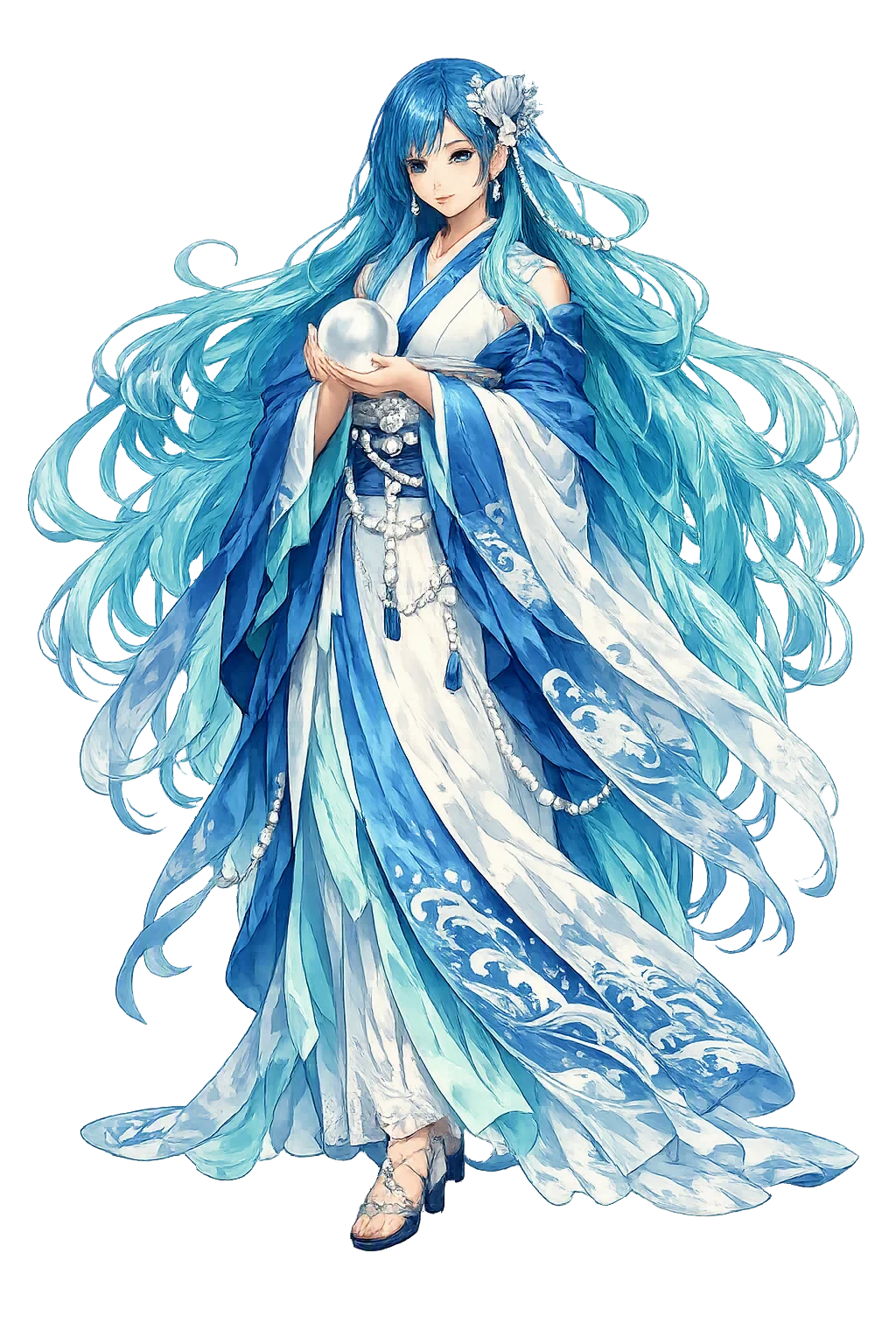
Toyotama is the daughter of the sea god Ryūjin and the wife of Hoori. Her name, 'Abundant Jewel,' evokes the treasures of the undersea palace. She is the mother of Ugayafukiaezu, making her an ancestor of Emperor Jimmu and a bridge between the ocean depths and the imperial line.
PuniCodex records the canonical scholarly spelling Toyotama and serves its temple at its temple. The displayed form is ASCII-equivalent — a description computed from the displayed form itself. The plain ASCII form toyotama contains the same letters: no recovered diacritics or special encoding is claimed. The work here is consistent citation, capitalization, provenance, and cultural context.
The Name
The name is attested in Japanese characters as 豊玉毘売命. Etymologically it means "Abundant jewel".
The canonical spelling Toyotama matches the conventional scholarly romanization. The plain ASCII form toyotama contains the same letters, so no lost diacritics or encoding transition is claimed. The editorial work is to fix one reviewed reference spelling, preserve capitalization and provenance, and keep the original evidence visible. The displayed form is ASCII-equivalent — a description computed from the displayed form itself.
The letter-by-letter transformation runs:
- t → T — Same, capitalized
- o → o — Same
- y → y — Same
- o → o — Same
- t → t — Same
- a → a — Same
- m → m — Same
- a → a — Same
The Original Script
The name is written in Japanese characters as 豊玉毘売命. That attested script remains the primary evidence for the conventional romanization Toyotama. The canonical Latin spelling does not pretend to recover marks it never contained: it fixes one reviewed reference form while leaving the original script visible for comparison.
The Kojiki writes 豊玉毘売命 — 豊 'abundance' + 玉 'jewel' + 毘売 hime 'princess' — 'abundant-jewel princess', the dragon daughter of the sea-king Watatsumi who comes up from the palace beneath the waves to bear Hoori's child. The spelling is semantic throughout. Her sister 玉依毘売 (Tamayori-hime, 'jewel-clinging princess'), who raises the child Ugayafukiaezu on shore, carries the paired name. The characters record a household of the deep, named for what the sea gives.
Pronunciation
The reconstructed pronunciation of the name is /to.jo.ta.ma/ — Modern Standard Japanese (Hepburn).
Phoneme by phoneme:
- To- — Voiceless alveolar stop [t] plus open-mid [o]
- -yo- — Palatal approximant [j] plus open-mid [o]; from 豊 'abundant'
- -ta- — Voiceless alveolar stop [t] plus open central [a]; from 玉 'jewel'
- -ma — Bilabial [m] plus open central [a]
For the modern speaker, the closest approximation is: 'TOH-yoh-tah-mah' — four even syllables, with the second beginning with a soft 'y'.
Kindred and historical forms of the name:
- Japanese — 豊玉毘売命 (Toyotama-hime-no-mikoto), 'Abundant Jewel Princess'
- Father — Watatsumi / Ryūjin, the dragon god of the sea
- Husband — Hoori (Hikohohodemi-no-mikoto)
- Son — Ugayafukiaezu, grandfather of Emperor Jimmu
Toyotama keeps its restoration plain: plain Hepburn romanisation, preserving no diacritic or distinctive letter. She is the sea princess and mother of the imperial ancestor Ugayafukiaezu.
Mythology
Toyotama's cycle, told in the Kojiki's Hoori narrative, is the story of a sea princess who marries into the land — and of the promise whose breaking closes the road between the realms forever. She is at once bride, mother, and exile: the ocean's gift to the imperial genealogy, and its loss.
The Bride of the Sea Palace (Kojiki)
Hoori — Hikohohodemi-no-mikoto, the hunter prince — came to the seashore weeping over a lost fishhook and a broken brotherhood. Guided by the old man of the sea, Shihotsuchi, he descended to the palace of Watatsumi, the dragon god of the depths. The palace walls were fish-scaled, its lanes alive with every creature of the sea, and the god received the prince with ceremony, presenting him to his daughter Toyotama-hime: 'I give you this maiden; dwell in our midst as long as heaven endures.' For three years Hoori lived in the sea palace, and there he recovered the hook, mastered his elder brother Hoderi, and won his bride (Kojiki, Hikohohodemi-no-mikoto; trans. Philippi). The marriage is the myth's hinge: the land's prince, powerless on land, is made whole by the sea's alliance — an oceanic bride as the seal between the hunting shore and the deep.
The Vow at the Birth-Hut (Kojiki)
When Toyotama was with child, she told Hoori: 'In our country, when our kind give birth, we do so in our true form; do not look.' She built a parturition hut, sealed its entry, and withdrew. But longing overcame the prince: he stole to the hut and peered inside, and there he saw no woman but a great eight-fathom sea-dragon — a wani, sea-serpent or crocodile — coiling about the child. Ashamed to be seen in her true shape, Toyotama abandoned the newborn, left the hut, and returned to her father's palace; and the road between the sea and the land, she declared, was closed, because he had broken his promise (Kojiki). The sources preserve the detail without comment, and its force needs none: in the economy of this myth the gaze is the one theft the sea cannot forgive. What Hoori took by looking, the lineage paid for in a mother lost.
Tamayori Raises the Child (Kojiki)
Toyotama did not leave the child wholly orphaned. From the sea palace she sent her younger sister, Tamayori-hime — 'the jewel-adorning princess' — to nurse the boy at the shore. The Kojiki names him Ugayafukiaezu, 'he of the unfinished roof': when the birth-hut was built, its thatching was left incomplete, and the name fixed the broken moment in the child himself. He grew at the edge of the sea he could never enter, married Tamayori — the aunt who had stood in his mother's place — and by her had four sons: Itsuse, Inahi, Mikenu, and the youngest, Kamuyamato-Iwarebiko. The pattern is an old one, attested across Japanese and continental tradition: what the mother could not stay to finish, the maternal kin complete, and the lost woman returns to the lineage through her sister. From that fourth son the chronicles will draw the first emperor.
Why Birth Is Hard (Kojiki)
The Kojiki closes the episode with an aetiology that turns a private shame into the human condition. Toyotama, departing, declares that she had meant to give birth easily — in the manner of her own kind, smoothly and without pain — but because Hoori had broken his promise, from that time forward women would suffer in childbirth. The sea princess thus bequeaths to every mother of the land the cost of a father's curiosity. The same chapter makes her the grandmother of empire: her youngest son's son took the name posterity knows as Emperor Jimmu, and Jimmu's eastern expedition, told later in the Kojiki, carries the sea's bloodline to Yamato and the throne at Kashihara. Read whole, the myth binds the two great facts of Japanese kingship into one sentence: the imperial line descends from the ocean, and it descends through a broken promise.
Symbols & Iconography
The iconography associated with Toyotama concentrates in a small set of recurring attributes, each a compressed statement about the name:
- Jewel — The abundance and treasure of the sea, enshrined in her name
- Sea palace (Ryūgū) — The undersea realm where she was born and to which she returned
- The wani (sea-dragon) — Her true form, seen by Hoori when he broke his promise
- Cormorant-feather thatch — The birth-hut she sealed with cormorant feathers — the garment between forms
Archaeology & Evidence
Toyotama has no excavated sanctuary and no inscription names her; her witnesses are books. The Kojiki was compiled in 712 and the Nihon Shoki in 720, and the Kojiki's oldest complete manuscript, the Shinpukuji-bon of 1371–72, still transmits the Hoori narrative. The myth's geography, however, is walked rather than read: the Miyazaki coast — Aoshima's tide-washed island shrine, the Cape Kasasa lookout, the Horikiri pass — preserves the story as local topography. Inland, at Kashihara in Nara prefecture, Kashihara Jingū marks the site of Jimmu's palace and throne, the terrestrial terminus of the sea-borne genealogy she began. Her material record, in short, is the map of Japan's founding geography.
Realm & Domain
Toyotama is the daughter of the sea god Ryūjin and the wife of Hoori. Her name, 'Abundant Jewel,' evokes the treasures of the undersea palace. She is the mother of Ugayafukiaezu, making her an ancestor of Emperor Jimmu and a bridge between the ocean depths and the imperial line.
Sea Princess
Daughter of Ryūjin and jewel of the undersea palace.
Wife of Hoori
She married the descendant of Ninigi and bore his son.
Mother of Ugayafukiaezu
Her son continued the line to Emperor Jimmu.
Shape-Shifter
Her true form was the sea-dragon she hid from Hoori's eyes.
Across Cultures
Toyotama belongs to one of the oldest families of tales in East Asia: the supernatural bride whose true form must not be seen — the Japanese cousin of the Chinese dragon-palace romances and of the hagoromo 'feather-robe' cycle, in which a wife recovers her stolen robe and leaves her human family. Buddhist Japan read her father's palace through the nāga lens: the fish-scaled halls of the deep are the sea-serpents' treasure house, and Ryūjin's daughter moves between the two cosmologies without friction. In the medieval Shinto-Buddhist synthesis she is simply a kami of rank, fixed in the imperial genealogy she founded. Modern Japan keeps her as the archetype of the bride from the sea — beautiful, powerful, and gone — and the Ryūgū palace she left behind remains the nation's favourite undersea legend, retold in Noh, in the otogi-zōshi fairytales, and on screen.
Kindred figures in the PuniCodex cross-tradition index include Hoori (hunter husband and sea wife), Ugayafukiaezu (mother and ancestor of Jimmu), Anāhitā (earth / mother / fertility), Ašeratu (sea / water), Auðhumla (earth / mother / fertility), and Ọbalúayé (earth / mother / fertility).
Cultural Legacy
Toyotama's legacy is dynastic before it is cultic: every emperor of Japan descends from her through Jimmu, so her name is woven into the state's founding genealogy. Her landscape is the Hyūga coast of Miyazaki — Aoshima, reached at low tide by its own sandbar, keeps the legend of the birth-hut, and Cape Kasasa and the Horikiri pass are pointed out as the myth's stations. The Ryūgū-palace motif she inhabits saturates Japanese art and story, from Noh and fairytales to modern film and anime, and 'Toyo-tama' was adopted by one of the twentieth century's great industrial houses — a modern reuse of the 'abundant jewel'. Her story endures because it is the founding genealogy's most human page: a marriage across worlds, a broken trust, a child raised between shore and sea.
The Scholarly Record
The account of Toyotama given in this edition rests on the witnesses and reference works listed below. Lexica and etymological dictionaries secure the form and meaning of the name; the literary and religious texts supply the narrative evidence.
- Kojiki, Hikohohodemi-no-mikoto and Toyotama-hime cycle; trans. Donald L. Philippi, Kojiki (Princeton University Press, 1969).
- Nihon Shoki (Nihongi), Age of the Gods volumes, parallel variants; trans. W. G. Aston (1896).
- Aoki, Michiko Yamaguchi, Ancient Myths and Early History of Japan (Garland, 1974).
A Meditation
Toyotama is the mother who leaves — and the myth refuses to let us blame her cleanly. Her husband broke the only condition she set, and she went back to the sea, closing the road behind her. Yet what she left behind became the imperial line, the nation, the shrine at the water's edge. The tale understands something modern grief counsellors know: absence can found a lineage as surely as presence.
It also understands cost, and prices it honestly — hence the aetiology of childbirth pain, the myth's blunt way of saying that every descent of new life into the world is paid for in suffering, and that the bill was handed to the land the day the land looked where it had promised not to. To stand on the Hyūga shore is to stand where a marriage between sea and land was signed, witnessed, and broken.
The Canonical Spelling
Toyotama is the canonical spelling used by this temple. The plain ASCII form toyotama contains the same letters, so there are no lost diacritics to recover and no special encoding transition to explain. What the temple preserves is the reviewed reference form: capitalization, conventional romanization, original evidence, and a stable place to inspect them. The value here is not added decoration; it is fidelity to the attested record.
Character by Character
The canonical form Toyotama and the plain ASCII form toyotama share the same letters. The character list therefore documents continuity rather than recovery: every character is carried forward deliberately, with capitalization serving as the proper-noun convention. No additional mark is inserted merely to make the restoration appear more elaborate.
The Japanese Pantheon
Toyotama is one of 45 entries the PuniCodex lexicon catalogues under the Japanese pantheon. The Pantheon page gathers the tradition's major figures in one place, and the Lexicon lets you filter all 983 restorations by tradition or script — the fastest way to see where this name sits among its kin.
Frequently Asked Questions
What does Toyotama mean? The traditional gloss is "Abundant jewel."
Which tradition does Toyotama belong to? Toyotama is catalogued in the Japanese pantheon of the PuniCodex lexicon.
Does this name need recovered diacritics? No. Toyotama is already an ASCII-form canonical spelling. The scholarly work is to preserve the attested convention and its evidence, not to add marks.
Can I use Toyotama in a normal browser? Yes. The spelling works directly in an ordinary browser, and the type tool can confirm and copy the canonical form.
Where does the scholarly information come from? The entry is built from lexica, inscriptional evidence, and reviewed scholarly sources listed in the Scholarly Edition.
Typing Toyotama
You do not need a special keyboard to use this name. Toyotama already uses ordinary Latin letters. The PuniCodex Type Tool lets you confirm the canonical spelling and copy it cleanly, while the original-script notes in the temple show the evidence behind the romanization.
Sister Temples
Other temples in the Japanese pantheon include Izanami, Kumano, and Ninigi — each with its own restoration story, its own scholarly record, and its own place in the lexicon.
Why This Record Matters
A door matters when people can walk through it. The digital temple is open, and everything behind it — the myths, the scholarship, the canvas, the patrons — hangs on a spelling the evidence supports. The PuniCodex project bets that the web will make room for names as they are actually documented, and Toyotama is one of its standing proofs. Visit, share, cite, and use the whole record.
Explore Further
This post is one doorway into the temple. The home page carries the full character breakdown and the ambient canvas; the lore page tells the myths in long form; the Scholarly Edition preserves the sources, pronunciation data, and revision history; and the patron wall supports the restoration directly. For the wider map, browse the Lexicon, explore the Pantheon, or return to the PuniCodex blog.
A Closer Look at the Spelling
A canonical name is a small map. In the case of Toyotama, the route does not lead through diacritics or special letters, because the conventional scholarly spelling already uses the Latin alphabet. The original evidence — 豊玉毘売命 in Japanese characters — carries semantic and phonetic information that no romanization can fully reproduce.
By fixing one reviewed spelling as the public reference, the project prevents the drift that occurs when a name is romanized differently in every article, map, and database. The character list shows exactly what is carried forward. "No change" here means a deliberate choice to keep the name stable, searchable, and faithful to the record.
Related Names
Sources
The full scholarly apparatus — every citation, revision, and review — lives in the Scholarly Edition. Key references for this post:
- Kojiki, Hikohohodemi-no-mikoto and Toyotama-hime cycle; trans. Donald L. Philippi, Kojiki (Princeton University Press, 1969).
- Nihon Shoki (Nihongi), Age of the Gods volumes, parallel variants; trans. W. G. Aston (1896).
- Aoki, Michiko Yamaguchi, Ancient Myths and Early History of Japan (Garland, 1974).
- Lexicon authorities for this entry: Kojiki, Nihon Shoki.