
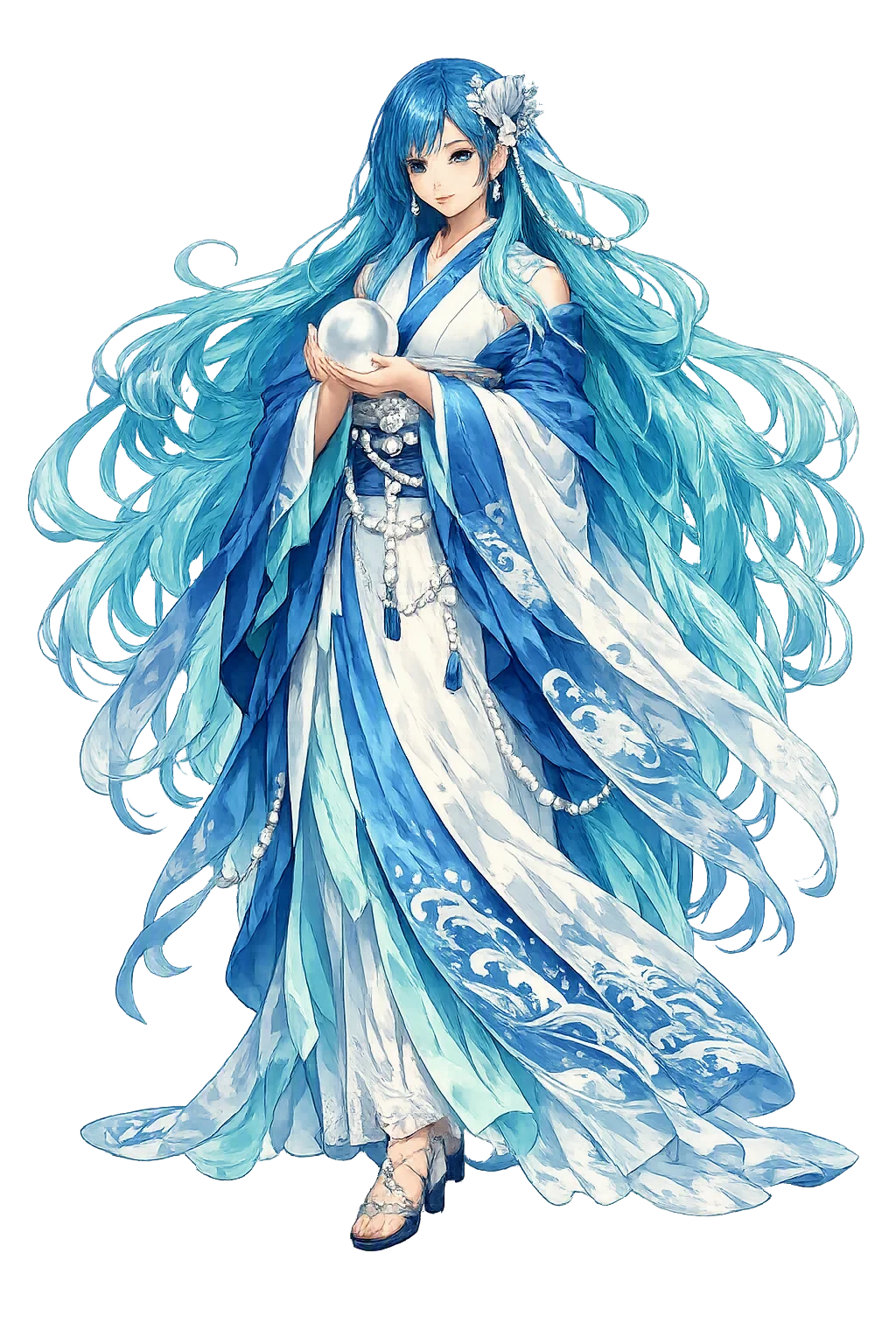
Toyotama: the stories first, then the spelling
You cannot weigh an accent without knowing what it carries. Here is what Toyotama has been carrying.
The Stories That Carry the Name
The Bride of the Sea Palace. Hoori — Hikohohodemi-no-mikoto, the hunter prince — came to the seashore weeping over a lost fishhook and a broken brotherhood. Guided by the old man of the sea, Shihotsuchi, he descended to the palace of Watatsumi, the dragon god of the depths. The palace walls were fish-scaled, its lanes alive with every creature of the sea, and the god received the prince with ceremony, presenting him to his daughter Toyotama-hime: 'I give you this maiden; dwell in our midst as long as heaven endures.
The Vow at the Birth-Hut. When Toyotama was with child, she told Hoori: 'In our country, when our kind give birth, we do so in our true form; do not look. ' She built a parturition hut, sealed its entry, and withdrew. But longing overcame the prince: he stole to the hut and peered inside, and there he saw no woman but a great eight-fathom sea-dragon — a wani, sea-serpent or crocodile — coiling about the child.
Tamayori Raises the Child. Toyotama did not leave the child wholly orphaned. From the sea palace she sent her younger sister, Tamayori-hime — 'the jewel-adorning princess' — to nurse the boy at the shore. The Kojiki names him Ugayafukiaezu, 'he of the unfinished roof': when the birth-hut was built, its thatching was left incomplete, and the name fixed the broken moment in the child himself.
And Here Is What the Spelling Preserves
Against those stories, the attestation: 豊玉毘売命, as Kojiki, Hikohohodemi-no-mikoto and Toyotama-hime cycle; trans. Donald L. Philippi, Kojiki (Princeton University Press, 1969) and Nihon Shoki (Nihongi), Age of the Gods volumes, parallel variants; trans. W. G. Aston (1896) record. The name means "Abundant jewel".
At a Glance
- Restored name: Toyotama
- ASCII form: toyotama
- Meaning: "Abundant jewel"
- Domain of influence: Sea, Mother of Jimmu
- Pantheon: Japanese
- Classification: Tier 2
- Original script: 豊玉毘売命
- Series: The Restoration Files, No. 496 of 548
The Name Travels
Toyotama belongs to one of the oldest families of tales in East Asia: the supernatural bride whose true form must not be seen — the Japanese cousin of the Chinese dragon-palace romances and of the hagoromo 'feather-robe' cycle, in which a wife recovers her stolen robe and leaves her human family. Buddhist Japan read her father's palace through the nāga lens: the fish-scaled halls of the deep are the sea-serpents' treasure house, and Ryūjin's daughter moves between the two cosmologies without friction.
The Address It Earned
The temple of Toyotama stands at /toyotama/ — lore, scholars, patterns — because a name carrying this much story deserves more than a parking page. Tier-2 here means one preserved truth — not less important, just singular. The temple shows it and names it.
The Sources Are Open
The myths above are retold from the temple's record; the primary voices are in the Sacred Texts: Kojiki and Nihon Shoki. Nothing in this file outranks them.
The File Continues
Read the founding dispatch for the name's full story, the Resonance File for the archetype at work — or the whole archive in one sitting.
Continue the series — previous file: Tōnatiuh (read it here) · next file: Trengtreng (read it here).
The Restoration Files are written from the same canonical record as the temples themselves: the lexicon, the lore catalog, the pattern atlas, and the cited scholarly sources. If a file ever disagrees with its temple, the temple is right — tell us, and the file will be corrected.