
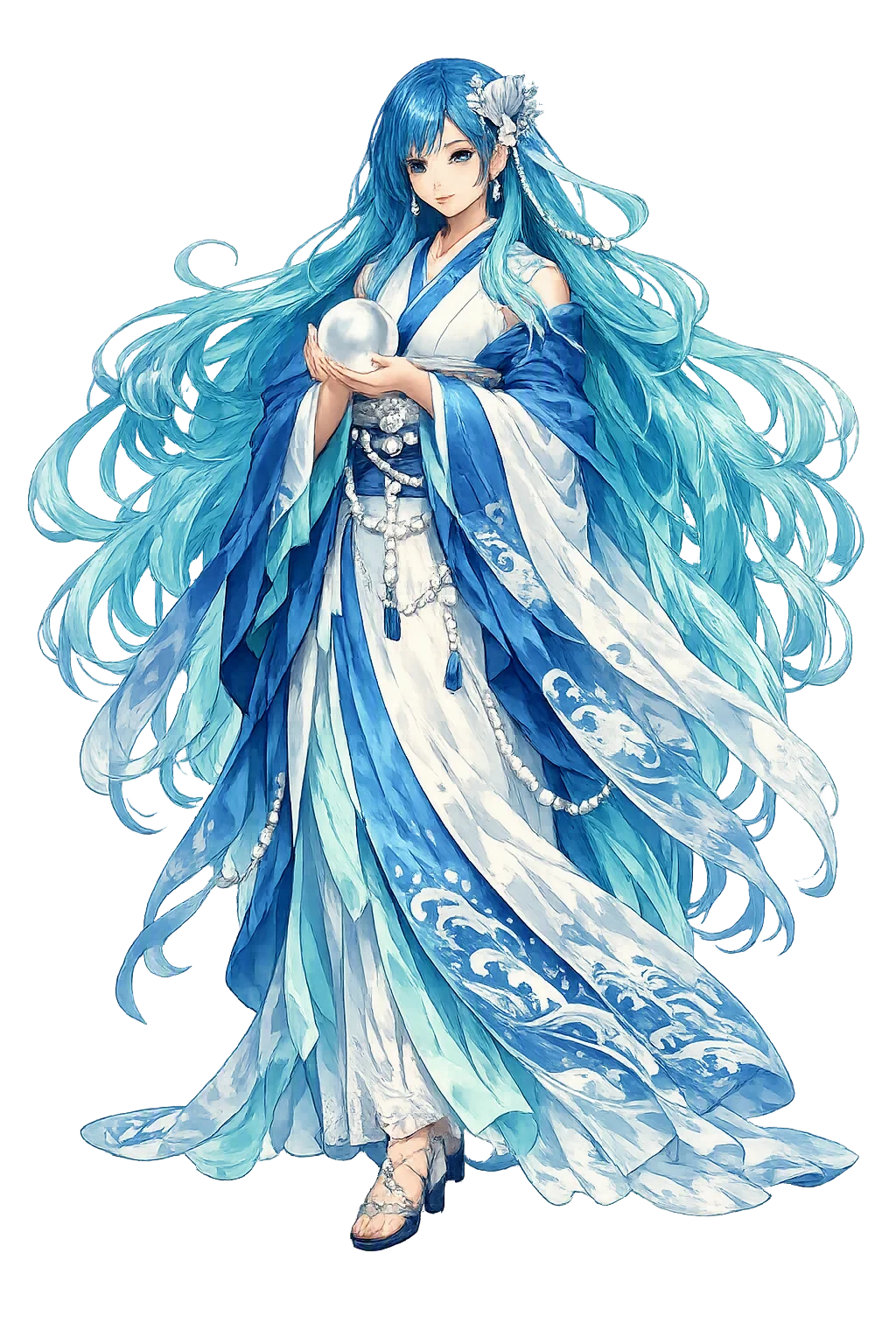
The name Toyotama and the world it opens
A name is a door. Toyotama opens onto an entire world: the domain of sea, mother of jimmu, a Japanese tradition, and centuries of storytelling, worship, and scholarship. This post walks through that world room by room — the name and its roots, the original script, the sound of it, the myths, the symbols, the sites, the afterlife across cultures — and ends at the newest room of all: a Unicode domain that makes the whole structure addressable. toyotama gets you to the same building, but only the restored form tells you why it was built.
At a Glance
- Restored name: Toyotama
- ASCII form: toyotama
- Meaning: "Abundant jewel"
- Domain of influence: Sea, Mother of Jimmu
- Pantheon: Japanese
- Classification: Tier 2
- Original script: 豊玉毘売命 (Japanese characters)
Overview
Toyotama (toyotama) — Sea, Mother of Jimmu — belongs to the Japanese tradition. The name means "Abundant jewel".
Toyotama is the sea princess, daughter of Ryūjin, and mother of the first emperor Jimmu.
PuniCodex restores the name as Toyotama. The plain ASCII form toyotama is the modern Hepburn romanization; the restoration capitalizes the conventional spelling. Because the Japanese source script uses logographic characters whose distinctive visual form cannot be conveyed in the basic Latin alphabet, and because no diacritic or special letter is added in this restoration, the name is placed in Tier 2. The Unicode form remains the philologically complete reference, while the ASCII spelling is a practical convenience for the domain-name system.
The Name
The name is attested in Japanese characters as 豊玉毘売命. Etymologically it means "Abundant jewel".
Toyotama means "abundant jewel," from toyo (abundant) and tama (jewel). She is the daughter of the sea god Ryūjin and the wife of Hoori. Her son Ugayafukiaezu became the father of Emperor Jimmu, the legendary first emperor of Japan.
The ASCII form toyotama survives only because the early domain-name system could not carry Japanese characters or diacritics; it is a technological compromise, not an ancient spelling. The Unicode restoration Toyotama gives the conventional Hepburn romanization with initial capitalization, the standard scholarly way to cite a proper name in romanized Japanese. The name is Tier 2 because the restoration does not add a distinctive diacritic or special letter absent from the ASCII form.
The letter-by-letter transformation runs:
- t → T — Same, capitalized
- o → o — Same
- y → y — Same
- o → o — Same
- t → t — Same
- a → a — Same
- m → m — Same
- a → a — Same
The Original Script
The name is written in Japanese characters as 豊玉毘売命 — Japanese logographic and syllabic script (kanji plus kana where attested), attested in the classical Japanese sources. The script is written top-to-bottom in traditional contexts and left-to-right in modern reproductions.
The scholarly transliteration is Toyotama (Hepburn romanization with initial capitalization), giving the normalized reading //to.jo.ta.ma//.
The characters 豊玉毘売命 are semantic: 豊 (abundant), 玉 (jewel), 毘 (an honorific particle), 売 (woman), 命 (honorific divine suffix). The name describes her as a precious and fertile sea princess.
Pronunciation
The conventional reading of the name is /to.jo.ta.ma/ — Modern Japanese (Standard Japanese).
For the modern speaker, the closest approximation is: 'TOYOTAMA' — pronounce each vowel clearly and avoid English diphthongs. Japanese is mora-timed, so each syllable receives roughly equal weight.
Toyotama is Tier 2 because the ASCII form toyotama already represents the same phonemic sequence; no stress mark, length mark, or distinctive letter is required to recover the spoken name.
Japanese is a mora-timed language: each short syllable receives roughly equal temporal weight, and long vowels or double consonants count as separate morae. The name Toyotama therefore falls into a regular rhythmic pattern that is lost if an English speaker stresses one syllable heavily. The Hepburn romanization used here records the modern standard pronunciation; it does not preserve the historical pitch accent of the word, which differs across dialects. When reading the name aloud, keep the vowels pure and avoid English diphthongs: the restoration Toyotama is the conventional scholarly citation form, not a phonetic transcription with added diacritics. Because the ASCII string toyotama already encodes the same phonemic sequence, the name remains Tier 2 in the PuniCodex system.
Mythology
Hoori married Toyotama, daughter of the sea god Ryūjin, at the bottom of the sea. When she was about to give birth, she asked Hoori not to watch; he broke the promise and saw her in the form of a wani (a crocodile or sea monster). Ashamed, she left the child and returned to the sea, sending her sister Tamayori to nurse the infant. Her son Ugayafukiaezu married his aunt Tamayori, and their son was Jimmu, first emperor of Japan.
The narrative of Toyotama participates in the larger mythic program of the Kojiki and Nihon Shoki: to explain the origins of the imperial house, the division of divine labour, and the relationship between the human and kami worlds. Because these chronicles were compiled in the eighth century under imperial patronage, the myths also serve a political theology, grounding earthly authority in divine descent and cosmic order. Read comparatively, the story of toyotama illustrates how Japanese myth uses genealogy, descent from heaven, and the negotiation of rival domains to construct a coherent sacred history.
Marriage in the Sea Palace (Kojiki)
When Hoori descended to the undersea palace seeking the lost fishhook, Ryūjin welcomed him and gave him Toyotama in marriage. For three years they lived in the palace, and Toyotama became pregnant. Hoori longed for the land, and she agreed to accompany him.
The Broken Taboo (Kojiki)
Toyotama asked Hoori not to watch her give birth. She entered a sealed hut, but curiosity overcame him. He peeked inside and saw her in her true form — a sea dragon or crocodile — giving birth. Ashamed, she returned to the sea, leaving their son Ugayafukiaezu on land. She sent her sister Tamayori to nurse him.
Ancestor of Jimmu (Kojiki)
Ugayafukiaezu grew up and married his aunt Tamayori. Their son was Kamuyamato-Iwarebiko, later Emperor Jimmu. Thus the sea princess Toyotama became the mother of the imperial line's immediate ancestor.
Symbols & Iconography
- Jewel — the tama of her name, signifying wealth and fertility.
- Sea palace (Ryūgū) — the underwater court of her father Ryūjin.
- Dragon or sea serpent — her father's form and her own transformed shape.
- Cormorant feather robe — associated with her child Ugayafukiaezu.
- Waves — the boundary she crosses between sea and land.
- Dragon or crocodile — Her true form, seen by Hoori when he broke his promise
Archaeology & Evidence
The textual record in the Kojiki and Nihon Shoki is the primary source for Toyotama. Coastal shrines in the Inland Sea region preserve traditions associated with the sea-god and his daughter.
The material record associated with Toyotama must be read alongside the textual traditions; shrines, ritual objects, and landscape features preserve practices that the chronicles only summarize. Excavations and architectural history therefore offer independent evidence for how devotion to toyotama developed across periods, even when written sources present a single mythic moment as eternal.
Realm & Domain
Toyotama is the goddess of the sea, fertility, and imperial ancestry. Her domain is the underwater palace of Ryūjin and the transition from the marine world to the human lineage of kings. She embodies the wealth of the sea and the danger of transgressing taboos.
The domain of Toyotama is understood within the broader Japanese religious landscape as both a specific functional sphere and a node in a network of kami, buddhas, and local spirits. Shrines, temples, and household rites all invoke the figure in ways that blur strict boundaries between Shinto and Buddhist practice. The restoration Toyotama therefore names not only a mythic person but a living field of ritual activity: pilgrimage, festival, iconography, and prayer continue to define what the name means in contemporary Japan. This combinatory or "syncretic" context is essential for interpreting the domains listed above.
Sea Princess
Daughter of Ryūjin and inhabitant of the undersea palace.
Wife of Hoori
She married the descendant of Ninigi and bore his son.
Mother of Ugayafukiaezu
Her son continued the line to Emperor Jimmu.
Shape-Shifter
She could transform between human and sea-dragon form.
Across Cultures
Toyotama is identified with the sea-god's daughter motif widespread in maritime cultures. In Japan she connects the imperial line to the ocean and to Ryūjin, the dragon king of the sea. Her story parallels other tales of animal-bride taboos.
The combinatory religious culture of Japan means that Toyotama was rarely understood in isolation. Medieval honji-suijaku theory, imperial ritual, and popular devotion continually redefined the figure in relation to Buddhist, Daoist, and local cults. These later reinterpretations are as historically significant as the original mythic portrait, because they show how a name accumulates meanings across communities and centuries.
Cultural Legacy
Toyotama is venerated in coastal shrines and in the imperial genealogies. Her story is one of the classic Japanese narratives of love, taboo, and the founding of the nation. She appears in popular culture as a sea princess and dragon descendant.
The Scholarly Record
The account of Toyotama given in this edition rests on the witnesses and reference works listed below. The primary chronicles secure the form and meaning of the name; the secondary studies supply historical, archaeological, and ritual context.
- Kojiki (Records of Ancient Matters), 712. Full text
- Nihon Shoki (Chronicles of Japan), 720. Full text
A Meditation
Toyotama embodies sea, mother of jimmu in the Japanese imagination. The name's restoration is not merely cosmetic: it preserves the capitalized scholarly romanization by which the figure is cited in academic and ritual contexts. The ASCII form flattens the visual identity of the original characters into plain letters, but the spoken name and the mythic role remain intact.
The Unicode Restoration
Toyotama is classified as Tier 2: the restoration needs no distinctive letters or diacritics its ASCII form would lose. The ASCII fallback toyotama still resolves everywhere, but it is the restored form that carries the name's full information. That is the whole thesis of this temple: the marks are the message.
Character by Character
The journey from toyotama to Toyotama, one character at a time:
- t → T — Same, capitalized
- o → o — Same
- y → y — Same
- o → o — Same
- t → t — Same
- a → a — Same
- m → m — Same
- a → a — Same
The Japanese Pantheon
Toyotama is one of 45 entries the PuniCodex lexicon catalogues under the Japanese pantheon. The Pantheon page gathers the tradition's major figures in one place, and the Lexicon lets you filter all 981 restorations by tradition, tier, or script — the fastest way to see where this name sits among its kin.
Frequently Asked Questions
What does Toyotama mean? The traditional gloss is "Abundant jewel."
Which tradition does Toyotama belong to? Toyotama is catalogued in the Japanese pantheon of the PuniCodex lexicon.
Why is Toyotama classified as Tier 2? Because the restoration needs no distinctive letters or diacritics its ASCII form would lose — and the marks in the restored spelling preserve exactly that evidence.
Can I use Toyotama in a normal browser? Yes. The DNS resolves the punycode form automatically, and the type tool on this site converts toyotama to Toyotama for copying and pasting.
Where does the scholarly information come from? The entry is built from lexica, inscriptional evidence, and reviewed scholarly sources listed in the Scholarly Edition. Every claim is traceable to a canonical source.
Typing Toyotama
You do not need a special keyboard to use this restoration. The PuniCodex Type Tool converts the ASCII form toyotama into Toyotama as you type, and the browser extension offers the same conversion inside any text field. Copy the restored form, paste it into the address bar, and the DNS does the rest.
Sister Temples
Other temples in the Japanese pantheon include Jizō, Kyōto, and Nishinakahime — each with its own restoration story, its own scholarly record, and its own place in the lexicon.
Why This Restoration Matters
A door only matters if people walk through it. The temple is open, and everything behind it — the myths, the scholarship, the canvas, the patrons — hangs on the restored spelling. The PuniCodex project bets that the web will make room for names as they were actually written, and Toyotama is one of its standing proofs. Visit, share, cite, type it yourself: each use is a small rehearsal for a web where no name has to hide its marks to be found.
Explore Further
This post is one doorway into the temple. The home page carries the full character breakdown and the ambient canvas; the lore page tells the myths in long form; the Scholarly Edition preserves the sources, pronunciation data, and revision history; and the patron wall supports the restoration directly. For the wider map, browse the Lexicon, explore the Pantheon, or return to the PuniCodex blog.
A Closer Look at the Marks
A restored name is a small map. In the case of Toyotama, the map does not lead through diacritics or special letters, because the source tradition wrote the name in Japanese characters rather than in the Latin alphabet. The ASCII form toyotama and the restored form share the same letters; the restoration is a decision about which conventional spelling should serve as the public reference.
That decision is not cosmetic. The original script attestation carries semantic and phonetic information that no romanization can fully reproduce. By fixing one conventional spelling as the canonical domain form, the project prevents the drift that happens when a name is romanized differently in every article, map, and database. The breakdown still lists each character — t, o, y, o, t, a, m, a — so visitors can see exactly what is being carried forward and what is not. What looks like "no change" is, in fact, a deliberate choice to keep the name stable, searchable, and addressable.
Toyotama in Its Tradition
Toyotama does not stand alone. It belongs to the Japanese tradition, where it is counted among 45 names in the PuniCodex lexicon. Its sphere — Sea, Mother of Jimmu — places it beside other figures who govern similar aspects of experience. The restored spelling is therefore not only a philological decision; it is a way of keeping the name in the company of its kin. When the address bar shows Toyotama, it marks the boundary between a generic search term and a named entry in a living catalog of myth. That catalog is the point of the project. Every restored name is a vote for specificity: the web should know the difference between a figure and a keyword, between a tradition and a trend. Toyotama is one such vote.
What You Will Find in the Temple
The temple page for Toyotama is more than a landing page. The home tab presents the character breakdown, the pronunciation guide, and the live domain status in a single view. The lore tab gathers the myths and narratives that give the name its depth. The Scholarly Edition tab publishes the sources, variant forms, and review history that justify the restoration. Industry patterns show where the name appears in modern commerce and culture, while the gallery and creatives tabs collect visual and sponsor material. The patron wall lets visitors support the restoration directly. Each tab is generated from the same canonical sources, so the domain, the blog, the scholars page, and the search index all agree. The result is a single source of truth about a name, delivered through several doors.
The Restoration on the Live Web
A domain name is a kind of publication. When Toyotama resolves, it proves that the restored spelling is not a theoretical exercise; it is a working address on the public internet. Search engines can index it, language models can encounter it, and anyone who copies it from a manuscript can paste it into a browser. That practical reality changes the status of the restoration. Before Unicode domains, a scholar could write the name correctly in an article while the public web flattened it to toyotama. Now the public web can carry the correct form end to end. The punycode translation happens silently, so the infrastructure remains compatible while the visible name keeps its marks. That compromise — human-readable restoration, machine-readable encoding — is the foundation of every PuniCodex temple.
Related Names
Sources
The full scholarly apparatus — every citation, revision, and review — lives in the Scholarly Edition. Key references for this post:
- Kojiki (Records of Ancient Matters), 712.
- Nihon Shoki (Chronicles of Japan), 720.
- Fudoki (Records of Wind and Earth), 8th century.
- Hepburn, James Curtis, A Japanese-English and English-Japanese Dictionary, 1867.
- Breen, John, and Mark Teeuwen, A New History of Shinto (Wiley-Blackwell, 2010).
- Grapard, Allan G., The Protocol of the Gods (University of California Press, 1992).
- Ono, Sokyo, Shinto: The Kami Way (Tuttle, 1962).
- Lexicon authorities for this entry: Kojiki, Nihon Shoki.