
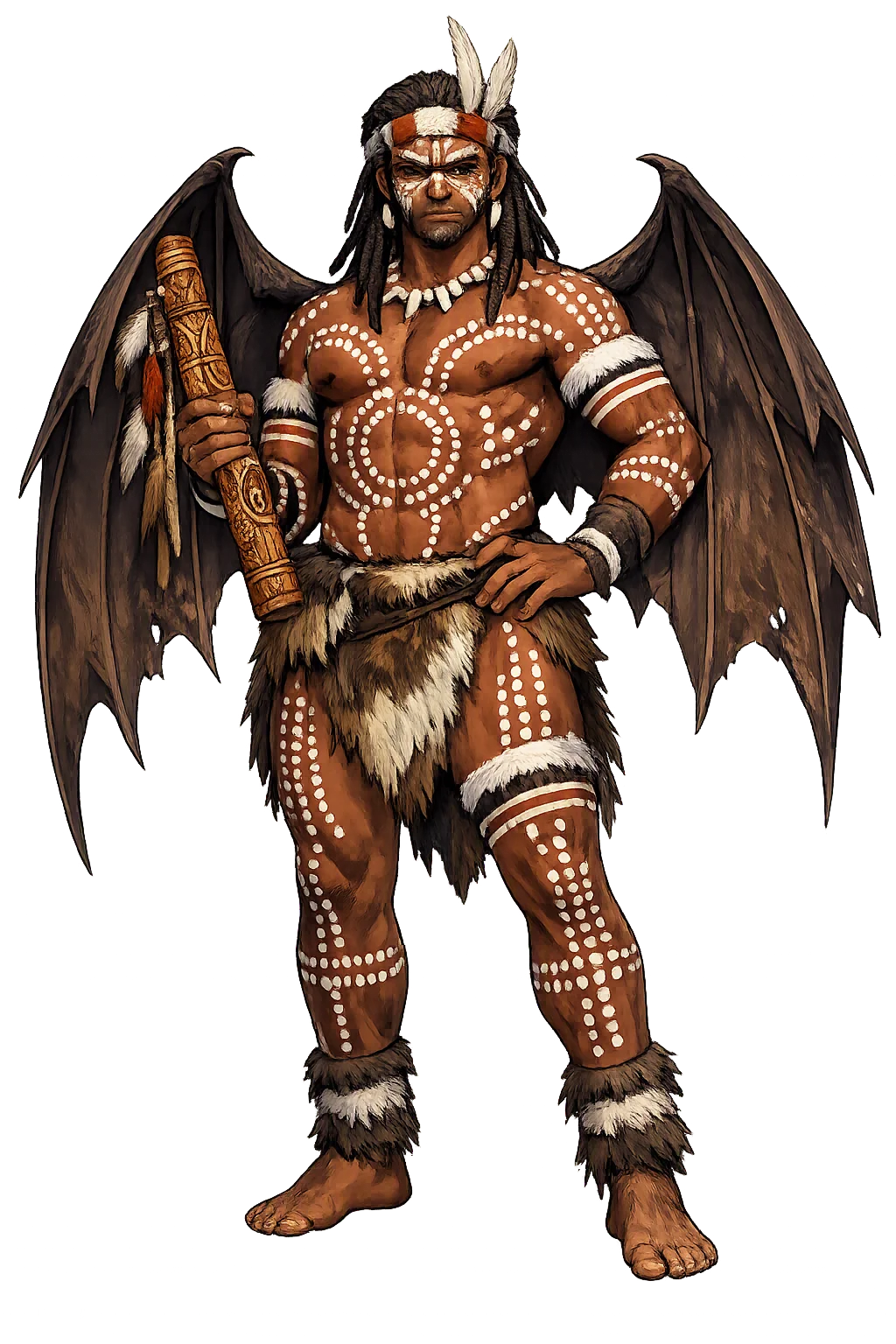
Tjinimin: the stories first, then the spelling
The marks in Tjinimin make the most sense standing next to the myths they have to carry. So the myths come first.
The Stories That Carry the Name
The Quarrel with Kunmanggur. In the beginning-time, when the ancestral beings walked in their first forms, Tjinimin set his desire against Kunmanggur, the great Rainbow Serpent, the water-being whose body made the rivers and whose authority ordered the relations between all the ancestral peoples. He coveted Kunmanggur's consorts, the Green Parrot-Girls, and pressed his claim in the quarrel that the old men still tell. Stanner recorded the narrative in the mid-twentieth century from Murrinh-Patha speakers at Port Keats (Wadeye), and it must be said that the published account is the publicly speakable layer of the story: senior custodians hold fuller versions that ethnography does not print.
The Vow beneath the Stars. Defeated in the quarrel, Tjinimin withdrew from the world in the most literal way the country allows: he hung himself upside down in a tree, head toward the earth, feet toward the sky, and there he gazed at the stars. In that suspension, between the ground of the living and the camp of the dead, he made a vow that the Murrinh-Patha tell as absolute: he would never lie with a woman again. No council imposed this sentence and no serpent demanded it — the old men emphasize that Tjinimin pronounced it himself, and that such a vow, once spoken beneath the stars, binds the speaker past recall.
The Short Nose of the Bat. Soon after the vow, the story says, Tjinimin's nose fell off. The detail is the myth's signature: it is the reason, the old men explain, that the bats of the Daly country have short noses — the ancestral being's bodily transformation became the permanent anatomy of the animal with which he is thereafter identified. In Murrinh-Patha understanding this is not merely an etiological curiosity.
And Here Is What the Spelling Preserves
At a Glance
- Restored name: Tjinimin
- ASCII form: tjinimin
- Meaning: "The moth man"
- Domain of influence: Trickster, Moth Man
- Pantheon: Aboriginal
- Classification: Tier 2
- Original script: —
- Series: The Restoration Files, No. 492 of 548
The Name Travels
Tjinimin belongs specifically to Murrinh-Patha tradition rather than to the wider cross-cultural networks of the Kimberley Wandjina or Arnhem Land Rainbow Serpent complexes. Within Murrinh-Patha cosmology he is grouped with the ancestor-figures whose stories encode law, kinship, and the origins of animal species.
The Address It Earned
The temple of Tjinimin stands at /tjinimin/ — lore, scholars, patterns — because a name carrying this much story deserves more than a parking page. The restoration keeps one feature the ASCII form drops. One is enough to matter, and the label says so plainly: Tier-2.
The File Continues
Read the founding dispatch for the name's full story, the Resonance File for the archetype at work — or the whole archive in one sitting.
Continue the series — previous file: Tiāndì (read it here) · next file: Tlāloc (read it here).
The Restoration Files are written from the same canonical record as the temples themselves: the lexicon, the lore catalog, the pattern atlas, and the cited scholarly sources. If a file ever disagrees with its temple, the temple is right — tell us, and the file will be corrected.