The Living Myth
Trickster, Moth Man · Bat-winged spirit of the Australian night
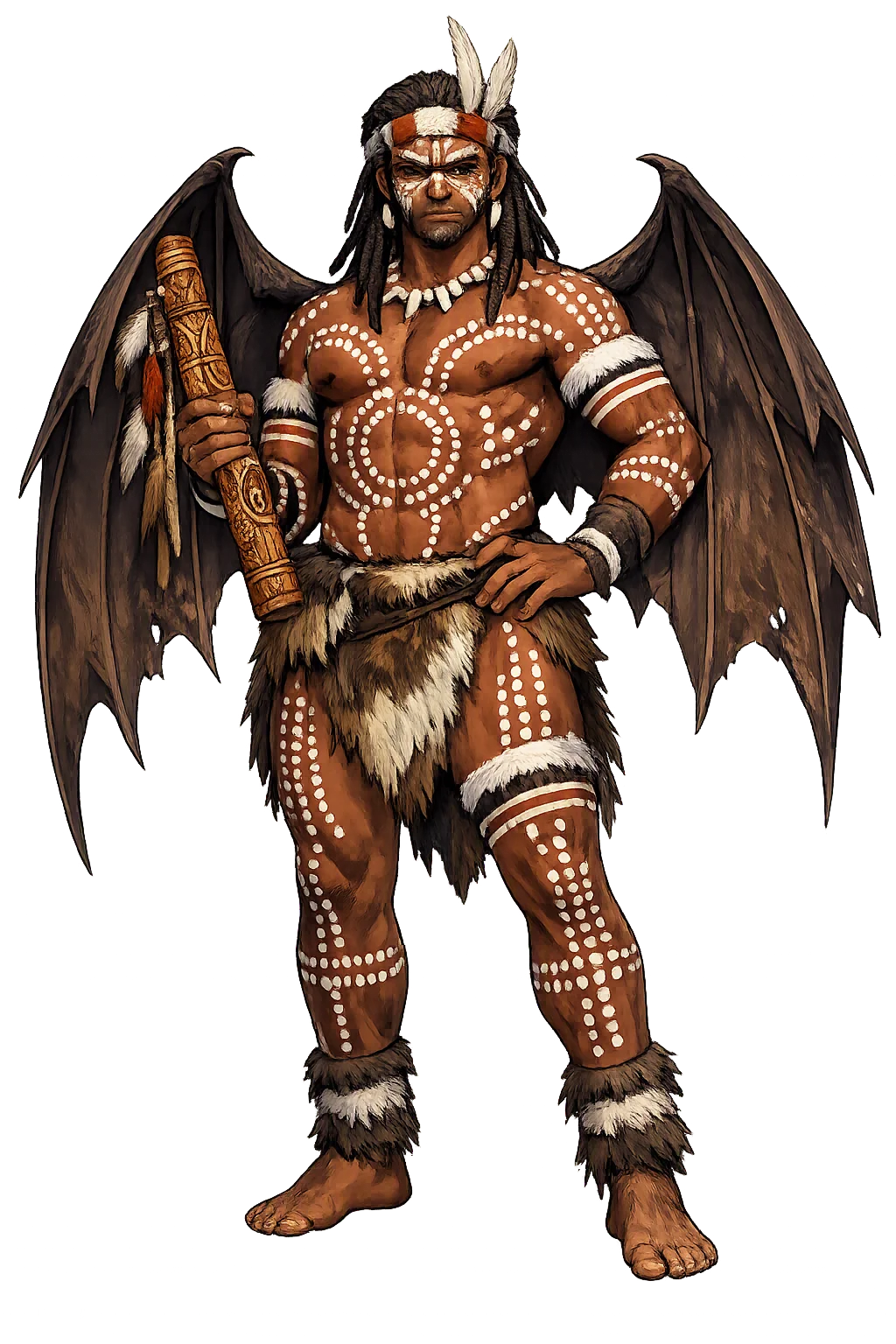
Stories of Tjinimin
The principal Murrinh-Patha narrative of Tjinimin, recorded by W. E. H. Stanner from the Daly River country, is a compact myth of boundary-crossing and transformation. It explains kinship, animal form, and the moral order through a single ancestral episode — and its fuller ritual meanings remain with the custodians who still keep it.
In the beginning-time, when the ancestral beings walked in their first forms, Tjinimin set his desire against Kunmanggur, the great Rainbow Serpent, the water-being whose body made the rivers and whose authority ordered the relations between all the ancestral peoples. He coveted Kunmanggur's consorts, the Green Parrot-Girls, and pressed his claim in the quarrel that the old men still tell. Stanner recorded the narrative in the mid-twentieth century from Murrinh-Patha speakers at Port Keats (Wadeye), and it must be said that the published account is the publicly speakable layer of the story: senior custodians hold fuller versions that ethnography does not print. What the published telling makes plain is the myth's charge — desire aimed at what is not one's own, aimed, moreover, at the possessions of the most powerful law-giver in the country. The quarrel defines the boundary of the permissible by showing what it costs to cross it.
Defeated in the quarrel, Tjinimin withdrew from the world in the most literal way the country allows: he hung himself upside down in a tree, head toward the earth, feet toward the sky, and there he gazed at the stars. In that suspension, between the ground of the living and the camp of the dead, he made a vow that the Murrinh-Patha tell as absolute: he would never lie with a woman again. No council imposed this sentence and no serpent demanded it — the old men emphasize that Tjinimin pronounced it himself, and that such a vow, once spoken beneath the stars, binds the speaker past recall. He hung there through the nights, looking down at the world he had forfeited and up at the order he could no longer join. The myth makes law interesting: its deepest form is not punishment from above but sentence passed on oneself, self-exile from the ordinary human sentence of desire and consequence.
Soon after the vow, the story says, Tjinimin's nose fell off. The detail is the myth's signature: it is the reason, the old men explain, that the bats of the Daly country have short noses — the ancestral being's bodily transformation became the permanent anatomy of the animal with which he is thereafter identified. In Murrinh-Patha understanding this is not merely an etiological curiosity. The bat, the flying fox that camps in the river trees, is kin: its face is the visible record of an ancestral choice, read every evening as the colonies rise at dusk. Tjinimin's punishment and his animal form are the same event — to be changed into the bat is both the consequence of the transgression and its memorial. The myth means that ancestral law is not written anywhere but on the bodies of the country: in the short nose of the bat, in the course of the river, any child can read what happens to those who reach for what the law withholds.
The final episode of the Tjinimin narrative is its modern history. W. E. H. Stanner, the Australian anthropologist, worked among the Murrinh-Patha of the Daly River from the 1930s and set down the Tjinimin cycle in his studies of Aboriginal religion (published in the 1950s–60s), moved by what he famously called the 'metaphysical pity' of a tradition that endures against enormous pressure. The story continues to be kept the older way as well: senior men teach it in initiation, holding the restricted meanings close, and recordings sit with AIATSIS in Canberra as the people's own archive. The sources are therefore honest about their limits — what is printed is what may be printed — and the myth's custodians, not its ethnographers, remain its authors. This afterlife completes the story's meaning: a tale about the cost of taking what is not yours is itself handled under a law of custodianship, passed hand to hand, never simply taken.
Bat, Rainbow Serpent, and Ancestral Law
Tjinimin is an ancestral being in the mythology of the Murrinh-Patha peoples of the Daly River region, Northern Territory. He is remembered as an ancestor of the Australian peoples, closely associated with the bat or flying fox and with Kunmanggur, the great Rainbow Serpent. His story turns on a quarrel, a vow, and the origin of the bat's short nose — a narrative that encodes law, social restraint, and the place of humans within the Dreaming.
Tjinimin is identified in Murrinh-Patha tradition as an ancestor of the Australian peoples, a foundational figure in the genealogical memory of the Daly River communities.
The figure is associated with the bat; a key myth explains the bat's short nose as the result of Tjinimin's vow and transformation.
Tjinimin's narrative is bound to Kunmanggur, the Rainbow Serpent, whose consorts and authority set the moral stakes of the story.
His attempt to transgress social boundaries, his defeat, and his lasting vow form a cautionary tale about desire, consequence, and the establishment of ancestral law.
From the original script to the living URL
Tjinimin
The name survives in scholarly transliteration. Tjinimin is the standard Aboriginal romanisation, documented in academic sources — “The moth man”. Because the spelling uses only Latin letters, the form is the same in both ASCII and Unicode.
No indigenous writing system is securely attested for individual aboriginal names. The form shown is a modern scholarly transliteration.
tjinimin
The plain tjinimin form is identical to the Unicode restoration. Because this name is already written in Latin letters, no diacritics, stress, or script information were lost — only capitalization differs.
Tjinimin
The Unicode restoration does not need to recover lost marks for Tjinimin. Its value is canonical spelling and consistent cataloguing, not the reconstruction of erased orthography. The domain is readable as-is to both DNS and humanity.
Tjinimin.com
This restoration is written entirely in ASCII letters — no Punycode encoding stands between Tjinimin and the DNS. The domain reads identically to machines and to human eyes.
Owned, ideal, and ASCII forms of Tjinimin
Tjinimin
The full Unicode restoration. tjinimin.com is not in the PuniCodex collection — it is watched for release; if it drops, this temple upgrades to an owned flagship.
How Tjinimin was spoken
How Tjinimin is preserved in writing
No indigenous writing system is securely attested for individual aboriginal names. The form shown is a modern scholarly transliteration.
Contribute scholarly provenance →The lore you have read is the living myth. Extended Lore opens the scholarly vault beneath it: the cult and its material remains, a history of the image, the name after antiquity, a meditation on what the name still means, and the full scholarly apparatus — etymology, orthography, sources.
Enter Extended Lore