PuniCodex

Extended Lore

𓅜𓏏 Ḏḥwtj

Etymology · Orthography · Cultural Legacy · Reception · Primary Sources

Tier 1 Ḏḥwtj.com
Ḏḥwtj — Writing, Wisdom, Moon
01

Quick Facts

Essential information about Ḏḥwtj, Writing, Wisdom, Moon

Original Script𓅜𓏏
Unicode RestorationḎḥwtj
Reconstructed Pronunciation/tɨˈχuːtiː/
PantheonEgyptian
DomainWriting, Wisdom, Moon
MeaningHe who is like the ibis
ClassificationTier 1
Primary DomainḎḥwtj.com
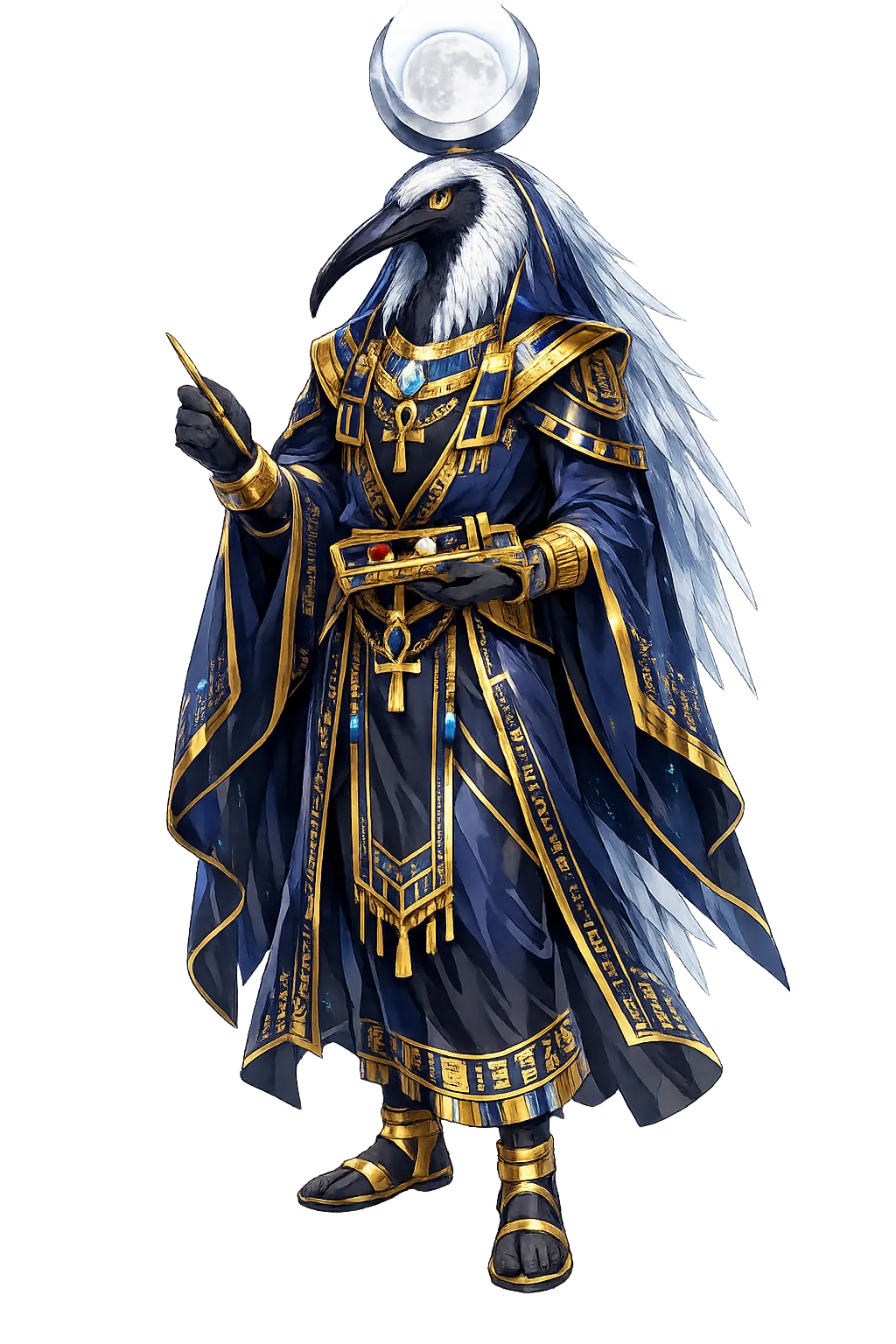
Sacred SymbolsIbis, Baboon, Scribal palette and reed pens, Crescent moon and disk, Eye of Horus (wedjat)
02

Etymology & Word Family

From original script to Unicode restoration

Original Script 𓅜𓏏 Ḏḥwtj — "He who is like the ibis"
Unicode Restoration Ḏḥwtj Restored stress, length, and script
Modern ASCII thoth Plain-ASCII fallback

The name Ḏḥwtj carries the orthographic signature of the egyptian tradition: 𓅜𓏏. Unicode restoration recovers what ASCII flattens.

03

Unicode Character Breakdown

Character-by-character philological analysis

CharacterUnicodeNameBlockPhonetic Role
U+1E0ELatin Capital Letter D with Line BelowUnknownD-with-dot-below: palatalized d
U+1E25Latin Small Letter H with Dot BelowUnknownH-with-dot: voiceless pharyngeal
wU+0077Latin Small Letter WBasic LatinW: bilabial glide
tU+0074Latin Small Letter TBasic LatinSame
jU+006ALatin Small Letter JBasic LatinJ: palatal approximant (Egyptological ḏḥwtj)

The Tier 1 classification reflects how much of the original phonology this restoration preserves — stress and vowel length for Greek names, distinctive letters and diacritics for every other tradition.

04

Cultural Significance

From ancient cult to modern memory

Ḏḥwtj in Later Traditions

Thoth's most enduring syncretism is with the Greek Hermes, producing Hermes Trismegistus, 'Thrice-Great Hermes,' the legendary author of the Hermetic corpus. This Graeco-Egyptian figure became a cornerstone of late antique mysticism, alchemy, and astrology, and was reclaimed by Renaissance humanists such as Ficino and Pico della Mirandola. In Coptic Egypt, Thoth's month name (Thōout) survived in the Christian calendar. His ibis and baboon forms influenced medieval bestiaries and early modern emblem books.

Modern Legacy

Thoth lives on as the patron of writers, scholars, librarians, and occultists. The figure of Hermes Trismegistus shaped Western esotericism for nearly two millennia, and the word 'hermetic' still signals sealed, secret knowledge. In popular culture, Thoth appears as a wise moon-god, a keeper of arcane books, and a judge of souls. For Egyptologists, he embodies the Egyptian conviction that writing is a form of magic: the right words, properly recorded, can preserve a person beyond death.

In the Earth

Thoth's principal cult center was Khemenu (Hermopolis Magna) in Middle Egypt, where remains of his temple and the nearby ibis and baboon cemeteries have been excavated. Thousands of mummified ibises and baboons were deposited as votive offerings at Saqqara, Tuna el-Gebel, and other sites. Temple reliefs from the New Kingdom onward show Thoth as scribe, healer, and lunar measurer. The Graeco-Roman Hermetic texts and Coptic references preserve his later reputation as Hermes Trismegistus.

05

The Meditation

What Ḏḥwtj means — beyond the dictionary

Thoth is the god who believes that what is written endures. In a world of disappearing messages and ephemeral speech, he reminds us that some words must be preserved: laws, treaties, poems, names. To invoke Thoth is to take seriously the responsibility of the scribe — the one who decides what gets remembered and how. His moonlight is not the blazing sun of Ra but the softer light by which we read, measure, and think.

06

Screen & Culture

Where Ḏḥwtj echoes through film, television, and games — and how

07

Frequently Asked Questions

Common questions about Ḏḥwtj, Writing, Wisdom, Moon, and Unicode restoration

01How do you pronounce Ḏḥwtj?

In reconstructed pronunciation, Ḏḥwtj is /tɨˈχuːtiː/ — approximately tji-HOO-tee — the first consonant is like a 'dj' made against the hard palate, and the middle h is a dry throat-fricative.

02What does Ḏḥwtj mean?

Ḏḥwtj means He who is like the ibis in the egyptian tradition.

03What are the symbols of Ḏḥwtj?

Ḏḥwtj is associated with Ibis (The bird whose curved beak and measured step made it emblematic of writing and calculation), Baboon (Thoth's other sacred animal, associated with the dawn and the rising moon), Scribal palette and reed pens (The tools of the divine scribe who records all deeds and spells), Crescent moon and disk (The lunar phases by which Thoth measures time and renews the cosmic order), Eye of Horus (wedjat) (Restored by Thoth after the conflict of Horus and Seth, symbolizing wholeness regained).

04Why are there different spellings of Ḏḥwtj?

Each form is a historically attested restoration rather than a mistake: Thóth is the alt-stress form (Acute on omicron: alternate stress position). PUNICODEX registers the full set so the tradition is preserved under every defensible spelling.

05Why restore Ḏḥwtj in Unicode?

Plain ASCII thoth strips the stress, length, and script that make the name specific. Unicode restoration returns the name to its original written dignity.

06What is the most important myth about Ḏḥwtj?

“The Word That Organized Creation” — Thoth moves through Egyptian myth as the indispensable companion: he is present at creation, mediates divine quarrels, heals the wounded eye, and judges the dead. His stories are less about his own ambition than about the power of knowledge, writing, and measured speech to resolve conflict and preserve order. The full telling lives on the lore page.

08

Scholarly Sources

The philological foundations of this restoration

Every claim on this page is grounded in established scholarship. The orthographic restorations follow disciplinary convention. The etymological chain follows the best available reference works. This is not invention — it is resurrection through scholarship.

Lexicography & Philology

  • Faulkner, R. O. A Concise Dictionary of Middle Egyptian. Oxford: Griffith Institute, 1962.
  • Wb

Primary Texts

Archaeology & Art History

  • Material evidence — iconography, inscriptions, and temple archaeology — for Ḏḥwtj and related cults.

Religious Studies

  • The Contendings of Horus and Seth (papyrus Chester Beatty I)
  • Faulkner, A Concise Dictionary of Middle Egyptian
  • Wb, ḏḥwty (Erman & Grapow)
  • Allen, Middle Egyptian: An Introduction to the Language and Culture of Hieroglyphs
  • Copenhaver, Hermetica: The Greek Corpus Hermeticum and the Latin Asclepius
  • Fowden, The Egyptian Hermes: A Historical Approach to the Late Pagan Mind
  • Jasnow & Zauzich, The Ancient Egyptian Book of Thoth
Return

The Surface Awaits

You have traced the name from its earliest attestation to its Unicode restoration. Now return to the myth. The story is where the name lives.

Back to Lore
Ḏḥwtj mascot