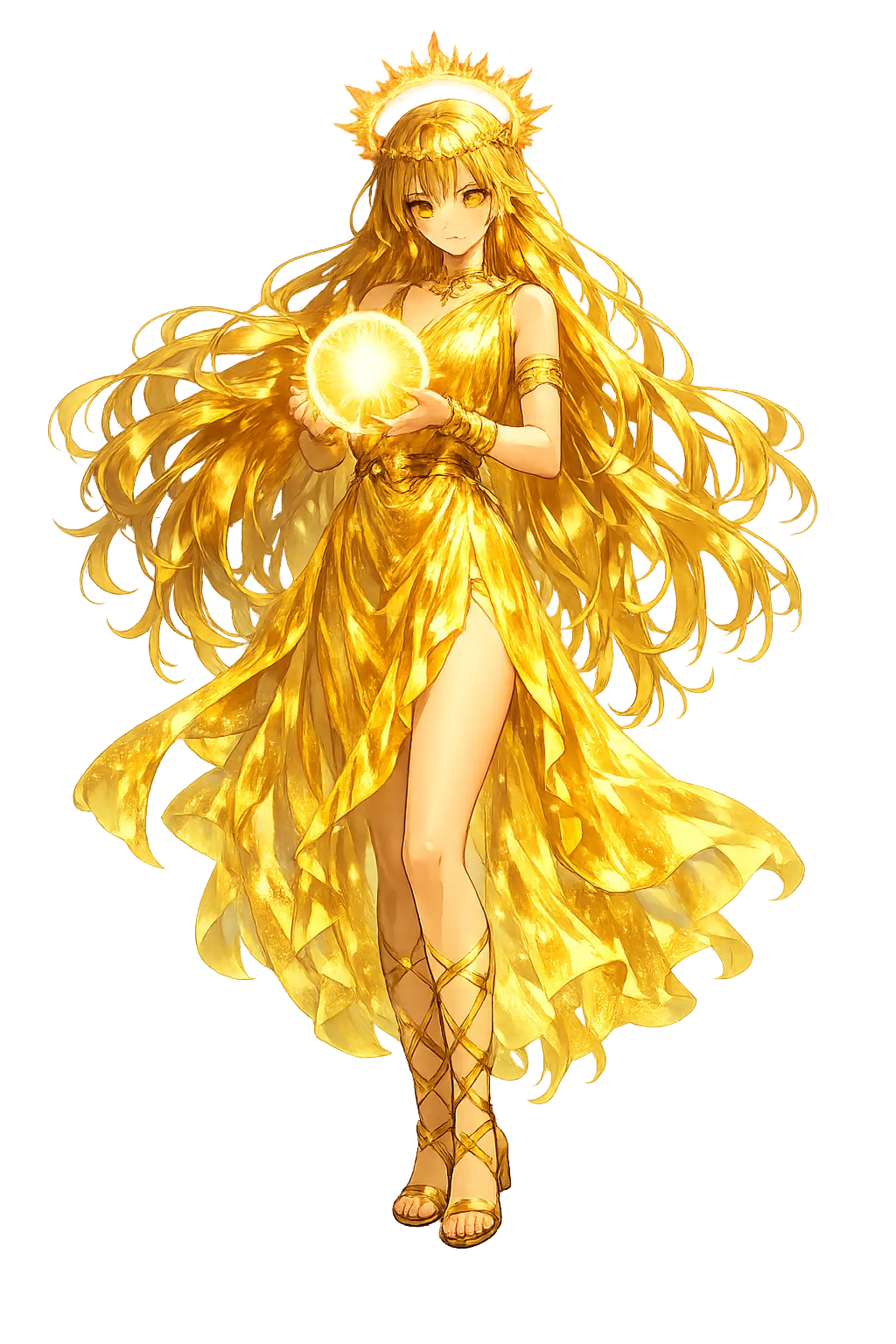
Stories of Theía
Theía has no independent narrative myths; her importance is genealogical and cosmological. Through her, the Titans bequeath light to the Olympian cosmos — and the tradition is honest enough to leave her otherwise silent. Two lines of Hesiod, an ode of Pindar, and a name that became a science are her whole surviving estate.
Hesiod mentions Theía exactly where her meaning lives. First, in the Titan catalogue, she is simply 'Theía, crowned with gold' (Theogony 135) — one word of ornament, and the only one he ever gives her. Then, at 371–374: 'Hyperion lay in love with Theía of the gold crown, and she bore him great Hēlios and bright Selḗnē and Ēōs, who brings light to all mortals and to the deathless gods.' That is the entirety of her recorded mythology — a birth, a marriage, three children — and it is enough to found a cosmology: the upper air wed to the high one, and every light that crosses the sky as their offspring. Later Greek poets repeat the triad without ever adding a scene; the goddess's silence in the tradition may itself be the myth — the medium of light does not appear; it makes appearing possible.
Pindar opens Isthmian 5 with the most vivid address Theía ever received: 'Mother of the Sun, Theia of many names' — and immediately explains the 'many names': it is because of her that mortals count gold as the most powerful of things, for the radiance of her doings shows upon gold and its gleam. The ancient scholiasts add the practical detail: sailors at sea see Theía in the sun's distant flash on the waves, reading the horizon by her. The logic is antique and precise — the goddess of the shining ether is present wherever light becomes visible as radiance: on metal, on water, on the glint that betrays a ship over the horizon. Her epithet also hints at a theological elasticity: the same luminous principle answers to whatever the moment requires — sight, splendor, the flash of gold. Theía is not a character but an optics, and Pindar hymns her as such.
Ancient and modern scholars alike connect Theía's name with θέα, 'sight', and the verb θεάομαι, 'to gaze in wonder' — the same root family as θέατρον, 'theater', and θεωρία, 'contemplation'. Later Greek writers could not resist the further step: that θεά, 'goddess', belongs to the same family — the divine as that which shines forth and is seen. The second derivation is linguistically shaky, and a scholarly entry must say so plainly; but the intuition was deeply Greek, and Plato's vocabulary of the knowable as 'visible in its radiance' lives in the same semantic field. Her gold crown completes the picture: the goddess of sight wears the substance that most resembles what sight loves. If her cult was negligible, her word-family conquered the language — theory, theater, and theology are all, etymologically, her daughters too.
Hesiod does not show Theía fighting in the Titanomachy, but the arithmetic of Theogony 717–720 leaves her no exemption: after the ten-year war, Zeus's side bound the Titans and hurled them 'into murky Tartarus, as far beneath the earth as earth is beneath heaven'. The Titanesses as a group disappear from the poem into that fall — while their luminous children ride on overhead, untouchable. Theía's fate, if she shared it, is the cosmic version of her own nature: the ether cannot be imprisoned, but the personification can. Later tradition quietly released her: she survives in Pindar and in the scholia as the ever-present mother of light, unshrined by any city but unexcluded from any sky — a goddess whose temple is whatever the light touches, and whose only liturgy is the daybreak itself.
Brilliance, The Eyes, The Celestial Luminaries
Theía is the Titaness of sight, shining, and the bright ether. Though less famous than her children Hēlios, Selḗnē, and Ēōs, she is the luminous source from which they spring — the divine principle that makes seeing and being seen possible. Hesiod gives her one marriage and three children; Pindar gives her a golden hymn; the rest is inference.
By Hyperion she bore the sun, moon, and dawn — every light that crosses the sky (Theogony 371–374).
Her name belongs to the root θέα, 'sight'; she is the shining by which anything is seen at all.
She personifies the bright upper air through which light travels to the eye — the medium, not the lamp.
From the original script to the living URL
Θεία
The name in its original Greek form. Theía (Θεία) is attested in the source tradition — “Goddess, divine”. Its diphthongs and acute accents carry the full phonetic and orthographic weight of the source tradition.
theia
Reduced to plain theia, the name loses everything that made it specific: diphthongs and acute accents. What remains is an ASCII string that machines can parse but that no longer speaks with its original voice.
Theía
The Unicode restoration recovers what ASCII flattened. Theía restores diphthongs and acute accents, returning the name to its original written dignity. The domain encodes to Punycode, but the browser displays the truth.
Theía.com → xn--thea-xpa.com
The non-ASCII characters in Theía are encoded while the ASCII remains visible. To the DNS, it is Punycode. To humanity, it is Theía.
Owned, ideal, and ASCII forms of Theía
Theía
Restores Θεία. The live temple domain — theía.com.
theia
Flattens Θεία. The plain ASCII fallback — what DNS and legacy systems see.
How Theía was spoken
How Theía is preserved in writing
A bespoke provenance study for Theía is being prepared by the PUNICODEX scholarly team.
Contribute scholarly provenance →The lore you have read is the living myth. Extended Lore opens the scholarly vault beneath it: the cult and its material remains, a history of the image, the name after antiquity, a meditation on what the name still means, and the full scholarly apparatus — etymology, orthography, sources.
Enter Extended Lore