
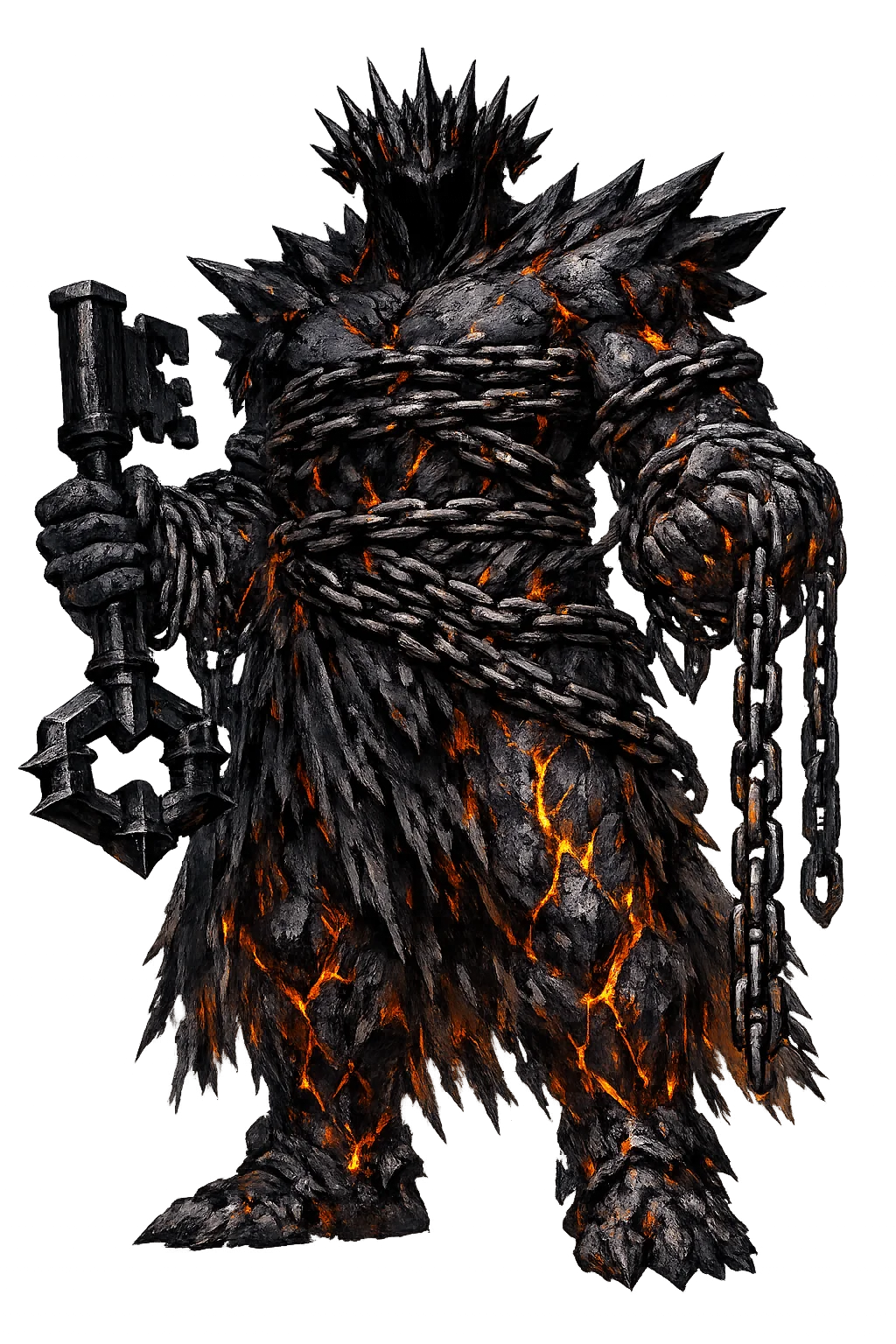
Tártaros: the stories first, then the spelling
You cannot weigh an accent without knowing what it carries. Here is what Tártaros has been carrying.
The Stories That Carry the Name
The Third Primordial. When the world began, Hesiod names three things that came to be of themselves: Cháos, the yawning gap; Gaia, the broad-breasted earth; and 'dim Tártaros, in the depths of the broad-pathed earth' (Theogony 116–120). The name may be older than Greek itself: a Linear B tablet from Knossos (Fp 14) appears to pair an offering 'to Tartaro' with offerings to the gods. Homer adds the famous measurement: Tártaros lies as far beneath Hades as heaven is above earth, and a brazen anvil would fall nine days and nine nights before striking bottom (Iliad 8.
The Titans Cast Down. When the ten-year Titanomachy ended, Zeus hurled the defeated Titans down 'under the murky gloom of the misty darkness' — into Tártaros, where a bronze fence runs round it, Poseidon fixed gates of bronze, and the Hundred-Handers stand as guards 'beyond the gates, the faithful wardens' (Hesiod, Theogony 713–735). The Iliad gives the scene from below: there the Titans sit at the threshold, 'a dreadful thing to hear' for any who would approach (Iliad 8. 478–481).
Tartarus and Gaia. Angered by the destruction of her children the Giants, Gaia lay with Tártaros and bore Typhōn, 'youngest of her children... a bane to mortals' (Hesiod, Theogony 820–822; cf. Apollodorus, Library 1.
And Here Is What the Spelling Preserves
Against those stories, the attestation: Τάρταρος, in the attestation Hesiod, Theogony 116–120, 713–735, 820–822 and Homer, Iliad 8.13–16, 478–481 give us. The name means "Deep place (from τάρταρος)".
The restoration keeps one feature the ASCII form tartaros cannot show:
- a → á — Acute on alpha: where the voice peaks.
A storyteller pronouncing the name would restore every one of them by instinct. The file only writes down what the voice already knows.
At a Glance
- Restored name: Tártaros
- ASCII form: tartaros
- Meaning: "Deep place (from τάρταρος)"
- Domain of influence: The Primordial Abyss
- Pantheon: Greek
- Classification: Tier 2
- Original script: Τάρταρος
- Series: The Restoration Files, No. 476 of 546
The Name Travels
The Romans transliterated the name directly as Tartarus and made it the lowest region of the underworld, a place of torment distinct from the neutral infernum. In Virgil's Aeneid, the wicked are judged and cast into Tartarus, while the blessed ascend to Elysium.
The Address It Earned
The temple of Tártaros stands at /tartaros/ — lore, scholars, patterns — because a name carrying this much story deserves more than a parking page. Tier-2 here means one preserved truth — not less important, just singular. The temple shows it and names it.
The Sources Are Open
The myths above are retold from the temple's record; the primary voices are in the Sacred Texts: Theogony, Homeric Hymns, and Works and Days. Nothing in this file outranks them.
The File Continues
Read the founding dispatch for the name's full story, the Resonance File for the archetype at work — or the whole archive in one sitting.
Continue the series — previous file: Tangaroa (read it here) · next file: Telipinu (read it here).
The Restoration Files are written from the same canonical record as the temples themselves: the lexicon, the lore catalog, the pattern atlas, and the cited scholarly sources. If a file ever disagrees with its temple, the temple is right — tell us, and the file will be corrected.